







































































































Most poor copies of Greek statues give themselves away at the hips, well before you reach the face. The classical ideal of sculpture is a system. It builds a body from ratios, balances it on one leg, and smooths it just enough that it reads as perfect rather than particular. Once you understand that system, you can judge almost any figure in a catalog or a commission drawing in about a minute.

Quick Answer
What it is: the classical ideal style of sculpture by the Greeks, set out in the fifth century BC, shows a human body improved by rule rather than copied from one model.
How to spot it: a calm face, a tilted hip line answered by an opposite tilt in the shoulders, and a head roughly one-seventh of total height.
What to check in a copy: the hip line, the head-to-body ratio, and whether the resting hand actually looks relaxed.
How to place it: set the base height so viewers meet the figure near eye level, and leave space to walk all the way around it.
Polykleitos and the Canon: Proportion Written as a Rule
Around 450 BC the sculptor Polykleitos of Argos wrote a treatise called the Kanon, then cast a bronze figure to prove it: the spear-bearer we now call the Doryphoros. The text is lost, but later writers preserved its principle. Beauty comes from the relationship of each part to the next, finger to palm, palm to forearm, forearm to the whole figure. Smarthistory's account of the Doryphoros sets out how surviving copies are measured against that idea.
This matters to buyers because the classical ideal of sculpture never set out to portray a particular athlete. It takes an average body and pushes it toward perfection. A sculptor working in this style should build from proportional rules, and you are entitled to ask which rules they used.
Contrapposto, the Weight Shift That Turned a Block Into a Body
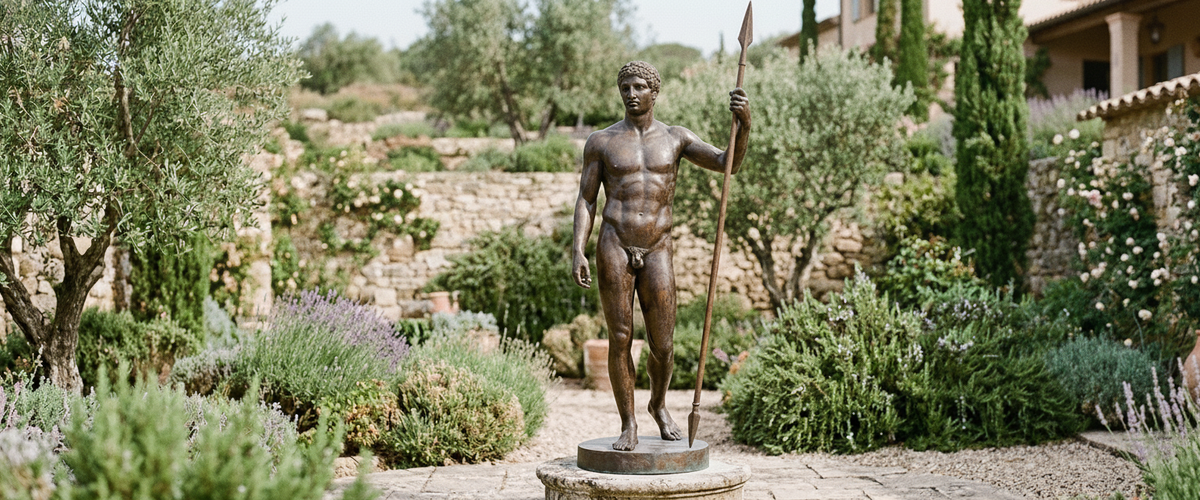
Earlier kouros figures stand rigidly upright, one foot advanced but the weight spread evenly across both legs, arms at their sides, like a block that has learned to stand up. Contrapposto ended that, and it became the signature of the classical ideal of sculpture. The weight drops onto one leg, so that hip rises. The shoulders tilt the other way to compensate, the free knee bends, and the head turns slightly. Britannica's entry on contrapposto follows the device from Greek bronze through to the Renaissance.
Hips tilt one way and shoulders the other: contrapposto in a cast bronze figure.
The result is a figure that looks capable of moving. Outdoors it also gives you a different silhouette from every side, which is why the pose works so well in a garden. On a figure around 250cm (about 8 ft 2 in) tall, the shifted stance keeps the statue from looking like a sentry box when you see it across a lawn.

Where Greek Sculptors Cheated Anatomy
Study an idealized Greek nude closely and you will find details no anatomy instructor would accept. The abdominal muscles form a tidy, almost architectural grid. The ridge above the hips is cut as one hard, continuous line that real bodies seldom show. The chest is broader and the pelvis narrower than average, and the face carries almost no expression.
These corrections were deliberate, and they sit at the heart of the classical ideal of sculpture. A crisp edge at the hip catches light from a distance, and a calm face leaves the body to carry the meaning. When a modern copy softens those features in the name of realism, it drifts toward portraiture and loses the ideal. Exaggerate them and you get a bodybuilder. The hip ridge is the detail worth scrutinizing hardest at the clay stage, because a few millimeters either way changes how the whole figure reads.
Bronze Originals, Roman Marble Copies and the Tree-Trunk Strut
The most celebrated freestanding statues of this period were cast in bronze, and most were later melted down for their metal. What survives of them in museums is largely Roman marble copies. Marble handles compression well but fails where a heavy torso rests on two slim ankles, so copyists added supports: a tree trunk beside the weight-bearing leg, a strut from hip to wrist, a block under a raised heel.
Those trunks belong to the history of these statues, but they were never part of the original design. Bronze carries its own load, so a cast figure rarely needs them. In marble or stone, expect some support at life size, and ask the sculptor where they plan to hide it. A cast standing figure such as the Life-Size Classical Spartan Warrior Bronze Statue can be engineered to stand on its own legs without a prop; carve the same pose in marble and you have to decide where the support goes.

How to Check a Modern Copy of the Classical Ideal of Sculpture
When you assess any figure sold as an example of the classical ideal of sculpture, ignore the patina or polish for a moment and look at the structure.
Hip line. Imagine one line across the hips and another across the shoulders. In true contrapposto they tilt toward each other on the weight-bearing side. Parallel lines mean a stiff figure.
Head-to-body ratio. Divide total height by head height. About seven reads as Polykleitan. Noticeably fewer looks childlike, and noticeably more looks mannered.
The relaxed hand. The arm on the weight-bearing side should hang loose with the fingers gently curled. Tense or splayed fingers on a resting arm are the most common sign of a rushed model.
Standing foot. The supporting heel should sit roughly below the pit of the neck. If it does not, the figure will look as though it is tipping.
Face. It should be calm, symmetrical and impersonal. Furrowed brows and open mouths come from the later Hellenistic tradition.
That last point is worth remembering when you weigh a calm standing figure against a dramatic group. A Hellenistic composition like the Life-Size Classical Laocoon and Sons Bronze Sculpture is superb, but its twisting bodies and anguished faces express a very different idea of sculpture. Neither is better. You should simply know which one you are buying.
Plinth Height and Room to Walk Around It
An idealized figure is meant to be met face to face, without the viewer looking down on it or craning up. Set the base so the eye lands somewhere between the statue's chest and chin. For a life-size figure that usually means a pedestal of moderate height. For an over-life-size piece, the base is often lower than clients expect, because the statue's own height does the work; a 250cm bronze such as the Life-Size Classical Greek Warrior Bronze Statue generally needs only a modest base, since its chest already sits close to eye level.
A 250cm bronze on a modest plinth, its chest near eye level the way the classical ideal of sculpture intends.
The most common mistake runs the other way. A client builds a tall stone pier before delivery, and from the terrace the first thing you see is shins. Put the same figure on a lower base and the pose suddenly makes sense. Leave space for a full circuit as well. The twist of the torso only resolves from the three-quarter views, so keep paths clear on every side, with extra clearance if the figure holds a spear or shield. Browse our garden statues with that walk-around space in mind.

Commissioning a Figure in the Greek Ideal
If you would rather commission than buy from stock, Giant Sculptures can work to your proportions, material and site. Ask to see the clay or digital model before casting and check it against the list above. Tell us how high the base will be, because a sculptor adjusts foreshortening for a figure seen from below. Budget depends on material, scale, complexity, engineering, installation and finishing, so the sensible first step is a tailored quote. To see the classical ideal of sculpture across different subjects and scales, start with our Greek and Roman statues and the wider figurative sculpture collection.
For wider placement ideas, Art Deco Bronze or Clever Fake? How to Read a Figure Before You Buy is useful companion reading before finalising the setting and sightlines.