





































































































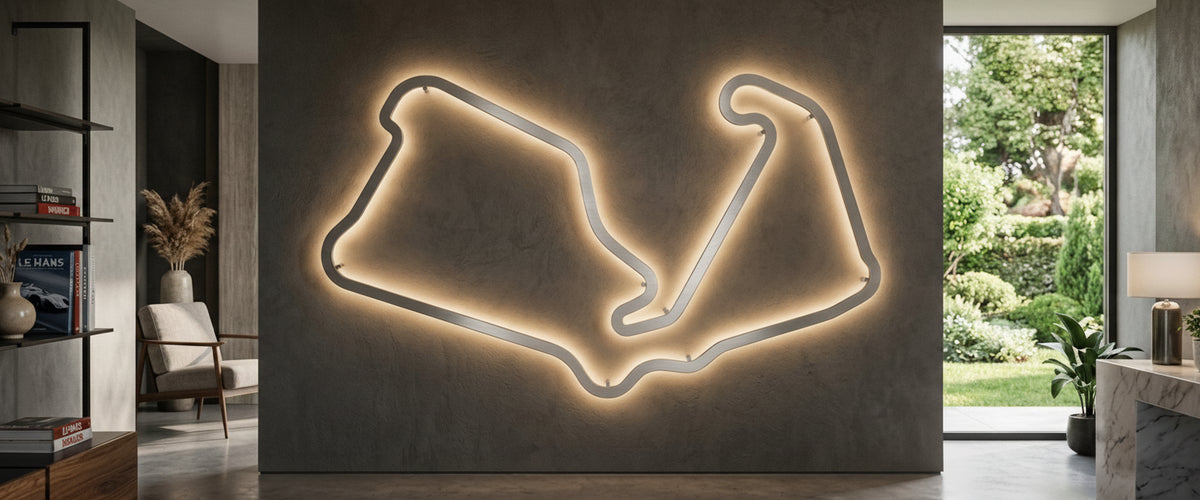

Most illuminated pieces fail for one dull reason: they get hung where the outlet happens to be. Wall art LED lights only work when the glow is treated as part of the architecture, sitting at the right height, on the right backdrop, at a scale that holds the wall. Get that wrong and you have an expensive night light. Get it right and wall art LED lights carry a room after dark, when every other object in it has gone flat.
We build and ship large-scale work for homes, hotels, showrooms and hospitality venues, and wall art LED lights now sit alongside bronze reliefs and metal panels in a lot of those briefs. The engineering questions are different, but the design questions are identical: how big, how high, against what, and seen from where.

At a Glance: What Decides Whether LED Wall Art Lands
- Scale first. Wall art LED lights under 3 feet (about 90 cm) on a broad wall read as a sign, not as art.
- Center height, not top height. Aim for the visual center around 57 to 60 inches (145 to 152 cm) from the floor in standing rooms, lower in seated lounges.
- One color temperature per wall. Mixing 2700K room lighting with 6000K white LED wall art makes both look wrong.
- Backdrop beats brightness. A matte, mid-to-dark wall does more for contrast than pushing your wall art LED lights another 20 percent brighter.
- Plan the driver and the cable before you plan the hook. Retrofitting power access into finished plaster is the expensive part.
- Outdoors, the rating matters more than the look. Sealed housings, weather-rated connectors, correct enclosure classification.

What Wall Art LED Lights Actually Look Like in Different Rooms
The category covers more ground than people expect. At one end you have layered acrylic and mirror work where the LED is the medium itself, throwing depth into a flat panel. At the other you have solid sculptural relief lit externally, where the LED never shows and the drama is all shadow. Both are legitimately LED wall art; they behave completely differently in a room.
In open-plan living spaces, the deciding factor is whether wall art LED lights still hold attention with the lights off. Layered acrylic handles that dual life well: something like the Zenith Black 3D Acrylic LED Layered Illumination Wall Art reads as a graphic composition in daylight and only shifts character after dark, which is what keeps it from becoming wallpaper. Anything that looks like a blank slab at midday will annoy the owner by month three. Where a narrow entry hall or corridor needs apparent depth rather than surface pattern, mirror-based work such as Horizon Endless Horizon 3D LED Mirror Wall Art is closer to the right design language, because it pushes the wall back instead of decorating it.
Themed graphic work is its own market. Circuit maps are the obvious example: Spa-Francorchamps LED wall art is one of the most requested motorsport subjects we get, usually for a garage, a sim-racing room, or a dealership lounge. The Spa outline has a genuine advantage over most circuits because the Eau Rouge and Raidillon sequence gives the silhouette a recognizable kink, so it still reads as Spa at a distance. Track maps under about 4 feet (1.2 m) wide lose that legibility and become a squiggle. Gaming and pop-culture panels, including UV-printed wood wall art, sit in the same bracket as the rest of the wall art LED lights market: strong subject, but it needs enough width to earn its wall.

Scale, Sightlines and Mounting Height
The single most common correction we make on placement drawings is height. People hang art to their own eye level while standing 18 inches from the wall, then live with it from a sofa 14 feet away. Work out where the piece is genuinely viewed from and set the center to that sightline. Dining rooms and lounges want the center lower, often 48 to 54 inches (122 to 137 cm), because everyone is seated. Hallways and stair walls want it higher and, critically, angled into the approach rather than the passing glance.
Scale follows the same logic. As a working rule, wall art LED lights should occupy roughly two-thirds to three-quarters of the visual field they are anchoring, whether that is a fireplace breast, a bed head, or a bar back. Hanging above a sofa? Aim for about two-thirds of the sofa width. On a wall over 20 feet (6 m) long, a single small panel looks apologetic; either go large or commission a run of related pieces at a consistent rhythm.
Depth is the forgotten dimension. Backlit and halo-lit wall art LED lights need standoff from the wall to produce their glow, typically 1 to 3 inches (25 to 75 mm). That standoff has to be built into the bracket, and it changes how the piece sits next to door casings and picture rails. We have had clients specify a beautiful backlit panel and then discover it projected further than the adjacent shelving, which killed the line of the room. Measure the projection, not only the face.

Indoor Versus Outdoor: When Each Wins
Indoors, LED wall art is competing with television screens, downlights and reflections. That competition is usually why a piece underperforms. Put an illuminated panel on the same wall as a large screen and it loses every evening. Put it on the perpendicular wall, where it becomes the thing you look at when the screen is off, and it earns its place.
Outdoors, the equation flips. A courtyard wall, a pool house or a covered terrace gives you total control of the background after dusk, and wall art LED lights become the only light source with a shape. The trade-off is engineering. Exterior work needs sealed housings, weather-rated connectors, correctly classified enclosures and a clear plan for how moisture drains rather than pools. The National Electrical Manufacturers Association publishes the enclosure classifications your electrician will reference, and it is worth agreeing on that spec in writing before fabrication, not after.
There is a third option people overlook: skip wall art LED lights built into the panel and light a solid sculptural piece externally instead. A cast relief such as the Traditional Horse Head Bronze Relief, 80cm takes grazing light beautifully, because a raking beam does the work an internal LED cannot: it carves the modeling instead of flattening it. For clients who want permanence and patina rather than technology, that is usually the better answer, and there is no driver inside the artwork to fail later. Our metal wall art range is full of pieces that behave this way.
Light, Backdrop and Contrast
Contrast is what makes LED illuminated wall art read as art. Three variables control it: wall color, wall finish, and ambient level. Matte finishes absorb spill and hold the glow tight to the piece; gloss and satin bounce it back and wash out the edges. Dark walls give you the strongest apparent contrast, though a warm mid-gray often looks better in daylight and only loses a little at night.
Color temperature is where most schemes come unstuck. If the room runs on warm 2700K lamps and the artwork emits crisp 6000K white, the artwork reads blue and the room reads yellow, and both feel cheap. Keep wall art LED lights within a few hundred kelvin of the surrounding scheme unless the cool cast is a deliberate effect. Dimming matters just as much. The Illuminating Engineering Society guidance on interior lighting quality is useful for anyone building a whole scheme rather than hanging one panel, and the takeaway for buyers is simple: a fixed-output piece with no dimmer will be too bright in a quiet room and too weak in a bright one.
Ambient level decides everything else. LED lighting wall art that looks powerful in a showroom under low light can vanish in a west-facing living room at 5 p.m. Ask where the piece will sit relative to windows, and check it in the worst-case daylight condition, not the best-case evening one.
Placement Mistakes We See in Commissions
For wider placement ideas that apply just as much to wall art LED lights, Bronze Metal Wall Art: How Placement Changes What You See is useful companion reading before finalizing the setting and sightlines.
- Hanging to the wall, not to the room. Centering on a wall that nobody looks at squarely. Center on the sightline instead.
- Ignoring reflections. Acrylic and mirror pieces opposite a glazed wall will show you the kitchen at night. Check the reflection path before you drill.
- No access to the driver. Drivers and transformers fail long before LEDs do. If the only way to reach one is to demolish the mount, you have built a problem.
- Visible cable runs. Plan a recessed outlet behind the piece or a hardwired feed. A trailing cord undoes the whole effect.
- Seasonal overload. LED Christmas wall art is a temporary layer, not a permanent scheme. Keep it on a separate circuit or a plug so it does not compete with the year-round piece.
- Under-scaling to protect the budget. Wall art LED lights bought two sizes too small never grow into the wall. Better to commission fewer, larger pieces.
A Buyer's Checklist Before You Order
- Measure the wall width, height and any projection constraints from adjacent joinery.
- Photograph the space at midday and after dark. Both conditions decide the specification.
- Fix the viewing distance and seated or standing sightline, then set the center height.
- Confirm the color temperature of the existing scheme and match your wall art LED lights to it.
- Decide plug-in or hardwired, and locate the driver with service access.
- For exterior sites, agree the enclosure rating, connector type and fixing method for the wall substrate.
- Check wall construction. Masonry, stud, and rendered block all need different anchors, especially for heavier metal panels.
- Ask for the shipping crate dimensions if access involves an elevator, stair turn, or narrow gate.
Commissioning Bespoke Wall Art With LED Lights
Bespoke is where wall art LED lights get genuinely interesting, because you can size the piece to the wall rather than the other way around. We work with clients on subject, silhouette, material and lighting method together: brushed stainless with a halo wash, layered acrylic with edge-lit color, perforated metal panels that throw pattern onto the wall behind, or Corten with concealed uplighting for exterior courtyards. Fabrication decisions follow the site, not a catalog page.
One commission that still shapes how we brief clients: a private collector's garage outside Austin wanted a circuit-map panel over 9 feet (2.7 m) wide, and the original plan buried the driver for the wall art LED lights inside the sealed backing box. We moved it into an accessible service panel in the adjacent wall cavity. Two years later the driver was swapped in twenty minutes with no damage to the finish. That single decision is worth more than any amount of specification sheet detail.
Budget for wall art LED lights depends on scale, material, the complexity of the lighting build, structural fixings, finishing and installation, so the honest answer is that a tailored quote is the only meaningful figure. Send us the wall dimensions, a photo, and the effect you are after. If you want to see the range of approaches first, our LED and neon art collection shows what wall art LED lights can do as a medium, and the broader wall art and wall decor range covers the sculptural alternatives worth weighing against it.