





































































































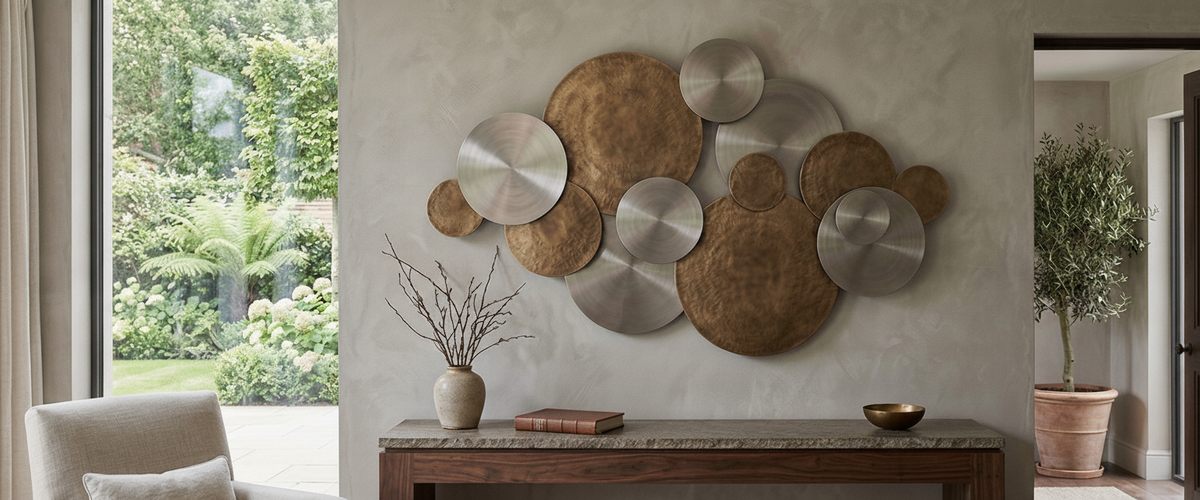

Most disc arrays fail on the wall, not in the workshop. The metalwork can be beautifully raised, the finish can be exactly right, and the whole thing still turns to visual porridge because someone set the gaps by eye from three feet away. Metal disc wall art lives or dies on spacing, count and depth. Get those three right and a wall of circles behaves like sculpture; get them wrong and you have an expensive rash of dots.

Key Takeaways
Metal disc wall art stops reading as individual forms once the gap drops below roughly a third of the smallest disc's diameter.
Odd counts (5, 7, 9, 11) with staggered depths look composed; even grids look like a product catalog page.
Set spacing for the distance people actually stand at, not for the width of the wall you are filling.
Brushed, hammered and powder-coated surfaces behave completely differently under downlights.
Outdoors, fixings and drainage matter more than the discs themselves, and coastal sites need sealed standoffs with 316 stainless throughout.
The Blur Threshold: How Close Discs Sit Before They Stop Reading as Discs
There is a point where circles merge into texture. In our experience laying out metal disc wall art on the studio floor before crating, the threshold sits around a third of the smallest disc's diameter. If your smallest disc is 12 inches (30 cm) across, gaps under about 4 inches (10 cm) start to close the composition up. From 15 feet (4.5 m) back, that array reads as one blobby mass rather than a set of distinct plates.
Deliberate overlap is a different move entirely and it works, but only when depth does the separating. Once discs physically overlap, you need at least an inch (25 mm) of standoff between planes so shadow draws the edge. Flat overlap with no depth is the worst of both options: no gap, no shadow, no read.
Staggered standoffs give a circular array shadow lines that shift through the day.
Odd Counts and Staggered Depth Beat a Tidy Grid Every Time
Symmetrical grids make metal disc wall art look like it is waiting for price tags. Odd numbers force the eye to travel. Seven discs in three loose clusters, sizes varying by a factor of two or three, with two or three sitting proud of the rest, will hold attention far longer than sixteen identical circles in a 4 x 4 block.
Depth is the cheapest drama available. Vary standoff distances between about 1 and 4 inches (25 to 100 mm) and the array gains real shadow at different times of day. Where a wall is too narrow for a spread array, the same logic can be compressed into a single framed piece: Aurelios Cosmic Blue Crystal Porcelain & Gold Orbit 3D Wall Art works because its rings sit at different heights rather than on one flat face. If you are commissioning metal disc wall art from scratch, ask for a depth schedule alongside the layout drawing.

Set the Spacing for the Viewing Distance, Not the Width of the Wall
The most common mistake we see in metal disc wall art briefs is spacing chosen to fill a measured wall. A 20-foot (6 m) reception wall does not want its discs spread evenly across 20 feet just because the wall is that wide. Ask where people stand.
Close viewing (4 to 8 feet / 1.2 to 2.4 m), such as a hallway or a seated lounge, rewards tighter gaps and finer surface detail; the hand of the maker is visible and gaps of 3 to 5 inches (8 to 13 cm) feel generous. Long viewing (25 feet / 7.5 m or more) across an atrium needs both bigger discs and wider gaps, because distance compresses everything. A metal disc wall art layout that looks airy on a drawing at 1:50 will look crowded when installed and viewed from the far side of a room. When in doubt, open the gaps up by around 20 percent.
Brushed, Hammered and Powder-Coated Discs Under Downlights
Finish is a lighting decision as much as a color decision, and it is the part of a metal disc wall art spec buyers skip. Brushed stainless throws a directional sheen; run the grain the same way across every disc or the array will look like a mismatched set. Hammered bronze or copper scatters light into hundreds of small highlights, which is forgiving under harsh downlights and genuinely alive under warm 2700K lamps. Powder-coated steel absorbs rather than reflects, so it needs depth and shadow to stop it flattening out. Matte black discs with no standoff under a wash of even light are the flattest thing you can hang.
Most metal disc wall art gets specified before anyone has decided how the wall will be lit, and that ordering is backwards. Depth and light angle matter just as much for relief work. A modeled bronze panel such as Galloping Herd Bronze Relief Wall Art - 120cm needs light raking across it at a steep angle to bring the modeling forward, while a disc array set proud of the wall can take a much softer, broader wash. Brief your lighting designer before the fixings go in, not after. The wider metal wall art range is the easiest way to compare how different finishes photograph under those two lighting approaches.

Keeping a Multi-Disc Array Dead Level on Plasterboard, Brick and Stud
Every metal disc wall art array reveals its own errors. One disc a quarter inch (6 mm) low in a group of nine is instantly visible, because the circles give the eye a perfect reference.
Make a template. Full-size paper or film with punched hole centers, taped up and stood back from, before a single drill bit touches the wall.
Plasterboard: heavier discs need toggle or metal anchors rated well above the piece's weight, or a plywood backing panel let into the wall during fit-out.
Brick and block: drill into the brick body, not the mortar joint, and use resin anchors for anything over roughly 40 pounds (18 kg).
Stud walls: map studs first, then design the layout around them. Retrofitting a disc position to a stud always looks retrofitted.
Use a laser line across the whole array, not a spirit level disc by disc. Cumulative drift is the killer.
Reception Walls, Stairwells and Long Corridors
Metal disc wall art earns its keep where a single framed piece would be lost. Reception walls suit large asymmetric clusters that read from the entrance door and reward closer inspection at the desk. Stairwells are badly underused: a staggered vertical arrangement is seen from three or four different heights as people climb, so the composition changes as they move. We once built a stainless and bronze array for a tasting room where the client had originally asked for one big circle; the staggered version, climbing the stair wall, ended up doing far more work.
Long corridors want rhythm rather than a single event. Repeat small clusters at intervals so the eye has something to pick up every few paces. Where a hospitality corridor needs surface warmth rather than more metal disc wall art, a carved circular relief such as Barwick Mocha Orbital Abstract 3D Carving Wall Art is closer to the right design language, and it sits comfortably in the same rhythm as a bronze or stainless cluster. The rest of the 3D wall art selection is worth a look if you are mixing materials along a single run.
Metal Disc Wall Art Outdoors: Rust Bloom, Stainless Fixings and Coastal Sites
For wider placement ideas, Abstract Metal Wall Art That Actually Reads From Across the Room is useful companion reading before finalizing the setting and sightlines.
Take metal disc wall art outside and the rules tighten. Corten discs develop the patina buyers want, but the run-off will stain any pale masonry beneath them during the first weathering cycles, and staining from weathering steel is a well-documented design consideration rather than a defect (see guidance on weathering steel). Detail a drip edge or accept the mark as part of the piece.
On exposed coastal walls, sealed standoffs and 316 fixings decide how long a circular array lasts.
Fixings for outdoor metal disc wall art should always be marine-grade stainless (316), never plated mild steel, and isolating washers stop dissimilar metals reacting where a bronze disc meets a steel bracket. On exposed coastal sites, salt-laden air gets behind every disc and works at the fixings, so sealed standoffs and a regular freshwater rinse do more for the life of the piece than any spacing decision. Conservation bodies consistently recommend regular gentle washing over aggressive cleaning for outdoor metalwork, standard collections care advice that applies just as well to a private terrace.

Before You Commission: A Quick Checklist
Measure the primary viewing distance and set gaps from that, not from wall width.
Choose an odd disc count and vary diameters by at least two to one.
Specify standoff depths per disc, in writing.
Confirm wall build-up (plasterboard, brick, stud, render) before the metal disc wall art layout is finalized.
Match finish to lighting type and color temperature.
Outdoors: 316 stainless fixings, isolating washers, drip detail under Corten.
Ask for a full-size template with the delivery.
Request a tailored quote; cost depends on scale, material, disc count, finishing and installation complexity, so there is no meaningful standard figure.
Giant Sculptures builds bespoke metal disc wall art and large-scale relief work for private homes, hotels and commercial receptions, with layout drawings and fixing schedules supplied as part of the commission. If you are still shortlisting, the wider wall art and wall decor range is a good place to compare scale before you commit to a composition.