





































































































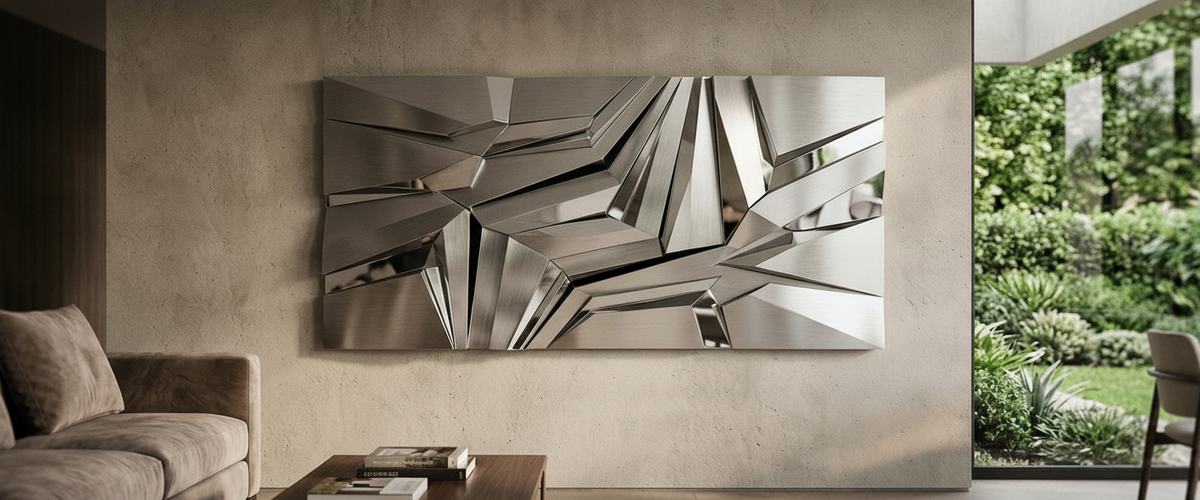

A layered steel panel can look magnificent under workshop strip lights and then go completely dead on a client's wall. Same piece, same finish, no damage in transit. The difference is almost always light angle and hanging height, not the artwork. Abstract metal wall art is a relief object pretending to be a flat one, and relief only exists when something casts a shadow across it. Get the lighting and the mounting right and a single panel of abstract metal wall art can carry a thirty-foot reception wall. Get them wrong and you have bought an expensive gray smudge.

At a Glance
Light from the side, not overhead. Grazing light at a shallow angle is what makes abstract metal wall art read as relief instead of a flat graphic.
Let viewing distance set the size. A corridor viewed from three feet (0.9 m) needs a different panel than a lobby viewed from thirty feet (9 m).
Match finish to wall texture. Matte powder coat sings on pale plaster; brushed or mirror-polished steel needs a busier backdrop like exposed brick.
Hang higher than domestic gallery height in offices. Furniture, reception desks and seated sightlines change the math.
Fixings decide flatness. A heavy panel that sits proud at one corner reads as a mistake from twenty feet away.
Side Light Reveals What a Ceiling Downlight Flattens
Most commercial ceilings are gridded with downlights aimed straight at the floor. That light hits abstract metal wall art from almost directly above, so every raised plate throws a shadow of about a quarter inch and the eye reads the whole thing as texture-free. Move the source to a wall washer or an adjustable spot set at a shallow angle and the same panel gains depth you can see from the far end of the room.
Aim for a beam that skims the surface rather than facing it head-on. The Illuminating Engineering Society's guidance on lighting practice for displayed objects is worth reading if you are specifying alongside an electrical consultant, but the practical test is simpler: hold a flashlight at 30 degrees to the wall and watch what happens to the shadows. If your abstract metal wall art suddenly looks twice as sculptural, you have found the angle you need to build into the lighting plan.
One caution on polished and mirror finishes. Shallow-angle light on highly reflective abstract metal wall art can bounce straight into a seated visitor's eyeline. In a boardroom, we usually specify a satin or brushed face for exactly this reason and save mirror polish for pieces seen while standing and moving.
Grazing light from an adjustable spot pulls shadow out of every layer of the relief.

Three Feet or Thirty: Viewing Distance Sets the Panel Size
Scale arguments in offices tend to be won by whoever brings numbers, and viewing distance is the single best guide to sizing abstract metal wall art. Here is the rule we use. In a corridor where the average viewer passes within three feet (0.9 m) of the wall, fine detail and shallow relief work beautifully, and an oversized panel just crowds the walkway. In a reception hall where the first sightline is thirty feet (9 m) from the entrance doors, anything under roughly five feet (1.5 m) across will read as a picture rather than an architectural feature.
Repeated relief survives distance because the rhythm is legible before any of the detail is, which is why layered striped panels such as Panthra Shadow Black Acrylic Stripe 3D Wall Art still hold a wall from the far side of a lobby. Work built on fine linework behaves the opposite way, gaining at close range and losing at long, so for a corridor passed at arm's length a more intricate relief like Aurelian Butterfly Display Acrylic 3D Wall Art is closer to the right brief. Plot where people actually stand before you plot the panel.
For double-height atriums, we generally recommend a single large commissioned piece of abstract metal wall art over a cluster of smaller ones. Grids of small panels look considered in a photo and fussy in real life once you are standing under them.
Matte Powder Coat on Plaster, Brushed Steel on Brick
Finish choice for abstract metal wall art is really a contrast decision. On a pale, flat plaster wall, a matte powder-coated panel in a deep tone gives you clean silhouette and crisp shadow with nothing competing. Brushed stainless on that same wall can look washed out because there is no visual texture behind it to push against.
Exposed brick, board-marked concrete and dark timber flip the logic. Against those surfaces, brushed or lightly patterned stainless holds its own and picks up the room's ambient color as it moves through the day. Stainless abstract metal wall art also earns its keep in high-traffic entrances; the Nickel Institute's technical library covers grade selection and cleaning routines for architectural stainless in some detail, which matters more than people expect in coastal or high-humidity buildings. Corten works outdoors on entrance walls but needs run-off management, since the oxide will stain pale paving beneath it.
Where a neutral breakout area needs warmth rather than metal tone, a saturated relief panel such as Panthra Ember Orange Acrylic Stripe 3D Wall Art anchors the wall without fighting the branding, and keeps the shadow lines that make the surface work. The wider metal wall art and 3D wall art ranges are the easiest way to compare depth and surface side by side before you commit to a finish.
Abstract Metal Wall Art for Office Walls Is a Different Brief Entirely
Domestic hallways forgive a lot. Commercial walls do not. Reception areas have desk heights, signage zones, security readers and door swings all competing for the same square footage, and boardrooms add the problem of the seated viewer plus the video-call background. Abstract metal wall art for office use has to survive being photographed over someone's shoulder on a Tuesday morning call, which rules out anything with aggressive specular glare.
Behind a reception desk, the bottom edge matters more than the gallery center line.
We shipped a set of layered panels to a law firm in Dallas last year where the boardroom wall was also the client's video backdrop. The original spec was mirror-polished. We switched it to a fine directional brush and dropped the relief depth slightly, and the piece went from unusable on camera to the thing every visitor comments on.
Lobbies have a second constraint: sound. Hard abstract metal wall art on hard plaster in a tall room can add to an already lively acoustic. Deep relief and perforated backing plates help scatter reflections rather than bounce them.

The Hanging Height We End Up Correcting on Almost Every Office Install
Gallery convention puts the center of an artwork at around 57 inches (145 cm). That figure comes from average standing eye level in an empty room, and offices are never empty rooms. Behind a reception desk, abstract metal wall art centered at 57 inches has its lower third hidden by the counter and monitor. Above a credenza or seating bench, the same height leaves an awkward gap that reads as an afterthought.
Our rule for commercial spaces: keep a hand's span of clear wall between the top of the furniture and the bottom edge of the panel, then let the center land wherever it lands. In tall lobbies, we push the center higher still so the piece relates to the ceiling plane rather than floating uncomfortably low. Boardrooms are the exception, where we drop the center slightly so seated occupants are not craning.
Fixings That Keep a Heavy Panel Dead Flat
Flatness is the detail that separates a professional install from a DIY one. Abstract metal wall art that stands off the wall by a quarter inch at one corner catches side light unevenly, and the whole composition looks skewed.
Plasterboard or drywall: find the studs. For anything heavy, span two studs with a timber or aluminum French cleat rather than relying on toggle anchors alone.
Solid brick: fix into the brick body, never the mortar joint. Mortar crumbles under shear load over time.
Dot-and-dab plaster over blockwork: the void behind the board will let a fixing pull through. Use long anchors that reach the structural substrate.
Render and concrete: drill test holes first to confirm depth and check for services and post-tension cables before you commit to a layout.
Every substrate: use packers or shims behind the mounting rail to correct wall bow, and check the panel with a long level across the face, not just the top edge.
Weight: get the finished weight in writing before the install date, in pounds and kilograms, and pass it to the building manager.

Commissioning a Bespoke Panel
When a stock piece is close but not right, a commission usually solves it faster than a compromise. At Giant Sculptures we build bespoke abstract metal wall art to a specific wall, matching relief depth to the available light angle, panel dimensions to the true viewing distance, and mounting hardware to the substrate the architect actually has on site. Cost depends on material, scale, relief complexity, engineering, finishing and installation access, so the honest answer is always a tailored quote rather than a headline figure.
Send us the elevation drawing, a photo of the wall with the lights on, and the distance from the main sightline. That is enough for our team to tell you whether abstract metal wall art is the right call for the space, or whether a freestanding piece would serve the room better. Start with the abstract art collection if you want a sense of the visual language before the conversation.
For wider placement ideas, Metal Sculpture Wall Hangings: Two Picture Hooks Will Not Cut It is useful companion reading before finalising the setting and sightlines.