







































































































The truck almost never fails. What fails is the last 60 feet (18 m): a side gate narrower than the crate, a lawn still soft from the irrigation cycle, three stone steps nobody thought to mention. If you need to ship large sculpture, whether a life-size bronze or a 10-foot (3 m) stainless steel piece, plan the delivery backward from the plinth. The ocean crossing is the predictable part.

Quick Answer
Survey the full route from curb to plinth, including turns, slopes and overhead clearance.
Match lifting kit to the ground surface, not just to the weight.
Specify crating by material. Bronze, marble and fiberglass each fail in different places.
Photograph every face before dispatch and again on arrival.
Confirm in writing whether your quote includes placement or stops at the curb.
How to Ship Large Sculpture: Freight Is the Easy Part
International art freight is a mature trade. Heat-treated export crates built to the ISPM 15 wood packaging standard clear customs routinely, and containers move bronze across oceans every week. The drama starts at the property line.
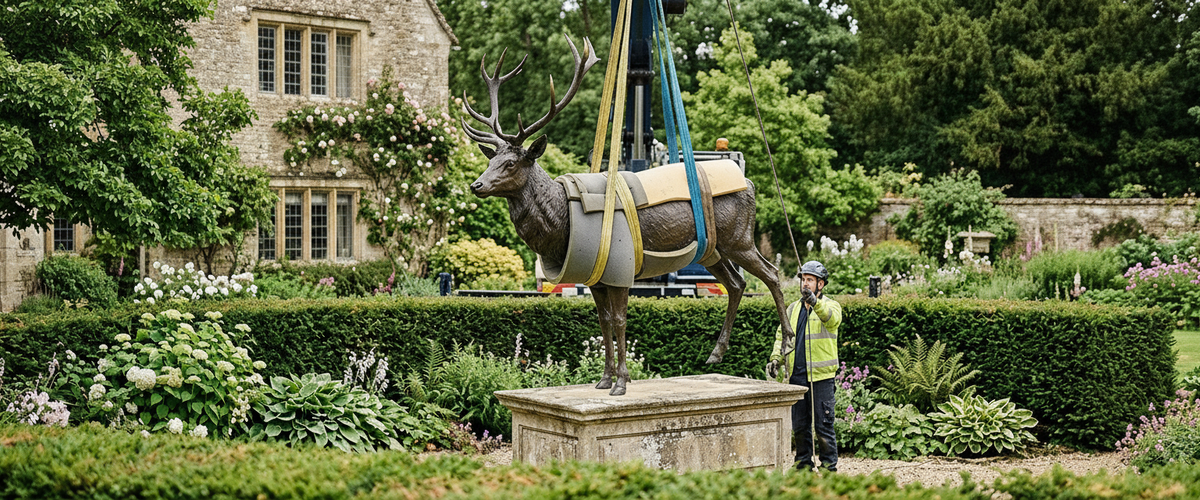
The pattern is familiar. A bronze figure crosses the Atlantic, clears the port and rides the highway without a scratch, then sits on the gravel drive because the garden path to the lawn is a few inches narrower than the site plan claimed. The fix is usually a knuckle-boom truck lifting the crate over the hedge, at the cost of a lost day and a second booking. That is why photographs of the actual route are worth more than any drawing, and why we ask for them on every commission.
When the path is too narrow, the route goes over the hedge instead.
Measure the Route Before Booking
Before you ship large sculpture pieces of any material, walk the path they will take and record each pinch point. Send the numbers and photos to your supplier before the crate is built, because crate orientation depends on them.
Measure at the narrowest point, hinges and latches included.
Gates and doorways: clear width and height, measured at the narrowest point (hinges and latches included).
Turns: a long crate that fits a straight path can jam on a 90-degree corner.
Slopes: gradient matters more than distance; a loaded pallet truck on a downhill path is a runaway.
Steps: count them, and note whether a ramp or track boards can bridge them.
Overhead: branches, eaves, balconies and power lines, which decide whether a crane is even possible.
Ground: lawn, gravel, pavers or deck, and whether it can bear a point load.

Tail-Lift, Pallet Truck or Crane Hire: Matching the Kit to the Ground
A tail-lift (a liftgate in US freight terms) lowers the crate from truck bed to street. It is ideal when the destination is a hard, level surface close to the curb, and useless beyond that.
Pallet trucks need concrete or tight paving. On gravel or turf they sink, so crews lay track boards or switch to a powered tracked carrier. A solid marble figure can weigh several times what a hollow-cast bronze of the same height weighs, so check the equipment rating against the crated weight, never the bare sculpture.
Crane hire becomes the sensible option when a piece must go over a wall, onto a roof terrace or across planting you refuse to trample. In cities like New York or San Francisco, expect street permits and sometimes a lane closure, which take time to arrange.
Where Bronze, Marble and Fiberglass Break Between the Van and the Plinth
Bronze rarely cracks, but its patina scuffs easily, and slender projections such as fingers, antlers or a raised sword arm can bend under a badly placed strap. Agree lifting points with the maker. For figures like those in our life-size and large statues range, strap positions should be marked on the crate itself so the receiving crew does not improvise.
Marble fails at narrow sections: ankles, wrists, drapery edges. It usually travels upright on its own base, braced within the crate, and it should never be lifted by any projection. A sharp jolt on a truck bed can open a hairline fracture that only shows months later.
Fiberglass is light, which tempts people to skimp. Gel coat cracks under point pressure, and an open truck at highway speed turns a lightweight piece into a sail. Mirror-polished stainless steel brings its own problem: every scuff shows, which is why pieces like those in our large balloon dog sculptures collection leave the studio under protective film.
As for wrapping a large sculpture for shipping: start with acid-free tissue or a breathable wrap against the finish, add closed-cell foam over projections, then fix the piece to custom crate blocking. Never stretch-wrap directly over a patina; it traps moisture and can mark the surface.

Photograph Every Face Before It Leaves
A condition report protects everyone, whether you ship large sculpture across an ocean or across town. Photograph all sides, the top, the base and close-ups of existing marks, with dates attached. The American Institute for Conservation treats documentation as the foundation of any handling decision, and insurers do too.
Check whether cover is a fine art policy at agreed value or standard carrier liability, which is usually limited by weight. On arrival, unpack with the driver present where possible, and write any visible damage on the delivery receipt before signing.
US Versus UK Delivery: Why Curbside Quotes Rarely Include Placement
For wider placement ideas, Large Eagle Statue in the Garden: Why the Perch Matters More Than the Bird is useful companion reading before finalising the setting and sightlines.
In US freight, curbside or liftgate delivery means the crate reaches the end of the truck and no further. The UK kerbside equivalent works the same way. Placement, uncrating, debris removal and anchoring are separate services, often called white glove, and most carriers quote without them by default. A piece from our large astronaut sculptures collection headed for a rooftop bar is a typical case: the freight quote and the placement quote come from two different crews, and the second matters more.
Buyer Checklist Before You Book
Route survey sent with photos and measurements
Crated weight confirmed against lifting equipment
Lifting points agreed with the maker
Insurance type and declared value confirmed
Condition report received before dispatch
Placement, uncrating and fixing included in writing
Plinth or foundation ready and cured before delivery day

Commissioning With Delivery in Mind
The easiest way to ship large sculpture is to design for it from the first sketch. On bespoke commissions, Giant Sculptures can plan concealed split points, hidden lifting eyes and bolt-down base plates so a piece that would never fit through a gate arrives in sections and is assembled on site. Budget depends on material, scale, complexity, engineering, installation and finishing, so share your route details early and request a tailored quote.