





































































































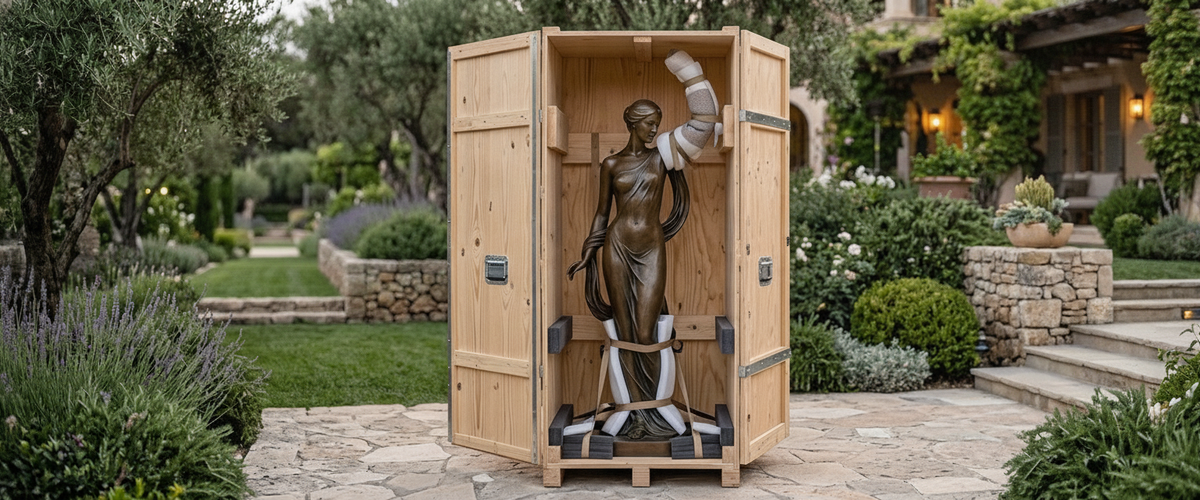

A piece can survive the foundry, the patination bench and a full cure, then lose a fingertip to a forklift in a warehouse outside Newark. Almost every damage report we have been sent photographs of started in transit, not in the studio. Learning how to ship a large sculpture is really about learning where the forces go: which way the mass wants to travel when a truck brakes hard, which part of the form sticks out far enough to catch a ratchet strap, and which surfaces will mark if the wrong foam sits against them for six weeks at sea. Crews who ship large sculptures for a living plan for those forces before anyone picks up a drill.

Key Takeaways Before You Book Anything
Crate design follows material. How you ship a large sculpture cast in bronze differs from how you move one carved in stone: bronze is braced from the base and its mounting studs, stone is braced against its own mass, never against carved detail.
Extremities fail first. Wings, antlers, raised arms and outstretched fingers need sub-crates, saddles or separate shipment.
Packing materials touch the finish for weeks. Choose inert, non-plasticized wrapping; the wrong film prints a pattern into a warm patina.
Mode sets risk and lead time. Sea freight handles scale and is how most buyers ship large sculptures overseas, road freight handles domestic bulk, air freight is limited by door apertures and cost.
The last sixty feet (18 m) breaks more deliveries than the ocean crossing. Survey gates, grades, overhead cables and elevator ratings first.
Condition photographs and nail-to-nail insurance are your only use if something arrives wrong.
Bronze Braces From the Base, Marble Braces From the Mass
These two materials want opposite crates. A cast bronze figure is usually hollow-walled with its weight concentrated low, and it almost always has threaded studs or a plate at the feet or plinth. That hardware is the anchor point whenever we ship large sculptures in bronze. We bolt the piece down through the skid so the crate floor carries the load, then add shaped uprights that stop rotation without pressing on the body. Nothing should clamp the torso.
Bracing follows the fixings and the pose, never a generic bounding box.
Stone behaves differently, and it changes the whole approach to large sculpture shipping. A marble or limestone figure is solid all the way through, so the mass itself is the structure, and the failure mode is a shear crack at a thin ankle or a drapery undercut. Here we build a cradle that supports the block and the widest bearing surface, use full-contact foam beds instead of point pressure, and keep the center of gravity low and central in the crate. Anyone quoting you a single crate spec for both materials has not shipped much of either.
For international moves, the timber matters too. Any crate built to ship large sculptures across a border must be heat-treated and marked under ISPM 15, the international phytosanitary standard for wood packaging. Unmarked crates get held at the port, and a held crate is a crate sitting in humidity with nobody watching it.
Wings, Antlers and Outstretched Hands: What Snaps First
Riggers who ship large sculptures week in, week out will all tell you the same thing: the break is nearly always the thing that sticks out. A stag's antler tine, a dancer's trailing fingers, an eagle's primary feathers, the raised arm on a figure waving. We shipped a stainless steel astronaut to a Napa estate where the helmet and the raised glove both projected well beyond the body line, and both traveled in their own foam-lined yokes inside the main crate rather than relying on the outer walls for protection. Pieces from our large astronaut sculptures range show why the crate has to be drawn around the pose.
Where a form allows it, the cleanest way to ship a large sculpture with a complicated silhouette is modular shipment. Wings bolt off. Tails and ears on a glossy large balloon dog sculpture can be engineered as separate welded sections when scale demands it, then assembled and finished at the site. That adds installation time and costs more in engineering, but it removes the single riskiest variable from a 6,000-mile trip.

What May Touch a Finished Surface, and What Leaves a Mark by Week Two
Packing looks trivial until you open a container in July, and it is where plenty of attempts to ship large sculptures quietly go wrong. Bubble wrap pressed against a warm wax-finished bronze can emboss a grid of circles into the surface. Plasticized PVC film off-gasses. Rubber tie-downs and adhesive tape lift patina and leave residue that takes a conservator to remove.
Our default stack is acid-free tissue or a soft interleaving layer first, then breathable spun-polyethylene sheet, then closed-cell polyethylene foam for shock, then the structural bracing, then the crate. Add a vapor barrier and desiccant for any ocean leg, because salt air plus condensation inside a sealed box will bloom on unprotected steel fixings long before it touches the sculpture itself. The American Institute for Conservation publishes useful collections care guidance on handling and materials contact that is worth reading before you sign off the packing spec used to ship large sculptures by sea.
Sea, Road or Air: The Decision That Sets Lead Time and Risk
Sea freight is how most monumental work moves. It takes oversize dimensions in stride via flat rack or open-top containers, and it is the only realistic option for multi-ton stone. The trade-off is time in a humid steel box and more handling points. Road freight is the workhorse for anything traveling within the US, and it keeps one crew on the piece from door to door; oversize loads simply need permits and route planning. Air freight is fast and is sometimes the right call for a tight gallery deadline, but aircraft door apertures cap what fits, and chargeable weight on a crated sculpture climbs quickly. The mode you pick can swing the cost to ship large sculptures by a wide margin.
When clients ask us how to ship a large sculpture to a fixed installation date, we work backwards from the site, not from the studio. Mode gets chosen after we know the access, not before.
The Last Sixty Feet: Gates, Grades and the Crane That Never Fits
A marble figure crossed an ocean without a scratch and then sat on a Dallas loading dock for two days because the freight elevator was rated well below the crated weight. That is the normal failure pattern when people ship large sculptures without a site survey. Before booking, measure gate width and height, driveway gradient and surface (gravel and lawn will not take a loaded crane outrigger), overhead power lines and tree canopy, turning circle for an articulated truck, door and elevator dimensions, and floor loading if the piece is going indoors or onto a terrace.
The final approach decides crate size, crane position and delivery day.
Send the rigger photographs with a tape measure visible in frame. Guessed measurements are how you end up paying for a second crane visit. Many of our commissions from the life size and large statues collection are sized during this conversation, because knowing the gate is 7 feet (2.1 m) wide changes the base design.

Pre-Shipment Checklist
Confirm material, crated weight and lifting points with the studio in writing; nobody should ship large sculptures off an estimate.
Approve a crate drawing that shows bracing against the pose, not a generic box.
Check ISPM 15 marking on the timber for any international leg.
Specify inert packing materials and a vapor barrier plus desiccant for sea freight.
Shoot timestamped condition photographs of every face and every extremity before the lid goes on, and agree who signs them off.
Complete a site access survey with measured photographs.
Arrange nail-to-nail fine art cover and read the exclusions.
Book a rigging crew briefed on the sculpture, not just the tonnage.
Condition Photographs and Who Signs Off
When you ship large sculptures, the photographs taken minutes before sealing the crate are the single most useful document in the whole move. Cover every elevation, then close up on fingers, edges, weld seams, patina transitions and the base. Name the person who took them and the person who accepted them. On arrival, the receiving party photographs the crate exterior before opening it. Crush damage on a corner explains a lot, and it explains it in a way an insurer will accept.
Nail-to-Nail Cover Versus the Carrier's Small Print
Standard carrier liability is usually calculated per pound of cargo, which bears no relation to the value of a commissioned bronze. Specialist fine art policies offer nail-to-nail all-risks cover from the moment the piece leaves its plinth in the studio to the moment it is installed. Read the exclusions carefully: inherent vice, packing carried out by anyone other than a professional, gradual oxidation, and unattended vehicle clauses all appear regularly. If the policy requires professional packing, a client-arranged van and some moving blankets will void it.
Sculpture is a long-term asset, and the freight leg is the shortest, riskiest part of its life. Nobody should ship a large sculpture on assumptions, which is why at Giant Sculptures we design the crate alongside the piece: the pose, the fixings and the base plate all determine how it travels. If you are commissioning at scale, tell us the delivery address and the access constraints at the enquiry stage; we will build the answer into the sculpture and give you a tailored quote covering material, engineering, finishing, crating and installation.
For wider placement ideas, Choose Your Outdoor Large Garden Sculpture for February, Not July is useful companion reading before you finalize the setting and sightlines, and long before anyone quotes to ship large sculptures to the site.