





























































































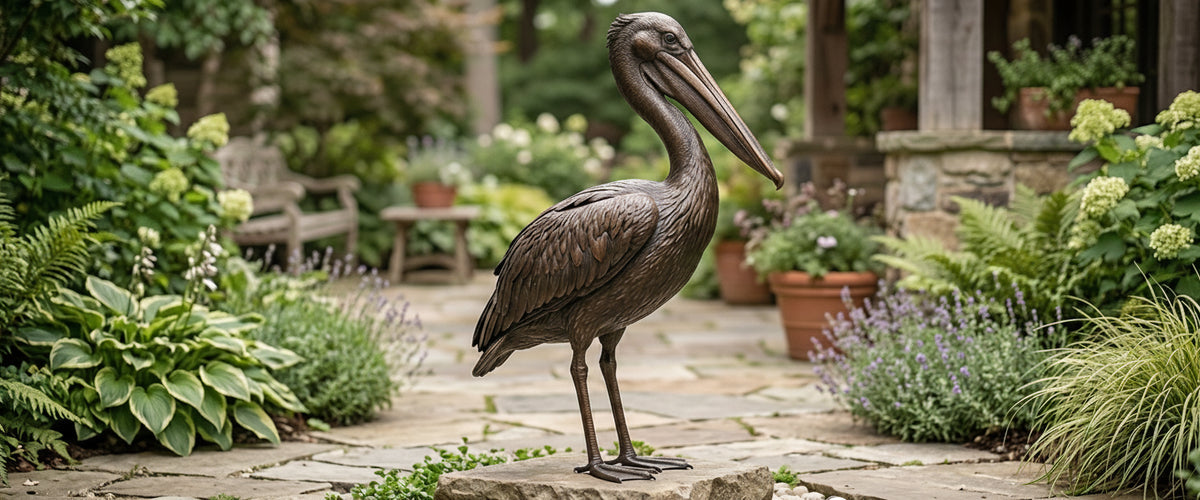

A pelican has one of the strangest, most sculptural profiles in the animal world: that long bill, the loose pouch, the heavy body balanced on comically thin legs. Cast in metal, those contradictions become an asset. Get the placement right and pelican bronze sculptures Rinnan collectors favour will hold a courtyard or an entrance hall with an ease that a more conventional subject rarely manages. Get it wrong and even a beautiful casting looks marooned. This guide is about the second half of that sentence: the practical choices that decide whether the pelican bronze sculptures Rinnan buyers order actually land.
Looking for the full range in this category? Browse our Bronze Sculptures collection for every available finish, size, and configuration.
We have shipped bronze birds to poolside terraces, lakeside properties, and gardens where the client wanted something that read as coastal without being literal. The pattern is always the same. The casting is the easy part. Where the pelican bronze sculptures Rinnan clients choose end up sitting, how high, and what stands behind them does most of the work.
Key Takeaways for Placing a Bronze Pelican Sculpture
Scale to the space, not the shelf. A pelican reads best when its full silhouette is visible from your main approach line.
Pedestal height changes everything. Lift a wading pose too high and it looks stranded; keep it low and it reads as if it belongs there.
Outdoor usually wins for large pieces. Bronze patinas well outdoors and pelicans carry a water association that gardens and pools reward.
Backdrop and contrast decide impact. A dark casting against dark planting disappears; against pale stone or sky it sings.
Budget depends on scale, pose complexity, finishing and installation. Ask for a tailored quote rather than assuming a fixed figure.

What Pelican Bronze Sculptures by Rinnan Look Like in a Real Room or Garden
The subject splits into two broad camps, and the camp you choose sets the room around it. A grounded, standing or wading bird has weight and stillness; it works as a quiet focal point beside water or at the turn of a path. A pelican in flight, wings extended, is all motion and negative space, and it demands room to breathe both around and above it. The pelican bronze sculptures Rinnan admirers respond to come in both readings.
That distinction matters more than most buyers expect. Where the setting can carry an architectural gesture, a Large Traditional Pelican in Flight Bronze Sculpture - 300cm earns its scale. Mounted on a plinth above a reflecting pool or cantilevered off a poolside wall, the extended wings throw a real shadow and the whole thing becomes a piece of the building's geometry. Try to squeeze the same casting into a courtyard with a low pergola and the wings will read as trapped.
At the other end, where you want people to come close and read the surface, a Life-Size Traditional Pelican Bronze Sculpture - 80cm is the intimate choice. It suits an entrance console, a stone ledge beside a plunge pool, or a planted bed where you round a corner and meet it at eye level. The pleasure there is in the detail: the texture of the feathers, the seam where the pouch meets the throat. Among the Rinnan pelican bronze sculptures, this is the one built for a second look.
Scale, Sightlines and Pedestal Height
Start with the approach. Stand where people will first see the piece and measure that distance honestly. A figure read from 40 feet needs mass and a clean silhouette; one read from 6 feet can carry fine surface work that would vanish across a lawn. A common error is choosing size by the size of the room and ignoring where the eye actually enters. This is where pelican bronze sculptures Rinnan collectors size correctly earn their keep.
Pedestal height is the lever most people underuse. For a wading or standing bird, the natural instinct is to raise it on a tall plinth so it feels important. Resist that. These birds live at ground and water level, and the pose carries an implied context. Set a standing pelican low, near the ground or just above a water line, and the brain accepts it instantly. Lift it to chest height on a column and it looks displayed rather than present.
A pelican in flight reverses the rule. Height is exactly what it wants, because a bird in the air needs air beneath it. Where the composition should read as interaction rather than a single figure, a Large Contemporary Dual Pelican Bronze Sculpture - 250cm gives you two birds in relationship, and giving them elevation plus clear space lets the composition open up rather than crowd itself.
One practical note on weight. Large bronze is heavy, and a flight pose with an elevated mount transfers load in ways a paved terrace was not always designed for. On bigger commissions we work back from the mounting point to make sure the substructure, footing or wall fixing is engineered for it. That conversation belongs at the design stage, not delivery day. The pelican bronze sculptures Rinnan customers place outdoors reward that early planning.
Indoor Versus Outdoor: When Each Wins
Bronze is happy in both, so the decision is about the piece, not the metal. Outdoor tends to win for the larger and mid-size birds. The subject has an obvious water logic, and an outdoor patina develops depth over years that indoor pieces never quite reach. The Getty Conservation Institute's guidance on outdoor bronze is a useful primer on how patina and protective coatings behave over time, and why maintenance is a long game rather than a one-off (see the Getty Conservation Institute).
Indoor placement wins when you want the piece read closely and kept in a controlled setting. Where the design language leans modern and the space gives it air, a Life-Size Contemporary Pelican Bronze Sculpture - 150cm works well in a double-height entrance or a gallery-style hallway where the ceiling gives it room and the surface can be lit deliberately. Indoors you also sidestep the seasonal cleaning that coastal and poolside sites demand, since salt and chlorine spray are the two conditions that ask most of a bronze finish. Either way, the pelican bronze sculptures Rinnan buyers pick should suit the room they answer to.
If you are still weighing options, browsing the wider bronze animal sculptures collection alongside the pelicans helps calibrate how different subjects handle indoor versus outdoor duty at the same scale.

Light, Backdrop and Contrast
Bronze is a dark, reflective material, and it lives or dies on what sits behind it. The most common disappointment we hear is that a piece looked stronger in the studio than at home. Nine times out of ten it is contrast. A brown-to-green patina against dense evergreen planting simply merges; the outline that gives a pelican its character gets swallowed. The pelican bronze sculptures Rinnan owners love most are the ones set against the right backdrop.
Give the silhouette something pale to sit against: limestone paving, a light rendered wall, water, or open sky. A bird in flight positioned so its wings break the skyline is the strongest reading you can get outdoors. Indoors, a plain wall in a warm neutral does far more than a busy backdrop.
Light direction matters as much as light level. Morning or late-afternoon light rakes across feather texture and pulls out the modeling; flat overhead light at noon flattens it. If you are lighting at night, aim for one or two angled sources rather than a single frontal flood, which erases depth. A small uplight set low near a standing pelican gives it a dramatic, lengthened presence after dark.
Common Placement Mistakes in Pelican Commissions
For wider placement ideas, Affordable Contemporary Bronze: Where to Place It so It Actually Reads is useful companion reading before finalising the setting and sightlines.
These are the recurring issues we catch before a commission goes wrong, and they apply squarely to pelican bronze sculptures Rinnan clients bring to us.
Under-scaling for a big space. An 80cm bird on a wide terrace reads as a garden ornament, not a focal point. Match mass to the volume it has to hold.
Over-elevating a grounded pose. A wading bird on a tall column looks stranded. Keep standing poses low.
Choking a flight pose. Extended wings need clear air above and to the sides. Check overhead structures and neighboring planting before you commit to a spot.
Placing dark bronze against dark backdrops. Contrast is not optional. Reserve pale surfaces or sky for the outline.
Ignoring the approach line. Position for the view people actually get, not the view on the site plan.
Forgetting salt and chlorine. Coastal and poolside sites are beautiful placements but ask for a regular rinse-and-wax rhythm to keep the finish even.
Commissioning a Bespoke Pelican
If none of the standard sizes or poses fit your site, a bespoke commission is the honest answer. As a bespoke sculpture supplier working at large scale, Giant Sculptures handles pose adjustments, mirrored pairs, custom patina tones, and mounting engineered for a specific wall or footing. We have adapted the flight poses in our pelican bronze sculptures Rinnan collectors know to a client's exact wingspan clearance and shifted a patina warmer to match a stone terrace.
Bring three things to that first conversation: a photo of the intended spot with something for scale, the approach distance, and a note on what stands behind the piece. With those, we can advise on size, pedestal, and finish before anything is cast. You can also explore the full bronze garden statues range to sharpen your brief. The pelican bronze sculptures Rinnan buyers see here are a starting point, not the limit.