





































































































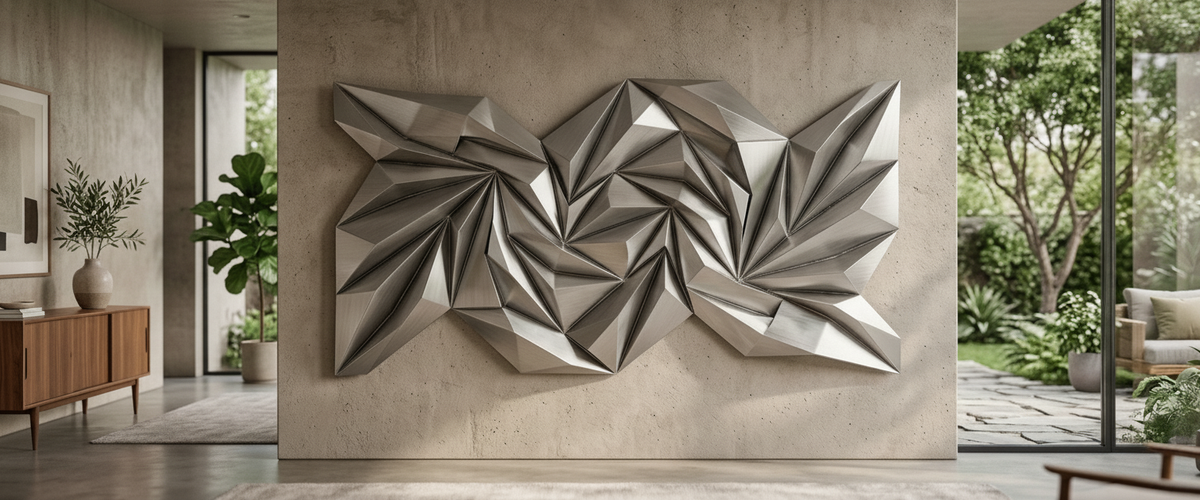

Most metal wall sculptures are chosen from a single photograph taken at one flattering distance. Then they get installed in a real building, where people see them from across a lobby, from the middle of a room, and from eighteen inches away while waiting for an elevator. Three completely different readings. A piece that only works at one of them will start to look like a mistake within a month.
Looking for the full range in this category? Browse our Metal Sculptures collection for every available finish, size, and configuration.

Key Takeaways
Metal wall sculptures get read at three distances, and each one asks for something different from the design.
Thirty feet reads silhouette and value contrast only. Fewer elements, bolder gaps.
Ten feet is where geometric designs confess: weld seams, facet alignment, panel gaps.
Arm's length shows tool marks, grain direction and edge quality. Nothing hides.
Cut, folded and welded construction each fail in different places. Choose by dominant viewing distance.
Lighting and standoff depth change the whole calculation, so specify them before fabrication, not after.
The Three Viewing Distances Every Wall Piece Has to Survive
Before we quote a commission, we ask the client one question that surprises them: where will people actually stand? Not where the piece hangs, but where bodies will be. In a Dallas office lobby we worked on, the answer was a security desk forty feet back and a coffee bar twelve feet to the left. Two dominant distances, one of them oblique. That single answer changed the design more than the client's mood board did.
Metal wall sculptures are unusual among sculpture types because they are almost always seen in transit. Freestanding work invites you to circle it. Wall work gets glanced at, then studied, then ignored, then rediscovered. The best pieces reward all four states.

Thirty Feet: Silhouette Wins, Detail Loses
At long range your eye resolves outline and light-dark contrast, and very little else. Fine engraving vanishes. Subtle brushed texture turns into flat gray. This is why metal wall sculptures made for lobbies need fewer elements than buyers expect, not more. A composition of eight strong shapes with real negative space between them will outperform forty small ones every time, because the forty collapse into a single indistinct rectangle from the entry door.
At entry-door range, outline and gap do all the work.
Geometric abstract sculpture handles this distance better than almost anything else, which is why it dominates corporate interiors. Hard edges hold their shape across a room. The Constructivist tradition that pushed geometry into public art was built on exactly that clarity of form, a lineage Tate traces through early twentieth century abstraction. Radiating and orbital arrangements work particularly well here. Where a long entry view calls for one uninterrupted outer geometry rather than a busy field of parts, Aurelios Cosmic Blue Crystal Porcelain & Gold Orbit 3D Wall Art holds a legible ring at thirty feet, and the finer material interest only turns up once you have walked toward it.
Ten Feet: Where Geometric Designs Confess
This is the distance buyers ignore, and it is the one that exposes workmanship. At roughly ten feet, metal wall sculptures with geometric designs start showing whether the facets actually meet. A one-millimeter misalignment across a twelve-inch (30 cm) triangle is invisible in a product photo and glaring in person, because your eye tracks the continuous line and sees it stutter.
Weld seams behave the same way. On a welded steel piece, the bead itself is fine if it was planned as part of the language. Ground-back seams that were meant to disappear but only half-disappeared look worse than an honest weld. Ask any supplier how seams are treated on the specific piece you are buying, not on their work in general. It is the single most useful question a first-time commissioner can ask, because the answer tells you how carefully the workshop thinks.

Arm's Length: Tool Marks and the Honesty of a Folded Panel
Corridors, stairwells, dining rooms and bedside walls all put people within touching range. Here, brushed grain direction matters. Edge burr matters. The radius on a folded corner tells you whether the panel was bent properly or forced. Folded metal has a quality we like at close range: the bend line is continuous material, so there is nothing to fail and nothing to fake.
Close viewing also rewards relief depth and shadow rather than surface pattern. Carved and layered relief panels work on the same principle as metal relief, and if your dominant viewing distance is under six feet (1.8 m), depth beats detail. For a corridor or a wall you pass within arm's reach, a regular carved grid such as Barwick Taupe Grid Abstract 3D Carving Wall Art stays legible because real shadow does the drawing, not printed or etched pattern.
How Metal Wall Sculptures Are Built: Cut, Folded or Welded
Three fabrication routes dominate large-scale work, and each has a distance where it shines.
Arm's length is where seam treatment and edge dressing are judged.
Laser or waterjet cut: crisp silhouettes, excellent at thirty feet, flat at arm's length unless edges are dressed and the surface is finished with intent.
Folded panel: strong at ten feet and close up, since the fold catches light differently on each plane. Needs enough wall depth to breathe.
Welded assembly: the only realistic route for deep, multi-layer geometric sculpture at architectural scale. Strongest close-range storytelling, most dependent on the fabricator's discipline.
The choice between a regular grid and an angled composition matters as much as the route itself. Where a room needs planes that shift with the light rather than a steady repeating rhythm, Barwick Mocha Angled Abstract 3D Carving Wall Art is closer to the folded-panel language, with each facet reading at a different value depending on where you stand.
Material choice runs alongside this. Stainless steel stays bright and holds mirror or brushed finishes well. Corten gives you a warm oxide surface that reads beautifully at range but can stain pale walls as it weathers, so it belongs outdoors or on protected mounting. Bronze relief carries the most value at close inspection and the most weight on your fixings. Our metal wall art collection is a useful place to see how those finishes behave at different scales.
Lighting Changes the Whole Calculation
Downlights flatten patina. Point a narrow beam straight down a bronze or blackened steel surface and the depth of color you paid for disappears into glare at close range. Pull the light off-axis, aim across the face at roughly 30 degrees, and the same surface springs back. Powder coated pieces behave in reverse: the color holds beautifully in raking light close up, then reads as one solid block from across the room, which is either what you wanted or a problem you did not anticipate. Powder coatings themselves are extremely durable when applied over correctly prepared metal, as the Powder Coating Institute outlines, so the question is aesthetic rather than technical.

Standoff Depth Is a Distance Tool, Not a Hanging Detail
Standoffs get treated as hardware on most metal wall sculptures. They are actually composition. Push a panel two inches (5 cm) off the wall and you create a shadow line that reads as an extra outline at thirty feet. Push it four inches (10 cm) with a wash light above, and the shadow becomes a second drawing that moves through the day. We have specified deeper standoffs purely to rescue a piece hung on a wall the client could not light properly, letting ambient room light generate contrast instead.
A Quick Checklist Before You Commission
Map your two dominant viewing distances and note any oblique approach angles.
Decide whether silhouette or surface is doing the main work.
Ask how seams, edges and folds are finished on your specific piece.
Confirm wall construction and whether blocking or a mounting cleat is needed.
Set standoff depth and lighting position before fabrication starts.
For outdoor installs, check fixings, drainage behind the panel and finish compatibility with your climate.
Budget on a bespoke piece follows material, scale, relief depth, engineering and finishing rather than a fixed rate per square foot, so the honest route is a tailored quote once the design and site are settled. If you are still narrowing the field, the wall sculptures collection shows how the same geometric language shifts when it moves from flat panel to deep relief.
Get the three distances right and metal wall sculptures stop being decoration that fades into the wall. They become the thing people position their furniture around.
For wider placement ideas, Metal Wall Art for an Entryway: What Guests Register in Three Seconds is useful companion reading before finalising the setting and sightlines.