





































































































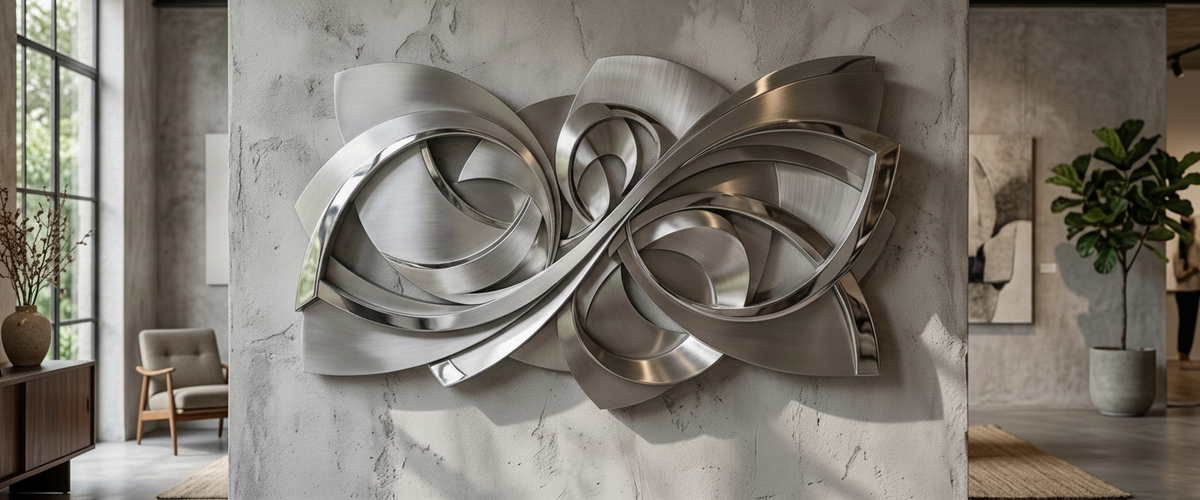

A guest forms an opinion about your house somewhere between the threshold and the coat hook. Call it three seconds, and in most homes the only competition for attention in that window is a light fitting and a pile of shoes. A metal wall art entryway scheme is the most direct way to win those three seconds, and also one of the easiest things to get wrong, because entry halls throw problems no other room does: two viewing distances, poor light, damp coats, and a wall you mostly see at an angle.

Key Takeaways
Size an entryway metal wall art panel to the wall you actually see, not the wall on the floor plan. In a tight hall, a 36 inch (90 cm) panel often reads better than a 60 inch (150 cm) one.
Check the piece from two positions: standing at the open front door, and partway up the stairs. They rarely agree.
Powder-coated steel, patinated bronze and brushed stainless handle damp coats and radiator heat far better than untreated mild steel.
One harsh ceiling fitting will flatten any relief. Add a directional source and the surface comes alive.
Deep relief and dimensional forms hold up better in narrow spaces than flat graphic panels, because you read them by shadow rather than by width.
Front-Door Sightline Versus the View from the Stairs
Every hallway has two governing views, and how a metal wall art entryway reads depends on which one you plan for. The first is the head-on sightline from the open door, usually 8 to 15 feet (2.4 to 4.6 m) away, where the piece is read whole. The second is the raking view from the stairs or the turn into the living room, where you see the panel at maybe 30 degrees and mostly perceive its edge profile and shadow depth.
Flat laser-cut work looks confident head-on and disappears at an angle. Dimensional work does the opposite: it can read as busy from the door and superb from the stairs. Our advice to clients choosing metal wall art for an entryway is to design for the view that gets used most. In a house where everyone comes in through the mudroom and the front door is ceremonial, that means the raking view, and a layered composition such as the Aurelios Cosmic Blue Crystal Porcelain & Gold Orbit 3D Wall Art works harder than a flat panel, because the orbiting elements keep changing relationship as you move past them.
The head-on sightline from the open door is where a panel is read as a whole object.

Why a Smaller Panel Often Beats a Bigger One in a Narrow Hall
Scale rules written for living rooms fall apart in a corridor. In a 42 inch (107 cm) wide hall you can never step back far enough to take in a 60 inch (150 cm) panel, so you experience it as fragments while walking. A 36 inch (90 cm) piece sits inside your cone of vision at close range and reads as a complete object. The composition survives. Most metal wall art entryway mistakes begin with a size chart borrowed from a room you can stand back in.
Go large only when the hall gives you distance: a double-height foyer, an open-plan entry, or a return wall seen across a living space. Entryway metal wall art can carry real bulk in those settings, which is where a bold relief like the Galloping Herd Bronze Relief Wall Art - 120cm earns its footprint, because the motion in the piece needs room to run. Squeeze the same panel into a 3 foot corridor and you get a wall of horse legs.
Hanging Above a Console Without Fighting the Lamp
Console walls are crowded, so a metal wall art entryway arrangement above one has to share the space. There is a lamp, a bowl of keys, a tray, possibly a mirror already claiming the center. Three rules keep the peace.
Leave breathing room above the console. Roughly 6 to 10 inches (15 to 25 cm) between the tabletop and the bottom edge keeps the panel and the furniture reading as one group rather than two arguments.
Do not center on the wall, center on the console. Hallway walls are almost never symmetrical once you count doorways and switch plates.
Let the lamp shade sit below the artwork's lower edge, or clearly overlap it. The half-overlap is the version that always looks like a mistake.
On mounting, treat any steel or bronze panel as a structural job. Fix into studs or use proper cavity anchors rated well above the piece's weight, and if the panel has a French cleat, set the cleat with a long spirit level rather than eyeballing it against a coving line that is probably not level either.

Wet Coats, Umbrella Drips and Radiator Heat
Entryways are the most abusive interior environment in a house, which is why finish choice drives every metal wall art entryway decision. Damp wool coats sit against the wall, umbrellas drip, and a radiator or floor vent cycles hot dry air a few feet away. Untreated mild steel will bloom rust spots along the bottom edge within a season in that setting.
Powder-coated steel is the workhorse here; a properly applied thermoset coating gives a hard, chip-resistant film that shrugs off knocks from bags and boots, and the Powder Coating Institute is a useful primer on how those finishes behave. For entryway metal wall art, brushed or satin stainless hides fingerprints better than mirror polish, which will show every knuckle print at coat-hook height. Patinated bronze is the most forgiving of all, since a waxed patina develops rather than degrades, and small handling marks disappear into the surface. Marble and stone relief also cope well with hallway humidity if you want a quieter, non-reflective option at close range; a carved panel such as the Attended Youth with Lyre Stone Relief Wall Art - 100cm gives you the same shadow depth without a single highlight to keep clean.
Powder-coated and patinated finishes cope with damp coats, drips and radiator heat.
Lighting a Steel Panel in a Hallway with No Window
Lighting is where most metal wall art entryway schemes quietly fail. Most entry halls have one ceiling fitting directly overhead, which is the worst possible light for relief work. It drops shadows straight down, kills the modeling, and turns a dimensional panel into a gray smudge. You need light arriving at an angle.
An adjustable spot set roughly 30 degrees off vertical will rake across the surface and pull out every ridge. If there is no ceiling track, a slim picture light or a pair of wall sconces flanking the panel does the same job. Keep the color temperature warm, around 2700K to 3000K, so bronze and gold finishes hold their depth rather than reading cold and flat. The Illuminating Engineering Society publishes recommended practice on accent lighting ratios if you want the technical version; the short version is that the artwork should sit several times brighter than the surrounding wall.
Two Entryways That Get It Wrong
The blank return wall. This is the short wall you face as you step in and turn. Owners often skip it because it feels like circulation space, then hang something on the long wall nobody looks at. The return wall is the one that counts for metal wall art entryway placement. It gets the full head-on view, and a small, deep piece there outperforms a large flat one down the corridor.
The stair-head gable. That tall triangular wall above the staircase looks like an invitation to go enormous. One client asked us for a nine foot panel there; we mocked it up in cardboard first and found the top third was invisible from every position in the house except the top step. We rescaled it, dropped the whole composition, and the piece finally worked. Cardboard templates cost nothing and have saved more commissions than any drawing.

Entryway Metal Wall Art Checklist
Measure the usable wall after subtracting switch plates, thermostats and door architrave.
Photograph the wall from the open front door and from the stairs. Compare.
Tape out the panel size in newspaper or cardboard and live with it for two days.
Confirm your fixing substrate: studs, masonry, or plasterboard with cavity anchors.
Choose an entryway metal wall art finish rated for damp and temperature swing.
Plan the light source before you buy, not after.
Check the sculpture clears the swing of the front door and any coat hooks.
Commissioning for the Wall You Actually Have
Standard sizes serve standard walls, and entryways are rarely standard. If you are planning a metal wall art entryway around an awkward return wall or a stair-head gable, bespoke lets you set the exact proportion, the depth of relief, the finish, and the mounting system for your substrate. It also lets you specify a lower profile if the piece sits within brushing distance of a busy circulation route. Budget depends on material, scale, complexity, engineering, installation and finishing, so the sensible first step is a tailored quote rather than a guess from a size chart.
The metal wall art collection is the place to compare finishes and forms for entryway metal wall art, and the 3D wall art range is worth a look if the raking view from your stairs is the one that matters most. Send us the two photographs and your measurements and we will tell you honestly whether a stock size fits or whether the wall deserves something made for it.
For wider placement ideas beyond a metal wall art entryway, Spacing Is Everything: A Buyer's Guide to Metal Disc Wall Art is useful companion reading before finalizing the setting and sightlines.