






































































































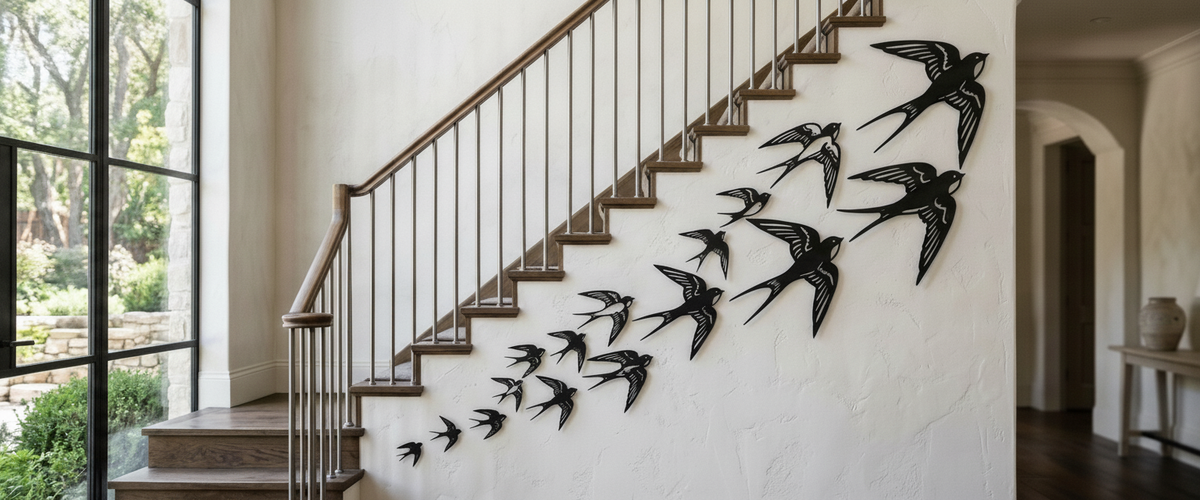

A staircase gives a piece of art about ten seconds of attention, and the viewer is climbing, turning and holding a rail the whole time. That is why a metal wall art staircase scheme succeeds or fails on rules a living room wall never tests. Pitch, sightlines, hand clearance and light all behave differently on a stair. We have made enough staircase metal wall art at Giant Sculptures to know that the brief is rarely about the image. It is about the climb.

At a Glance
Design for motion: bold silhouettes and strong rhythm read better than fine detail on a stair.
Follow the pitch: align pierced or linear work to the stair rake, not the floor below.
Check three views: the hall, the treads and the landing each see the piece differently.
Respect the rail: keep cut edges well clear of where hands travel.
Plan the light: a skylight or wall-washer can turn cut metal into moving shadow.
Nobody Stands Still on a Stair: Design for the Ten-Second Glance
In a hallway, people stop and look. On a stair they keep moving, eyes split between the next tread and the wall. Fine engraving, small text and delicate filigree simply vanish at that pace. What survives is silhouette, repetition and contrast: a flock of birds rising across laser-cut steel, a ribbon of brushed stainless catching light, a field of pierced Corten that shifts as you pass it.
Think of it as a sequence. Good metal wall art for staircase walls rewards the person going up and the person coming down, and it should still make sense from a single frozen glance halfway.

Follow the Rake, Not the Floor
The most common mistake we see is a rectangular panel hung level with the ground floor. On a stair wall, that panel looks as though it is sliding downhill. Your eye reads the diagonal of the stringer and the handrail first, so the artwork has to agree with it.
A pierced panel cut to the stair rake reads with the handrail, not against it.
One client learned this the hard way. They sent us photographs of a pierced steel screen bought elsewhere, hung dead level beside a steep stair. It fought the handrail from every angle. Our replacement was cut as a parallelogram matched to the measured stair pitch, with the pattern drifting upward along the same line. Same wall, entirely different result. If you are commissioning a metal wall art staircase piece, send us the rise and run of the treads, not just the wall height.
Three Viewpoints, One Piece
Staircase metal wall art is seen from below, alongside and above. From the entrance hall it is a distant composition, often foreshortened. From the treads it is close, sliding past at shoulder height. From the landing you may look down on its top edge or across at it square.
Before you buy, stand in all three spots and photograph the wall. Layered pieces from our 3D wall art collection work especially well here, because depth changes as the angle changes and the piece seems to open up on the climb. Flat panels need a stronger outline to hold their shape when viewed obliquely.

Sharp Edges at Hand Height: Clearance From the Rail
Laser-cut steel and aluminum can carry crisp edges, and a stair puts hands, sleeves and shoulders right beside them. Building codes already set a minimum gap between a handrail and the wall; the International Residential Code calls for at least 1-1/2 inches (38 mm) of clearance. Art should never eat into that zone.
Our studio rule is to keep the lowest edge of any pierced metal well above the rail line, or to set the work far enough along the wall that a steadying hand cannot reach it. Where a piece must run close, we deburr and radius the edges, specify thicker gauge plate, and choose finishes that will not mark skin or clothing. Raw Corten is a poor choice at hand height indoors unless fully stabilized and sealed, because loose rust bloom transfers. A brushed stainless finish hides fingerprints far better, and marine-grade stainless steel, whose corrosion resistance is explained well by the Nickel Institute, shrugs off humidity near entrances and pools.
Light That Climbs With You
Cut metal is half object, half shadow. On a metal wall art staircase, that shadow is often the better half. Sunlight from a skylight above a stairwell shifts across the day and sends the pattern sliding down the wall. A recessed wall-washer set at a grazing angle does the same at night, throwing the piercings onto the plaster so the shadow climbs alongside you.
Stand-off mounts and grazing light let the pattern climb the wall with you.
Two practical notes. Stand-off mounts of a couple of inches give shadows room to separate from the metal, which matters far more on a stair than on a flat wall. And avoid placing a spotlight where it glares straight into the eyes of someone descending. We once adjusted a commission after the client found the morning sun bouncing off polished stainless into the stairwell; a brushed finish solved it.
A Landing Anchor and a Rake-Wall Run
On tall or switchback stairs, one piece rarely carries the whole space. The strongest schemes split the work. A landing anchor, square and generous, gives a pause point where people actually stop. A rake-wall run, linear and angled to the pitch, leads the eye up toward it.
The two should share a material or motif without matching exactly. A bronze-toned sunburst on the landing paired with a looser bronze grass motif along the rake, for example, reads as one idea told twice. Browse our metal wall art collection with that pairing in mind rather than hunting for a single hero piece.

How to Choose Metal Wall Art for a Staircase: Buyer Checklist
Measure the wall, the stair rise and run, and the handrail height.
Photograph the wall from the hall, mid-stair and the landing.
Choose bold silhouettes over fine detail.
Match linear or pierced work to the stair pitch.
Keep cut edges clear of hand height; ask about edge finishing.
Pick a finish suited to the light: brushed for bright stairwells, polished for dim ones.
Confirm wall construction and fixings, since large panels can be heavy.
Decide whether the space needs one piece or a landing-and-rake pair.
When to Commission Rather Than Buy
Stock panels suit standard walls. Stairs are rarely standard. If your wall is angled, double height or interrupted by a window, a bespoke piece cut to the exact geometry usually costs less in compromise than a ready-made one forced to fit. Budget depends on material, scale, complexity, engineering, installation and finishing, so the honest answer for any metal wall art staircase project is a tailored quote. Share your measurements and photographs with Giant Sculptures, and we will show you how the piece reads from every step. You can also explore the wider wall art and wall decor range for adjoining spaces.
For wider placement ideas, Where the Depth Really Comes From in 3d Metal Wall Art is useful companion reading before finalising the setting and sightlines.