





































































































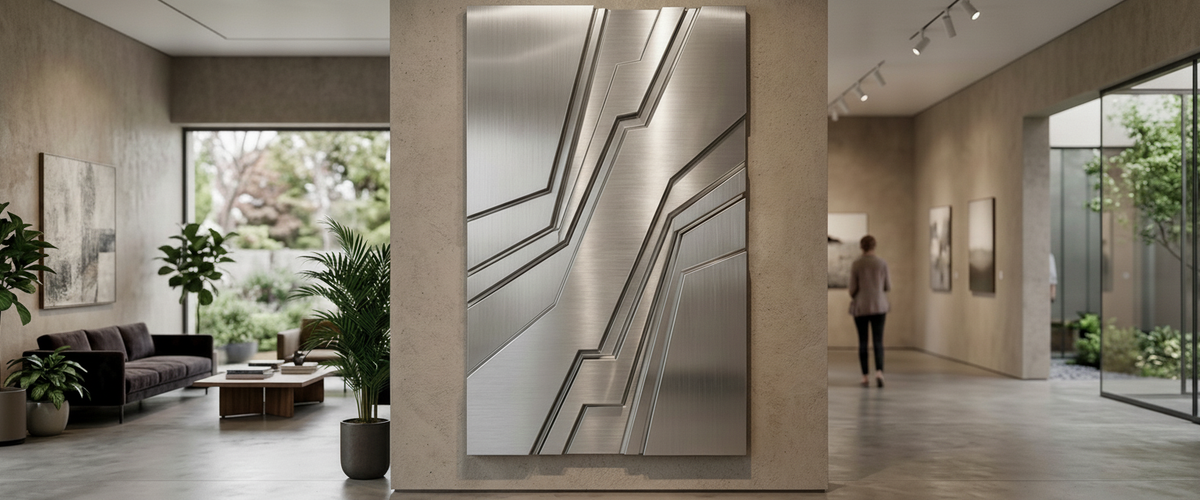

A stairwell is the one wall in a house you read from four different heights in about ten seconds. That is what makes a metal wall art staircase scheme so satisfying when it lands, and so awkward when it does not. Hang a panel at standard gallery height and it will look correct from the bottom tread and wrong from everywhere else. The rake changes the geometry, the eye level keeps moving, and the wall itself is usually taller and narrower than anything else you own.

At a Glance
Align to the string line, the diagonal edge of the stair, not to the floor or the ceiling.
Go taller than feels comfortable. Stairwell walls swallow small work.
Choose finishes that shrug off knuckles and bag straps near the handrail zone.
Light from above and slightly to the side so relief reads on the climb and the descent.
Confirm the wall build (studs, plasterboard, lath and plaster, masonry) before you choose weight.
Half-landings and stepped walls are where a bespoke commission usually beats an off-the-shelf panel.
Aligning to the string line is what keeps a metal wall art staircase reading correctly from every tread.
Why a Stairwell Punishes the Wrong Piece
Most walls give you one viewing position. A stair gives you a moving one. You approach from the hall at full distance, then pass within arm's reach on the flight, then look down on the top edge from the landing. A flat print survives that; a sculptural relief either gains from it or exposes itself. Deep-cut metalwork rewards the changing angle because the shadow pattern shifts as you climb, which is why a metal wall art staircase piece with genuine depth outperforms a shallow one. Printed-looking work goes dead the moment you get close.
There is a second problem nobody mentions until the drill is out. Stairwells are dust traps. Warm air rises through them, carrying lint and cooking residue up to the highest, least reachable part of the wall. Anything with fine open fretwork at 14 feet (4.3 m) will need a ladder and a soft brush twice a year. Plan for that before you fall in love with lace-fine cutwork.

Reading the Rake: Align to the String, Not the Floor
The single most common mistake we see in photos clients send us is a level row of panels marching along a diagonal wall. It reads as a mistake even to people who cannot say why. The eye takes the stair's string line as the horizon in that space, so artwork should sit parallel to it. Get that one thing wrong and even the best metal wall art staircase arrangement looks accidental.
Practical method: run a length of painter's tape from the nosing of the bottom tread to the nosing of the top tread, extended onto the wall. That is your reference line. Set the center of each piece at a consistent perpendicular distance above it, usually somewhere between 24 and 36 inches (61 to 91 cm) depending on ceiling height. Then cut paper templates at the real footprint of each piece, tape them up, and walk the stairs three times before you commit. Ten minutes of tape saves a wall full of filled holes.
Single Tall Panel or a Rising Cluster
Most metal wall art staircase decisions come down to one question: a single statement piece or a sequence. Narrow flights, such as a townhouse stair or a service stair in a boutique hotel, usually want one tall vertical work rather than a group. A single column of metalwork gives the wall a spine and stops the space feeling busy at shoulder height. For a narrow flight, a layered banded panel such as Panthra Shadow Black Acrylic Stripe 3D Wall Art suits the job better than a wide horizontal composition, because the banding still resolves from the hall below and picks up raking light as you pass it.
Wider stairwells with a generous half-landing can carry a rising cluster: three to five pieces stepping up in sympathy with the treads. Keep the spacing between them constant and let the whole group climb. Motif-led sets suit this better than abstract ones, since repetition gives the eye something to follow. Where the wall calls for a dispersed sequence rather than one solid mass, Aurelian Butterfly Display Acrylic 3D Wall Art is closer to the right design language, since individual elements can be pitched slightly differently without the group losing coherence. Browse the full metal wall art range to compare panel proportions before you decide.

Finishes That Survive Handrail Traffic
Everything within about 18 inches (46 cm) of the handrail is a contact zone. Coats, backpacks, vacuum cleaners and knuckles all pass through it. Brushed stainless steel and powder-coated steel are the two most forgiving choices there, because brushed grain hides light scuffing and a quality powder coat resists chipping far better than wet paint. Polished mirror finishes look superb in a double-height stairwell but only above the reach line; at hand height they show every fingerprint by Wednesday.
Corten and other weathering steels belong outdoors or in a covered exterior stairwell, not on interior plaster, since the oxide layer can transfer color to walls. Blackened or oiled steel indoors is beautiful and low-maintenance, needing little more than a dry microfiber wipe. For deep-relief work, dust with a soft brush before you wipe, or you will simply drag grit across the finish.
Raking light at roughly 30 degrees gives relief work depth on the climb and on the way back down.
Lighting a Stairwell Relief So Shadows Work Both Ways
Relief needs a light source with direction. A single downlight buried in the ceiling directly above a panel will flatten it. Aim for a wall-washing or accent fitting set off to one side at roughly 30 degrees so the raised elements throw a visible shadow. Then check the effect from the descending direction too, since shadows that look sculptural going up can look muddy coming down.
Where a stairwell has no daylight at all and lives on warm artificial light, tonal black relief can lose its edges by evening. In that situation a saturated colorway like Panthra Cobalt Blue Acrylic Stripe 3D Wall Art keeps its shape when shadow alone is not doing the work.
Glare control matters more here than in a living room, because in a stairwell your eyes are working at multiple distances while your feet are busy. The Illuminating Engineering Society publishes guidance on lighting stairs and changes of level, and it is worth reading before you specify anything that could throw a hard shadow across a tread. Warm dimmable LEDs at a fixed low level overnight also give the piece a second life after dark.
Fixings, Weight and What Your Wall Can Actually Hold
This is where enthusiasm meets structure. Standard plasterboard on studs will take a substantial panel if you can hit at least two studs; toggle and anchor systems have published pull-out figures, and the Gypsum Association is a sensible reference for what wallboard can and cannot carry. Older US and UK homes with lath and plaster behave differently again: the plaster keys are brittle, so fix into the framing behind rather than trusting the surface.
Half-landing returns are the trickiest spot. They are often a short wall built with fewer studs, sometimes with a stair stringer or a duct running through. Locate before you drill. For heavier work we supply pieces with a French cleat or a welded backing rail so load spreads across multiple points instead of hanging from two screws. On a recent tall multi-panel commission, the client's contractor added noggins between studs while the stairwell was being repainted; that half-hour of prep is what allows a genuinely heavy metal wall art staircase installation to sit flush and silent for decades.

Metal Wall Art Staircase Buyer Checklist
Measure the wall's widest and tallest usable area, plus the distance from the nosing line to the ceiling.
Photograph the wall from the bottom, mid-flight and landing. Send all three when you ask for advice.
Decide your reach line: what can realistically be cleaned without scaffolding.
Confirm the wall construction and any services behind it.
Check clearance so nothing projects into the walking envelope near the handrail.
Ask for the hanging hardware spec and total weight in writing before purchase.
Match finish to traffic: brushed or powder-coated low down, polished high up.
When a Stepped Stairwell Wall Is Worth a Bespoke Commission
Off-the-shelf panels assume a rectangle. Stairwells rarely give you one. If your wall steps around a half-landing, tapers under a soffit, or runs three stories in a converted warehouse, a bespoke metal wall art staircase commission causes far less frustration and looks considerably better than three unrelated pieces fighting each other. Bespoke also lets you set relief depth to suit the actual viewing distance, which is the detail that separates a sculptural wall from a decorated one.
At Giant Sculptures we work from site photographs and dimensions to develop stairwell pieces in stainless steel, mild steel and mixed metalwork, including sectional designs that arrive as modules and assemble on the wall. Budget depends on material, overall scale, relief complexity, engineered backing and finishing, so the honest answer is to send your measurements and ask for a tailored quote. If you are still exploring styles, the 3D wall art and broader wall art and wall decor collections are a useful place to test what holds your attention from a distance.
Get the alignment, the finish and the fixings right and metal wall art for a staircase becomes the piece guests remember, because it is the one they walk through rather than glance at.
For wider placement ideas, Metal and Wood Wall Art: What a Sculptor Weighs Before Saying Yes is useful companion reading before finalising the setting and sightlines.