






















































































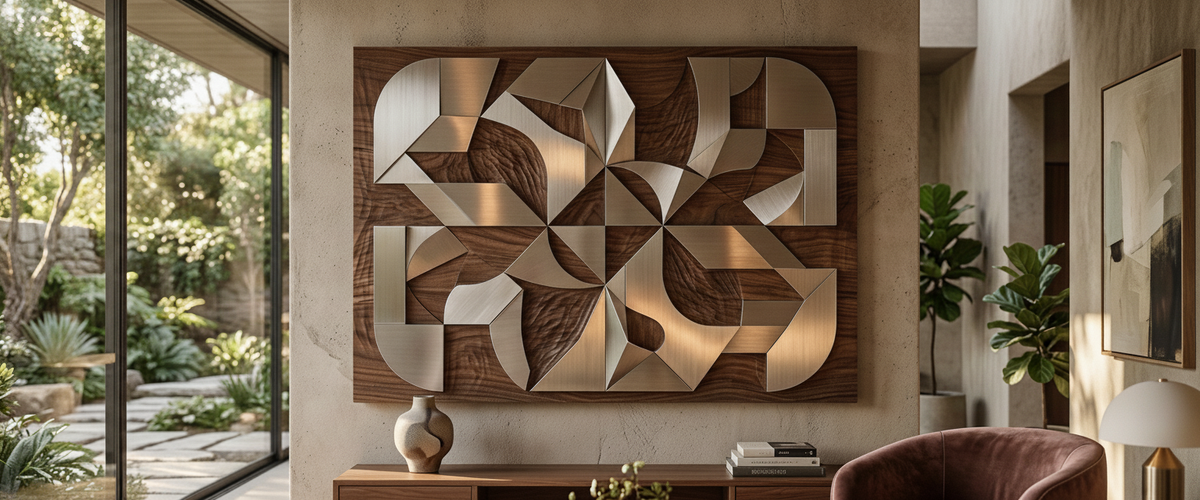

Put a slab of wood next to a sheet of steel and someone will call it minimalist. Build it wrong and it splits, warps, or streaks rust down an expensive wall in the first humid summer. A metal wood wall piece looks like the easiest thing in the world to make until you are the one signing off on the joinery, the finish, and the fixings that have to hold it flat for the next thirty years. Most of the work that matters happens before a tool touches the material.
We get asked for these metal wood wall combinations constantly, usually for a hall wall, a stairwell, or a guest bedroom that needs presence without another framed print. What follows is the thinking behind the scenes: what we weigh before we take on a commission, and the questions that separate a buyer who gets a great result from one who gets a warranty claim.

Key Takeaways for Metal Wood Wall Commissions
- Material movement is the whole game. Wood expands and contracts with humidity; metal does not. How the two are joined decides whether the metal wood wall piece survives.
- Scale changes the design, not just the size. A composition that reads at 10 ft can fall apart at 30 ft, and vice versa.
- Finish drives longevity and cost. Sealed hardwood, oiled walnut, brushed stainless, and intentional Corten patina all age very differently.
- The studio process protects you. Maquette, material sample, fabrication, then install. Skip a stage and you are gambling.
- Budget depends on material, scale, complexity, engineering, and finishing. Ask for a tailored quote rather than a per-square-foot number.

What Sculptors Actually Think About Before Taking a Metal Wood Wall Commission
The first question is not aesthetic. It is environmental. Where will this hang, and what is the air doing there? A metal wood wall panel destined for a climate-controlled apartment in New York is a different engineering problem from one going into a Napa guest house with wide seasonal swings, or a covered loggia in Texas that sees real heat. Wood moves. A wide oak or walnut panel can grow and shrink measurably across its width over a year, and if you pin it rigidly to a steel frame that will not budge, the timber loses. It cracks, or it bows off the wall.
So before we talk about the look, we talk about how the wood in a metal wood wall build is allowed to breathe. Floating fixings, slotted mounts, grain orientation, and moisture content at the time of build all get decided early. The Forest Products Laboratory has published decades of data on wood movement and equilibrium moisture content, and any studio working in solid timber should be able to explain how they account for it (fpl.fs.usda.gov). If a maker cannot, that is your first warning sign.
The second consideration is contact chemistry. Certain woods, oak in particular, are high in tannins. Put raw oak against bare steel with any moisture present and you get black staining and accelerated corrosion at the join. We either isolate the two materials, choose a metal finish that tolerates the pairing, or select a timber that behaves. None of this shows in the photos. All of it shows in year three.

Craft Decisions That Change the Final Result and the Price
Once the environment is settled, the craft choices behind a metal wood wall piece begin, and each one moves both the look and the number on the quote.
Metal choice. Brushed or mirror stainless steel reads cool, modern, and reflective; it holds up well indoors and out. Corten (weathering steel) gives you that warm rust-orange surface that pairs well with pale timber, but it needs the right detailing so runoff does not stain the wood beneath it. Bronze brings warmth and age, and it is the material we reach for when a client wants a wall piece that feels like it belongs in a collection rather than a showroom. Where a single cast form is meant to anchor a wall on its own, before you introduce any timber ground behind it, a piece like the Classical Figural Torso Wall Sconce Bronze Sculpture - 90cm is closer to the right starting point than a busier composite panel.
Wood choice. Walnut, oak, ash, and sculptural carved panels each carry a different weight and grain story in a metal wood wall composition. For a base that brings rhythm and shadow rather than flat board, a carved multi-panel timber field such as the Harmonic Forms 4-Panel wood carving gives a metal element something to sit proud against.
Relief depth. How far the metal stands off the wood decides how the piece behaves under light. Shallow relief reads as pattern. Deep relief throws real shadows that shift through the day; a bronze relief such as the Traditional Horse Head Bronze Relief - 80cm looks one way at breakfast and another at dusk for exactly that reason. Depth costs more to fabricate and mount, so it is a genuine budget lever, not just a style one.
Join detail. Visible bolts, hidden fixings, inlaid metal set flush into routed timber; every option is a different labor cost and a different visual honesty on a metal wood wall build. We are happy to show the mechanics or hide them completely. Both are valid. Neither is free.

Why Some Metal Wood Wall Pieces Read Right at 10 ft and Wrong at 30
This is the mistake we see most in reference images clients send us. A metal wood wall piece photographed for a lifestyle shoot at close range gets ordered for a double-height entry hall, and the proportions collapse.
At 10 ft, your eye reads texture: the tooling on the metal, the grain of the walnut, the crispness of an edge. At 30 ft, from the bottom of a stairwell, all of that disappears and only the silhouette and the big tonal blocks survive. A busy composition full of fine detail turns to visual mush at distance. A bold, simple gesture that looks almost too plain up close becomes exactly right across a room.
We size the design to the viewing distance, not just the wall. A monumental bronze form like the Monumental Classical Galloping Horse and Swallow Bronze Sculpture - 500cm is built to be read from across a courtyard, and its impact depends on being seen from far enough back. Hang the wrong scale of relief in the wrong-sized room and you either overwhelm it or lose it. Getting this right is most of what our design stage is for.
Studio Process: Maquette, Sample, Fabrication, Install
A metal wood wall commission we shipped to a designer furnishing a guest bedroom on the West Coast makes the case for process well. She wanted metal and wood wall art that felt calm rather than loud, sized for the wall above a low headboard. We ran the full sequence, and it saved everyone from an expensive guess.
- Maquette. A scaled model, physical or rendered, that shows the composition, proportions, and relief depth in three dimensions. This is where you catch a design that photographs well but sits awkwardly in the actual room.
- Material sample. A real offcut of the chosen timber next to the chosen metal finish, in the client's own light. Screen colors lie. Walnut under warm evening light is not the walnut you saw on a monitor.
- Fabrication. Carving, cutting, finishing, and building the mounting system. Moisture content is checked before the timber is committed. Metal is finished and, where needed, isolated from the wood.
- Install. Wall type, stud spacing, and weight all get confirmed. A heavy composite panel needs mounts rated well above its actual weight, fixed into structure, not just plasterboard.
For that bedroom piece, the sample stage changed the metal from a mirror finish to a soft brushed one, because the mirror bounced the bedside lamps straight back into the room. A rendering would never have told us that.
Honest Red Flags Buyers Should Ask About Before They Commit
If you are commissioning metal and wood wall art for a guest bedroom, a lobby, or a stairwell, put these questions about your metal wood wall piece to any studio before you pay a deposit.
- How is the wood allowed to move? A blank stare here is the biggest red flag of all.
- What stops the metal staining the timber? Ask specifically about tannin and moisture at the join.
- What is the mounting system, and what does it weigh? You need to know before your contractor prepares the wall.
- Indoor only, or outdoor rated? A piece built for a dining room will not survive a covered patio without changes to finish and fixings.
- Will I see a sample before fabrication? Any serious maker of bespoke, large-scale work will say yes.
- How do I care for it long term? Oiled timber wants re-oiling; brushed stainless wants the right cleaner; Corten needs its runoff managed. The answer should be specific.
Giant Sculptures works on bespoke, large-scale metal wood wall commissions in bronze, stainless steel, Corten, stone, and carved timber, and we would rather talk you out of the wrong material than sell you a piece that fails in year two. If you are still gathering ideas, the metal wall art and wood wall art collections are a good way to see how the two materials behave before you brief a metal wood wall design. When you are ready for something built for your exact wall, ask us for a tailored quote; the cost genuinely depends on material, scale, relief depth, engineering, and finish, and no honest per-foot figure exists.
For wider placement ideas, 3D Geometric Wall Art: What Sculptors Weigh Up Before Saying Yes is useful companion reading before finalizing the setting and sightlines.