






































































































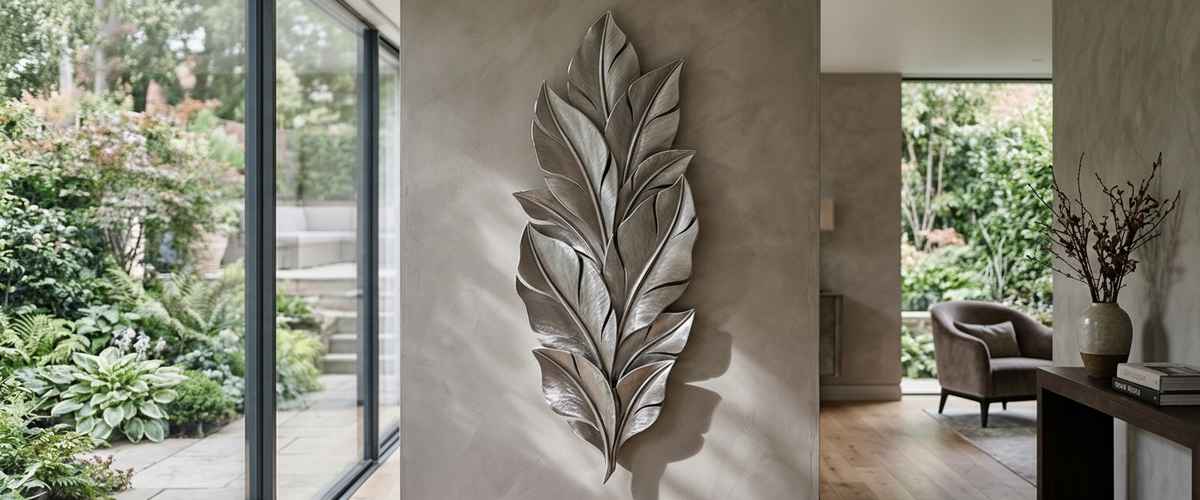

Most decisions about entryway metal wall art get made while standing in the middle of the hall, which is the wrong place to stand. The first real look anyone gets at the piece comes from the doorstep, with the door half open and a coat still on, and about four seconds to take it in. If the piece reads in that moment, it works. If it only makes sense from two feet away, it is just something hanging above the mail. This guide shows you how to judge a piece from that doorstep view. It then covers how to size it against the console and mirror, clear the door swing, pick a finish that holds up to porch light and humidity, and fit the awkward walls of narrow period halls.
At Giant Sculptures we make and ship large-scale metal wall art for private homes and hospitality lobbies. Entryway metal wall art is among the briefs we see misjudged most often, usually because a buyer falls for a piece photographed flat and front-on and then hangs it somewhere it will only ever be seen at an angle.

At a Glance
Judge entryway metal wall art from the open front door, not from inside the hall.
If the piece shares a wall with a console, it should hold its own against the table and any mirror.
Measure door swing and coat traffic before you choose a relief depth.
Choose the finish for your actual light: porch glare, a fanlight, or one pendant at night.
In narrow or period halls, a bespoke width usually beats the nearest standard size.
Metal Wall Art for Entryway Walls: Judge It From the Open Door
The threshold view is a long, slightly oblique look into a fairly dark space. That favors metal wall art for entryway walls over prints and canvases, because metal gives you edges and cast shadow, which carry farther than detail. A strong silhouette against a contrasting wall reads from 15 feet (about 4.5 m). Fine engraving does not.
Before buying entryway metal wall art, open the front door, step back onto the porch, and have someone hold a sheet of cardboard cut to the proposed size against the wall. You will know within seconds whether it is too timid. In our experience it usually is, and buyers end up going up a size. Browse the metal wall art collection with that doorstep view in mind and you will start sorting pieces by outline rather than surface pattern.
The doorstep view: outline and shadow carry, fine detail does not.

Above the Hall Table, the Metal Must Beat the Console and the Mirror
A console table is a heavy horizontal block, and a mirror is a bright rectangle that reflects whatever is behind you. Hang a modest piece of entryway metal wall art between them and it disappears. Pick one lead object. If the metal is the star, drop the mirror or move it to the opposite wall where it can bounce light onto the piece.
As a working guide, let the artwork span at least two-thirds of the console width and hang its lower edge 6 to 10 inches (15 to 25 cm) above the tabletop. Check that a table lamp does not clip the outline; a shade cutting into a sculptural edge looks accidental every single time.
Let the metal lead: wide enough to hold its own against the console.
Door Swing and Coat Hooks: Clearance for Deep Relief
A flat print asks nothing of the room. Sculptural metal wall art for the entryway, with 4 or 5 inches (10 to 13 cm) of projection, asks plenty. Open the front door fully and see where the handle and leading edge land. Then picture someone shrugging off a backpack or hanging a wet coat. Leaves, petals and sharp folded steel are exactly what sleeves snag on.
Pieces from our 3D wall art range are best on the wall facing the door or on a return the door never reaches. For hotel and venue entrances, remember that US accessibility guidance limits wall-mounted objects in circulation paths, between 27 and 80 inches above the floor, to 4 inches of projection. Deeper relief belongs above that zone or in a recess.

Brushed Steel, Bronze Patina or Blackened Iron: Which Survives a Porch-Lit Wall
Brushed stainless steel is the most forgiving choice for metal wall art in an entryway next to an exterior door. Pay attention to grain direction, though. A vertical brush under a porch light throws bright streaks down the piece, while a horizontal or circular brush scatters the glare. On coastal homes, from the Hamptons to Malibu, specify 316 grade rather than 304.
Bronze with a patina warms the room and ages well, but the surface responds to handling and humidity, and an entry gets both. A thin coat of microcrystalline wax once or twice a year keeps it even. The National Park Service Conserve O Gram series covers cleaning and waxing metals in practical detail.
Blackened or waxed iron looks wonderful on pale plaster and is the least tolerant of the three. Every time the door opens in a humid Texas or Florida summer, moisture reaches it. Unless the piece is properly sealed, you will see rust bloom at the edges first. The Getty Conservation Institute's work on coatings for metal sculpture points the same way: coating and maintenance matter as much as the metal itself.
Fanlight by Day, One Pendant by Night
A sidelight or fanlight throws raking daylight across the wall, which flatters relief and makes brushed finishes glow. After dark the same entry often runs on a single overhead pendant, which flattens a shallow piece and drags long shadows down a deep one. The art changes character twice a day.
A useful test is to light the piece under one bare overhead bulb, because that is how most halls look at 9 p.m. Some entryway metal wall art that sings in daylight loses half its drama under that test. If your hall works the same way, think about a small picture light or a wall washer aimed from the side.
Narrow Period Halls, Where Bespoke Width Beats Catalog Size
Brooklyn brownstones, Boston row houses and Charleston single houses share one problem: the usable wall sits between a door casing and a stair newel, and it is rarely a standard width. An entry wall can be barely 30 inches (76 cm) between moldings. At that width, every catalog piece is either lost or crammed in. A tall, slim panel made to the measured width solves it.
This is where bespoke entryway metal wall art earns its keep. We can adjust proportions, relief depth and finish to the wall rather than forcing the wall to accept the nearest size. Budget depends on material, scale, complexity, engineering, installation and finishing, so ask for a tailored quote with your measurements and a photo taken from the front door.

Metal Wall Art Entryway Checklist
Photograph the wall from outside the open front door.
Mock up the size in cardboard and test it from the doorstep.
Measure the door swing, coat hook zone and lamp height.
Pick relief depth to fit that clearance, keeping 4 inches or less in commercial walkways.
Match the finish to humidity and exposure: stainless near the coast, sealed iron only in dry, sheltered entries.
Check the piece under both daylight and your night lighting.
Confirm wall construction and fixings for the weight; a large steel panel can run well past 50 pounds (23 kg).
Get those seven right and your entryway metal wall art will greet people the way an entry should. When the wall is awkward, the hall is historic, or the standard sizes all feel slightly off, talk to us about a commission, or keep browsing the wider wall art and wall decor collection for scale ideas first.
For wider placement ideas, Outdoor Metal Wall Art That Won't Stain Your Facade is useful companion reading before finalizing the setting and sightlines.