





























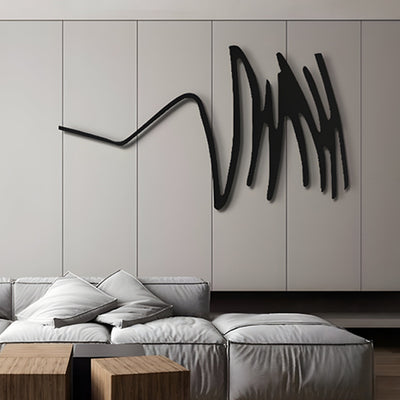

















Rust does not stay on the sculpture. Hang a raw steel panel on a pale wall, and within one wet season the first orange streaks start creeping down the render beneath it. They rarely scrub off. Most advice on outdoor metal wall art focuses on the piece itself. The wall it hangs on is often the more expensive surface, so that is where we start.
At a glance
Corten and raw mild steel shed iron oxide onto whatever sits below them, sometimes for years before they stabilize.
Powder-coated steel fails at edges, welds and fixing holes. Once the coating is breached, rust travels underneath it.
Aluminum and grade 316 stainless steel bleed the least. Waxed bronze comes close if it is maintained.
Stand-off brackets and a clean drip edge matter as much as the choice of metal.
Match the metal to the surface. Brick forgives a lot; painted render and limestone forgive very little.

The Run-Off Nobody Prices In
When clients budget for outdoor metal wall art, they price the panel, the shipping and perhaps the installer. Almost nobody prices the wall. Rain hits the metal, picks up dissolved oxide or copper salts, and leaves from the lowest edge in a narrow stream. On brick, that stream soaks into the mortar joints. On limestone, it moves into the stone itself, which is porous enough that the stain settles below the surface where scrubbing can't reach. Painted render is the worst case. The mark is visible from the street, and the only reliable fix is often repainting the whole elevation.
Corten on a Pale Wall: Handsome Above, Ruinous Below
We love weathering steel for freestanding work. It forms a dense, protective rust layer and asks almost nothing of the owner. The catch is that this layer takes time to settle, and while it forms, the steel releases loose oxide with every rainfall. SteelConstruction.info's guidance on weathering steel lists run-off staining of adjacent surfaces as a known design issue, and our experience bears that out. A Corten panel mounted on cream stucco can leave a stain wider than the artwork itself within a couple of years.
Corten can still work as outdoor metal wall art. Ask for it to be pre-weathered in the studio before shipping, mount it well proud of the surface, and reserve it for dark brick, rust-toned stone, or a wall with a planted bed beneath it rather than pale paving.

Where Powder-Coated Steel Cracks First
Powder coating looks like the answer for outdoor metal wall art: a sealed skin of color with no bare steel showing. On a flat sheet it performs well. The trouble starts where the coating is thinnest or most easily damaged. That means sharp laser-cut edges, the inside of tight curves, welds, and every drilled fixing hole. A ladder knock or an overtightened screw breaks the film. Water gets underneath, rust spreads beneath the paint as a creeping blister, and eventually it breaks through and runs down the wall.
Aluminum behaves differently. Its corrosion product is a thin gray-white oxide, so even a chipped coated aluminum panel won't paint orange lines on the masonry. For large laser-cut designs on light facades, we usually steer clients toward coated aluminum over coated steel. They give up a little rigidity and keep a much cleaner wall.
Coastal Air: Stainless Grades and Bronze Patinas That Stay Off the Wall
Salt changes the rules. Grade 304 stainless steel is perfectly respectable inland, but within a few miles of the ocean it can develop brown tea staining, and that discoloration washes down too. For homes in Malibu, the Hamptons or along the Gulf Coast, we specify grade 316. It contains molybdenum for better resistance to chlorides, and the International Molybdenum Association publishes clear material on why that matters. A smooth polished finish also gives salt fewer places to sit.
Bronze is the other coastal workhorse. Left untreated, it sheds copper salts that leave green streaks on pale stone. That looks charming on a statue plinth and unwelcome on a limestone facade. A patina sealed with hot wax keeps run-off minimal, provided the wax is renewed once or twice a year. On a sea-facing elevation, a waxed relief of moderate width, such as the Galloping Herd Bronze Relief Wall Art - 120cm at roughly 4 feet (120 cm), is a sound choice, as long as the waxing schedule is agreed at handover rather than left to chance.

Stand-Off Brackets and Drip Lines That Protect the Facade
A panel fixed flat against a wall traps moisture behind it and leaves a stained rectangle when it is eventually moved. Stand-off brackets hold the piece away from the surface, typically by an inch or two (25 to 50 mm), so air circulates and the back dries quickly. On outdoor metal wall art, a slight downward chamfer on the lower edge helps water drip clear of the facade instead of tracking back along the underside. Before final fixing, run a garden hose over the piece in position. It is low-tech, and it catches problems that drawings miss.
Fixings should be stainless steel whatever the panel is made from. Where dissimilar metals meet, isolate them with nylon or EPDM washers to prevent galvanic corrosion at the one spot nobody can see.
Matching Outdoor Metal Wall Art to the Surface Beneath
Brick
Brick is the most forgiving surface. Warm red or reclaimed brick absorbs a little rust tone without complaint, so Corten and bronze both suit it. Check the mortar first, though. Soft lime mortar holds stains more readily than the brick face does.
Timber Cladding
Iron reacts with the tannins in cedar and oak and leaves blue-black marks that sand out only partly. On timber, choose stainless steel or aluminum, and allow generous ventilation behind the piece so the cladding can dry.
Painted Render and Pale Stone
This is the least forgiving pairing. Here we recommend 316 stainless, coated aluminum, or a change of medium entirely. On a broad pale elevation, a carved relief such as the Six Galloping Horses Marble Relief Wall Panel - 180cm, at about 6 feet (180 cm), brings the same sculptural presence with no metallic run-off at all. Where the wall is a narrow pier beside an entrance, a smaller panel like the Bamboo Grove and Rockery Marble Relief Wall Panel - 100cm keeps the proportions right at around 3 feet (100 cm). The outdoor wall art collection sets stone and metal side by side, which makes that comparison easier.

Buyer Checklist Before You Commit
Identify the wall surface and its color, and photograph what sits directly below the planned position.
Note your distance from the coast. Within a few miles, specify 316 stainless or waxed bronze.
Ask how edges, welds and fixing holes are protected on any coated piece.
Confirm the stand-off depth and whether the lower edge sheds water clear of the wall.
Agree a maintenance routine (waxing, rinsing salt, checking fixings) before installation.
For pale or historic masonry, request a sample or a material recommendation in writing.
The right piece suits both your taste and your wall. Our metal wall art collection brings together outdoor metal wall art decor and sculptures in one place, so it is a good place to start. For a specific facade, Giant Sculptures can design a bespoke commission in the right metal, finish and bracket system. Budget depends on material, scale, complexity, engineering, installation and finishing, so send us photos and measurements for a tailored quote.
For wider placement ideas, Large Metal Wall Art for a 30-foot Living Room Wall: A Studio Case Study is useful companion reading before finalising the setting and sightlines.