



























































































The sculpture arrives on a Tuesday. The problem, if there is one, showed up eight months earlier in a survey nobody commissioned. Material installation large sculpture planning is one conversation, not two: the alloy or stone sets the weight, the weight sets the foundation, and the foundation sets your calendar. The real cost drivers are density and mass, base and anchor design, site access, crane and rigging time, concrete curing, and the upkeep your chosen finish will demand a decade from now. Get that order right and the crane is on site for one afternoon. Get it wrong and you are hiring road plates to protect a driveway you already paid to resurface.

Key Takeaways
Point load beats total weight. A 900 lb (408 kg) figure standing on two ankles is harder on a terrace than a 2,000 lb (907 kg) piece on a wide base.
Concrete sets the schedule. Foundation pours and grouted anchors need curing time before anything is lifted onto them.
Access is a hard constraint. Gate widths, turning circles and crane swing arcs cannot be negotiated on delivery day.
Finish choice is a maintenance contract. Some surfaces need nothing for decades; others need access equipment in year eight.
Budget the site, not just the artwork. Engineering, rigging, permits and reinstatement are real line items in any large sculpture material and installation budget, and they vary enormously by location.
Lifting lugs, swing arc and outrigger ground conditions are designed months before delivery day.
Weight per Square Foot: Bronze, Cast Stone, Resin and Fabricated Steel
Every material installation large sculpture decision starts with density. Cast bronze runs around 550 lb per cubic foot (roughly 8,800 kg/m³) and stainless steel around 500 lb per cubic foot (about 8,000 kg/m³), though both are usually cast or fabricated hollow, so wall thickness drives the final mass more than volume does. Cast stone and concrete sit near 145 lb per cubic foot (about 2,300 kg/m³) and are almost always solid, which is why a modest cast stone urn can outweigh a much taller bronze. Marble is heavier again. Resin and composite pieces are the lightest by a wide margin, which makes them easy to place and easy to move, including by people you did not invite.
The number that actually matters is bearing pressure: pounds per square inch under each contact point. Our studio tapes the full-size footprint on the shop floor before a commission is signed off, because a slender standing figure concentrates its whole mass into two small anchor zones. That is fine on a properly reinforced pad and unkind to a sixty-year-old flagstone terrace. When buyers compare a cast bronze piece with a fabricated steel equivalent, the material and installation for a large sculpture gets worked as a load case first and an aesthetic question second; the answer often changes the base design rather than the artwork.

Why the Pad, the Pins and the Cure Time Set Your Delivery Date
Studios get blamed for slow delivery when the real gating item is concrete chemistry, and it is the part of material installation large sculpture scheduling buyers least expect. A foundation pour gains strength over days, not hours, and curing conditions affect the result; the American Concrete Institute's guidance on curing practice is the standard reference your contractor will be working from. Chemical anchors and grouted baseplates add their own cure windows on top.
Then there is the hardware, the quiet half of large sculpture material and installation. Cast-in anchor bolts have to be set with a template while the pour is wet, which means the sculpture's base plate geometry must be final months before the piece ships. Post-drilled epoxy anchors give more tolerance but demand clean, dry holes and a rebar scan first. On coastal sites, we specify stainless fixings throughout; galvanized bolts in salt air become the weakest part of an otherwise permanent installation.
Stainless cast-in bolts set to a template, ready for the baseplate to be grouted and levelled.
Access Before Artwork: Gates, Swing Arcs and Lift Points
Access shapes the material installation large sculpture plan more than most buyers expect, so measure the narrowest point on the route, not the widest. We once had a commission bound for a Napa vineyard where the driveway was generous, the courtyard was generous, and the stone gate pillars were about two inches short of the crated width. The fix was a longer route across turf, ground protection mats and a half-day of extra rigging. Entirely avoidable with one tape measure.
Cranes need more than a parking spot. They need outrigger footprints on ground that will take the load, a swing arc clear of tree canopies and power lines, and a set-down zone. Lift points also deserve scrutiny: a well-engineered monumental piece has concealed lifting lugs designed into the structure, positioned so the work hangs level and the slings never bear on a finished surface. Ask where they are before you ask when it ships.
Floors and Terraces That Lie to You
Structural capacity is where material installation large sculpture planning either holds or quietly falls apart. An interior slab looks solid and frequently is not. Mezzanines are designed to a uniform load figure that a concentrated sculpture base can exceed locally. Thin screed over insulation will dish under a point load. Rooftop terraces on pedestal pavers almost always need the load carried down to a structural bearing point, which means a spreader plate or a bespoke base designed with your engineer. We have shipped mirror-polished work into Manhattan lofts where the freight elevator capacity, not the artwork, dictated that the piece be built in bolted sections and assembled on the floor.
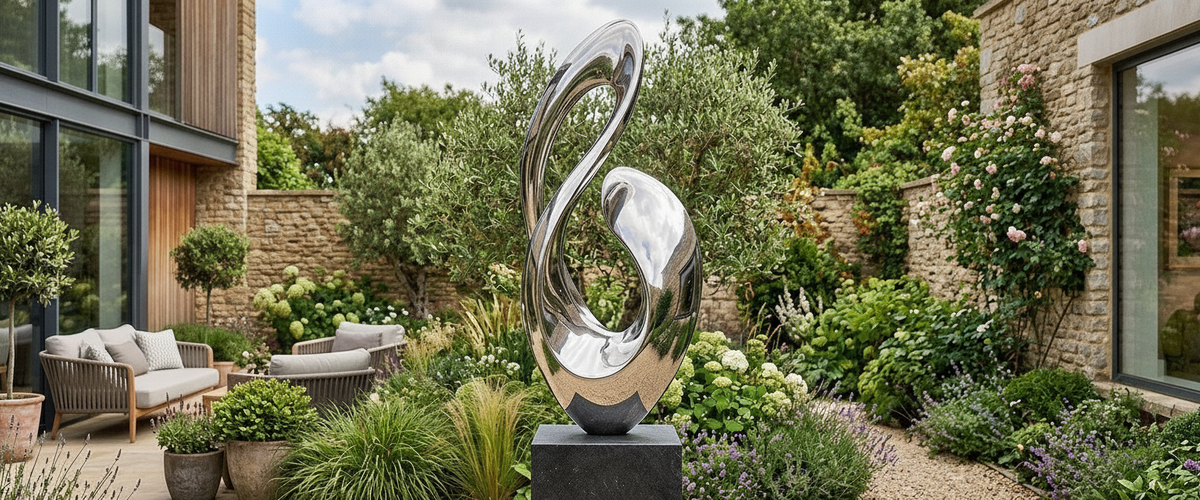
For interiors, the material and installation math for a large sculpture usually favors fabricated stainless steel: high visual impact, hollow construction, and a weight you can actually get through a building.

Finishes That Will Demand Scaffolding in Year Eight
Finish is the part of the material installation large sculpture equation that bills you later rather than now. Some surfaces age quietly. Corten weathers to a stable oxide layer and asks for nothing except drainage detailing so run-off does not stain pale paving. Solid stone and marble need occasional cleaning and sensible siting away from de-icing salt. Patinated bronze is stable but benefits from periodic waxing; the Getty Conservation Institute's research into outdoor bronze protection is worth reading before you commit to a maintenance regime.
Painted and lacquered finishes are where the future cost hides. A high-gloss coating on a 15 ft (4.6 m) piece will eventually need recoating, and recoating means access equipment, masking and weather windows. Mirror polish stays beautiful but shows everything, and irrigation overspray leaves mineral deposits that need removing before they etch. None of this is a reason to avoid those finishes. It is a reason to price them honestly across twenty years rather than across one invoice.
What the Site Visit Answers That a Photograph Never Will
For wider placement ideas, Large Acrylic Wall Art Lives or Dies by the Light You Give It is useful companion reading before finalizing the setting and sightlines.
Photographs flatten everything that matters, which is why a visit settles the material installation large sculpture questions an image cannot. On site we read the sun path, because a reflective piece facing a west elevation will throw light into a bedroom window at 6pm in July. We look at prevailing wind for anything with sail area. We check where snow gets plowed on mountain properties, because a snow bank against a base is a salt and abrasion problem. We look at drainage, sprinkler heads, and the sightline from the room people actually use.
Where the Installation Budget Quietly Overtakes the Sculpture Budget
On complex sites, material installation large sculpture budgets can push the total well beyond the fabrication cost. The usual suspects: topographic survey, a stamped engineering design for the foundation, excavation and spoil removal, the pour itself, crane hire and certified rigging, traffic management or street permits in urban locations, ground protection, reinstatement of turf or paving, lighting conduit, and specialist transit insurance. Coastal, sloped and rooftop sites carry the most variables.
We do not publish a number for this, because an honest one does not exist without a site. Material and installation for large sculpture costs depend on scale, complexity, engineering, rigging and finishing, and the only reliable route is a tailored quote built against your actual location.

Pre-Commission Checklist
Run this material installation large sculpture checklist before you sign anything off:
Measure the narrowest point on the delivery route, including gate pillars and overhead branches.
Confirm the crane set-up zone, outrigger ground conditions and swing arc.
Get the slab, terrace or mezzanine load capacity confirmed by a structural engineer.
Agree the base detail, anchor type and lifting point positions in writing before fabrication starts.
Ask for the realistic foundation and curing schedule and work backward from it.
Ask what the chosen finish needs at year five, year ten and year twenty, and how you will reach it.
Line up permits, insurance and any HOA or planning approvals early.
Book a site visit or supply photographs, levels and dimensions before signing off the design, so the material and installation for your large sculpture is priced against reality.
Handled properly, material installation large sculpture planning runs alongside the design rather than chasing it. That is how we approach bespoke commissions at Giant Sculptures: the base, the anchors, the route and the finish get resolved with the form, so the piece that arrives on your site is the piece that stays there, upright and unbothered, for decades.