





















































Most large acrylic wall art fails for one avoidable reason: somebody aimed a spotlight straight at the face of it. The panel goes chalky, the color washes out, and the client stands there wondering why the piece looked so much better in the studio. Acrylic is a light-carrying material. Treat it like a printed canvas and you throw away the only thing it does better than anything else on the wall.
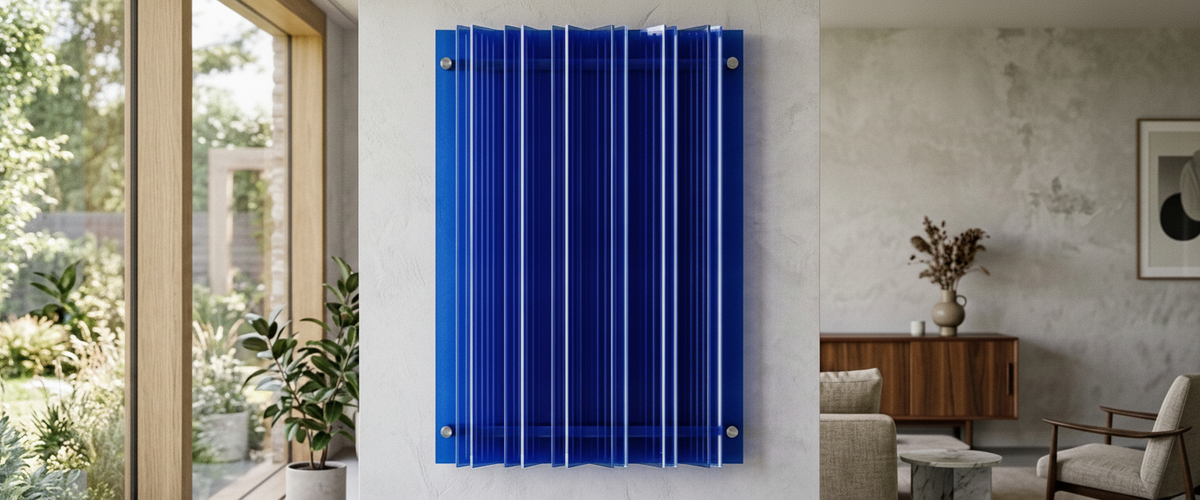
Angled light at roughly 30 degrees pulls shadow across the ribs instead of flattening them.

Key Takeaways Before You Buy
Six things worth settling before you commit to large acrylic wall art.
Rake the light across the panel at an angle rather than head-on. Frontal light flattens acrylic.
Polished edges do the glowing. Sawn or matte edges kill the effect completely.
Standoff fixings create a shadow gap of roughly 0.75 to 1.5 in (20 to 40 mm), and that gap makes the piece read as floating.
Backing color matters more than wall color. Dark walls sharpen edge glow; pale walls soften it.
Check your windows first. A wall facing glass will mirror the view back at you for half the day.
Some walls want metal instead. Tight corridors, glare traps and north-facing dead zones are metal territory.
Rake the Light Across the Panel, Never Straight at It
Acrylic transmits light rather than bouncing it back. Point a narrow-beam downlight at 90 degrees to the face and most of that beam passes through or reflects straight into the viewer's eye as a hotspot. Move the fitting so the beam arrives at roughly 25 to 35 degrees from vertical and everything changes: the surface relief catches shadow, the layers separate, and the color reads as depth instead of a printed sheet.
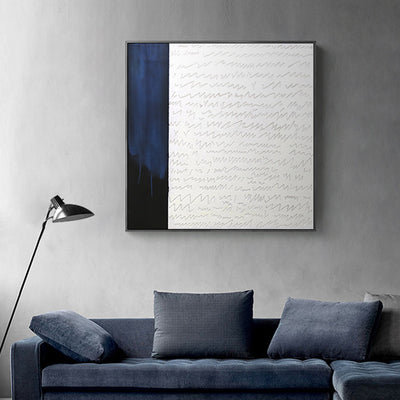
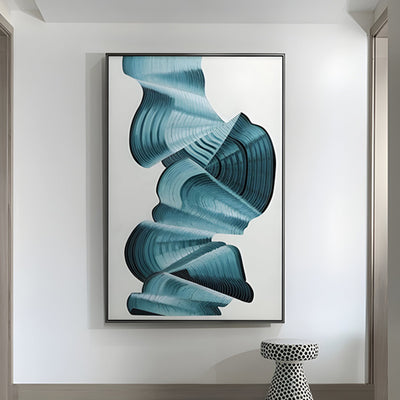
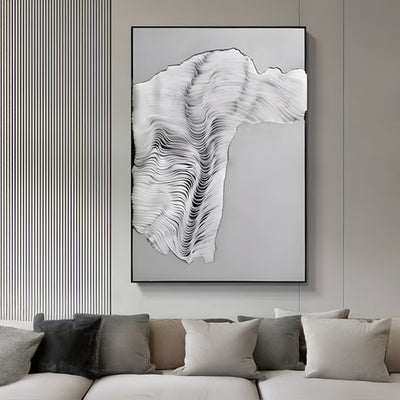
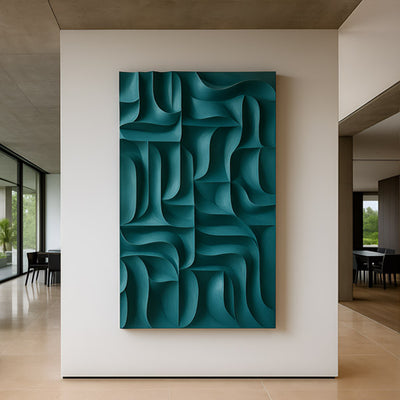
Layered pieces reward this most, and any large acrylic wall art with real surface relief gains the most from an angled beam. A ridged, stripe-built panel such as the Panthra Cobalt Blue Acrylic Stripe 3D Wall Art carries physical geometry for the beam to travel across, so angled light turns what could be a flat blue rectangle into a run of bright and dark ribs. Flat-faced panels have far less to work with, which is exactly why their edges become the star.

Edge Glow Is the Whole Trick, and Polished Edges Deliver It
Cast acrylic carries light along its thickness the way a fiber-optic strand does, so ambient light entering the face travels sideways and exits at the perimeter. That is why a well-made panel appears to have a bright pinstripe running around its border. The finish on that border decides whether you see it. A sawn edge scatters the light and looks gray. A diamond-polished or flame-polished edge sends it out cleanly.
When we specify large acrylic wall art for a commission, edge finish is one of the first questions we settle, ahead of color. It is also the detail buyers most often forget to ask about, and the one that separates a genuine acrylic piece from something that could have been printed on board. Museum conservators treat plastics as a serious art material with their own handling rules, and the Tate's overview of plastic in art is a useful reminder that these materials have a real conservation history behind them.
Standoff Fixings and the Shadow Gap
Flush-mounting large acrylic wall art is a waste of the material. Standoff barrels hold the panel clear of the plaster, and that void does two jobs at once: it lets ambient light wrap behind the sheet and re-enter the edges, and it casts a soft shadow line that visually detaches the work from the wall.
Practical points on fixings for a large piece. Use four points minimum on anything above about 4 ft (1.2 m) wide, six on a panel over 6 ft (1.8 m). Fix into studs or use proper cavity anchors rated well above the panel weight, because acrylic sheet at 10 to 20 mm thick gets heavy quickly at scale. And check the wall is genuinely flat first. Acrylic will not hide a bowed plasterboard run; the shadow gap will simply vary along its length and the eye picks that up instantly.
A 20 to 40 mm standoff gap lets light wrap behind the sheet and re-enter the polished edges.
Daylight to Lamplight: How a 6 ft Panel Changes at 4pm
Large acrylic wall art is a different object at three points in the day, and this is the part most buyers only discover after installation. Morning daylight through side glazing skims the surface and lifts the relief. Midday sun flattens it. Then at around 4pm in winter, when the daylight drops and the lamps come on, warm point sources take over and the edge glow becomes the dominant feature.
We shipped a set of stripe panels to a home outside Napa where the client had planned everything around the daytime view. The pieces looked strong until dusk, then went dead, because the only artificial light in the room was a central pendant sitting directly in front of the wall. Two adjustable ceiling fittings, repositioned about 2 ft (600 mm) out from the wall face, fixed it in an afternoon. Plan the evening scene before you plan the daytime one; daylight is generous, lamps are not.

Reflections and Sightlines: Read the Room Before You Pick the Wall
Polished acrylic is partly a mirror. Before you commit a wall to large acrylic wall art, stand where people will actually stand, look at the candidate surface, and note what is behind you. If the answer is a bank of windows, a TV, or a bright kitchen island, that content will appear in your artwork for a good part of the day.
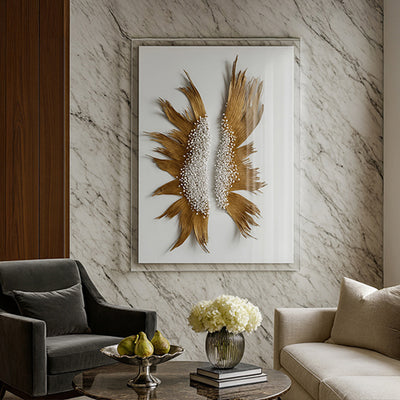
The fix is usually geometry, not material. Shift the piece to a return wall at 90 degrees to the glazing, or place it where the primary sightline is oblique rather than square-on. Sculptural, non-flat work is far more forgiving on a reflective wall: a faceted composition such as the Papillara Blue Butterfly Feathered Acrylic 3D Wall Art scatters reflections across dozens of small elements rather than one large mirror plane, so a bright window behind the viewer becomes sparkle instead of glare.
Dark Walls, Pale Walls and the Backing Color That Decides If It Floats
Contrast controls the edge glow. On a deep charcoal, ink blue or near-black wall, the perimeter light reads brilliantly and the panel looks lit from within, which is why gallery-style rooms in NYC apartments so often go dark behind large acrylic wall art. On off-white or pale plaster, the glow softens and the piece becomes graphic and calm, which suits big open Texas and California living spaces where you do not want a single dominant object.
Neither is wrong. But pick deliberately, and match the panel to the decision. Against pale plaster the work has to supply its own contrast, which is where a saturated body color like the Panthra Emerald Green Acrylic Stripe 3D Wall Art holds the wall; paler translucent work needs a dark ground behind it or it dissolves into the plaster. Work through the acrylic art collection with your wall color in front of you rather than in the abstract.
When Acrylic Loses to Brushed Metal
Three situations where we steer clients away from large acrylic wall art entirely. Narrow corridors, where the viewing distance is under about 5 ft (1.5 m) and every fingerprint and reflection is at nose height. Glare traps, meaning walls facing full south-facing glazing with no shading, where the panel spends hours as a mirror. And north-facing dead zones with weak ambient light and no lighting plan, where edge glow has nothing to feed on.
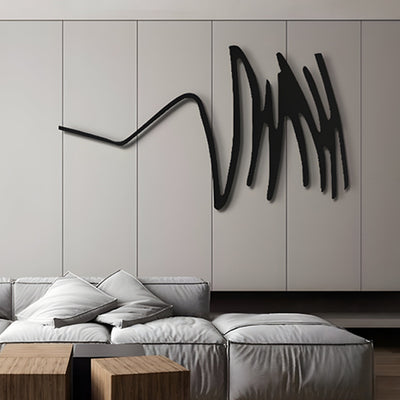
In all three, brushed or patinated metal wins. It reflects diffusely, carries surface texture that reads in flat light, and shrugs off contact. Our metal wall art pieces suit exactly these positions, and the surface stays legible when acrylic would have gone blank.

Pre-Purchase Checklist
Run through this before you order.
Confirm the edge finish is polished, and ask which method.
Measure the wall and mark the panel outline in tape at full size before ordering.
Identify two artificial light positions, offset from the wall, not square to it.
Stand at the main viewing point and note every reflective object behind you.
Check wall construction and flatness, and confirm the fixing type.
Decide the backing color before the piece arrives, not after.
Agree the cleaning routine: soft microfiber, plenty of clean water, no ammonia glass cleaner, no dry wiping. Conservation bodies such as the American Institute for Conservation publish sound general collections-care guidance worth reading.
Commissioning Large Acrylic Wall Art at Scale
Bespoke gets interesting once a wall exceeds standard sheet sizes. We routinely design multi-panel arrangements with a consistent reveal between sections, which handles both manufacturing limits and site access; a single 10 ft (3 m) panel rarely makes it up a residential stairwell, while three sections do. Color matching to a specific textile or paint reference is straightforward, as is adjusting rib depth to suit the viewing distance.
Cost depends on scale, sheet thickness, edge treatment, the complexity of any three-dimensional build-up, structural fixing design and installation access, so we quote each commission individually rather than working from a list. Send us the wall dimensions, a photograph taken from the main sightline, and the time of day the room matters most. That last detail shapes the design more than most people expect. Start with the 3D wall art range if you want depth and shadow, or the wider wall art collection if you are still comparing materials.
For wider placement ideas, Black Metal Wall Art Lives or Dies on the Wall Behind It is useful companion reading before finalising the setting and sightlines.