






































































































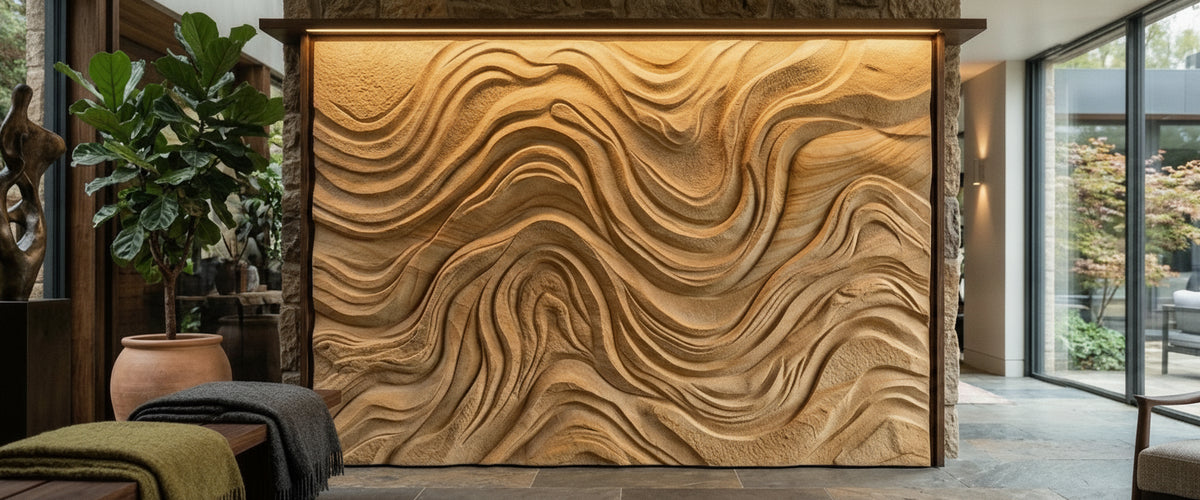

Most LED sandstone wall art looks right in a product photo and wrong on the wall at 10 p.m. The cause is nearly always the same: the stone was chosen first and the lighting was added afterward. Sandstone is porous and granular, with real depth of color, and LEDs will either reveal that or flatten it. At Giant Sculptures we treat the light as part of the carving, so the questions below come up on every illuminated commission we quote.

At a Glance
Grazing light suits deep relief. Halo backlighting suits thin, pierced or shallow panels.
Relief deeper than about 1.5 inches (40 mm) usually wants light from the side, not from behind.
Warm white between 2700K and 3000K, with a CRI of 90 or higher, keeps natural sandstone honest.
Pixel panels and sculpted 3D panels need different LED spacing.
Fix the driver location and the access panel before the wall is closed up.
Backlit, Edge-Lit or Grazed: Three Ways to Light LED Sandstone Wall Art
Sandstone is not translucent at the thickness needed for carving, so a "backlit" piece works in one of two ways. Either the panel sits on a stand-off with LEDs hidden behind it, throwing a halo onto the wall, or light passes through carved openings and perforations. Both are graphic. They can be very good, but they light the wall around the stone more than the stone itself.
Edge-lighting runs a concealed strip along the top or bottom of the panel, washing light down or up across the face. It is tidy and works well in narrow corridors. Grazing sets fixtures a few inches from the wall so the light rakes across the surface, and every tool mark throws its own small shadow. In our view grazing is the method that does LED sandstone wall art the most justice, because the stone's texture is the whole point of buying it.
Grazing light rakes across deep relief so every tool mark casts its own shadow.
Relief Depth Decides Whether the LED Reads as Glow or Glare
Shallow relief, under roughly 3/4 inch (20 mm), barely changes under grazed light. It can look like a printed photo of stone. Those panels benefit from a halo, which gives them presence without asking the carving to do work it cannot do.
Deep relief behaves the other way. Graze it and the forms come alive. Put strips behind it and the bright halo competes with the carving, leaving the sculpted face dark and reducing it to a silhouette. Before crating, we light every piece of LED sandstone wall art in a darkened bay at the studio, and the most common fault we catch on halo-lit panels is a strip mounted too close to the wall. It shows as a row of bright dots. Increasing the stand-off to around 2 inches (50 mm) and fitting an opal diffuser usually turns those dots into an even wash.

Warm White Flatters Sandstone Grain; Cool White Turns It to Concrete
Sandstone carries ochre, honey, buff and rose tones that only show under warm light. At 2700K to 3000K those colors read as stone. Push past 4000K and the surface drifts toward gray, and by 5000K a fine quarried panel can pass for cast concrete. Color rendering matters as much as temperature, so ask for CRI 90 or higher. A cheap strip with poor rendering can make the same stone look muddy.
Specify dimmable drivers from the start. A hotel bar wants the wall bright at 6 p.m. and low by midnight, and a retrofit dimmer on a non-dimmable driver tends to flicker.
Why Pixel and 3D Sandstone Panels Need Different LED Layouts
Sandstone pixel art is built from a grid of small square tiles set at varying depths, a little like a low-resolution image pressed into stone. It needs a very even wash, because any patch that is brighter than its neighbors reads as a mistake in the picture. Tight LED spacing, continuous strips and good diffusion are non-negotiable.
3D sandstone wall art, with sculpted and organic forms, wants the opposite: directional light from one dominant side so the forms model themselves. Lighting from several directions cancels the shadows and flattens the piece. Where a wall cannot take the weight of carved stone but the room still calls for that ridged, earth-toned texture, a lighter textured relief such as Tectra Drift Earth Textured Oil Painting 3D Wall Art answers a single side light in much the same way. If stone is the brief, our sandstone art collection is worth reviewing with that raking effect in mind.
Driver Heat and Missing Access Panels: What Dims the Glow by Year Three
LEDs last a long time, but only when heat can escape. The US Department of Energy points out that LED performance depends on heat management. A driver sealed into a plastered cavity behind heavy stone runs hot, and the light output drops early. Mount strips in aluminum channel, keep drivers remote where you can, and put them somewhere ventilated.
The hardest lesson we have learned concerns access rather than heat. Sandstone is heavy, and lifting a large panel off its fixings to reach a failed driver means scaffolding, two installers and a closed room. With LED sandstone wall art, we now ask for a driver location and a service hatch on the drawings before carving starts.

Hotel Bars, Spa Walls and Garden Walls: Where the Glow Earns Its Place After Dark
For wider placement ideas, Why Wood Sculpture Wall Art Lives or Dies by Its Shadow is useful companion reading before finalising the setting and sightlines.
Back-bar walls are the natural home for LED sandstone wall art: warm grazed stone behind glassware reads as both expensive and calm. Spa walls work beautifully too, though humidity means IP65-rated fittings and a sealed stone surface. Garden walls in Napa or the Hamptons call for low-voltage outdoor systems, a breathable sealer and stone chosen for freeze-thaw resistance.
Warm 2700K light behind a back bar keeps the stone's honey and ochre tones intact.
Long hotel lobbies are where sandstone weight starts to set the limits. Across a span of 20 feet or more, engineered metal such as the Silver Sculptural Metal Wall Panel - 710cm carries the same raked-light drama without the structural load a run of stone would demand. If colored light is the brief, our LED and neon art range is a better starting point than stone.
Buyer Checklist Before You Commission
Wall construction: confirm the load capacity before choosing panel thickness.
Lighting method: match halo, edge or grazing to the relief depth.
Color: 2700K to 3000K, CRI 90 or higher, dimmable.
Access: a remote, ventilated driver and a service hatch on the drawings.
Environment: IP rating and sealer suited to humidity or outdoor exposure.
Care: plan dry cleaning first. The National Park Service's masonry cleaning brief recommends the gentlest method that works.
Budget depends on stone type, scale, carving complexity, engineering, lighting specification, installation and finishing, so the most reliable figure is a tailored quote. Send us the wall dimensions and a photo of the space, and we will propose a lighting method alongside the carving. Our wider wall art collection is also a useful place to compare materials and scale.