






































































































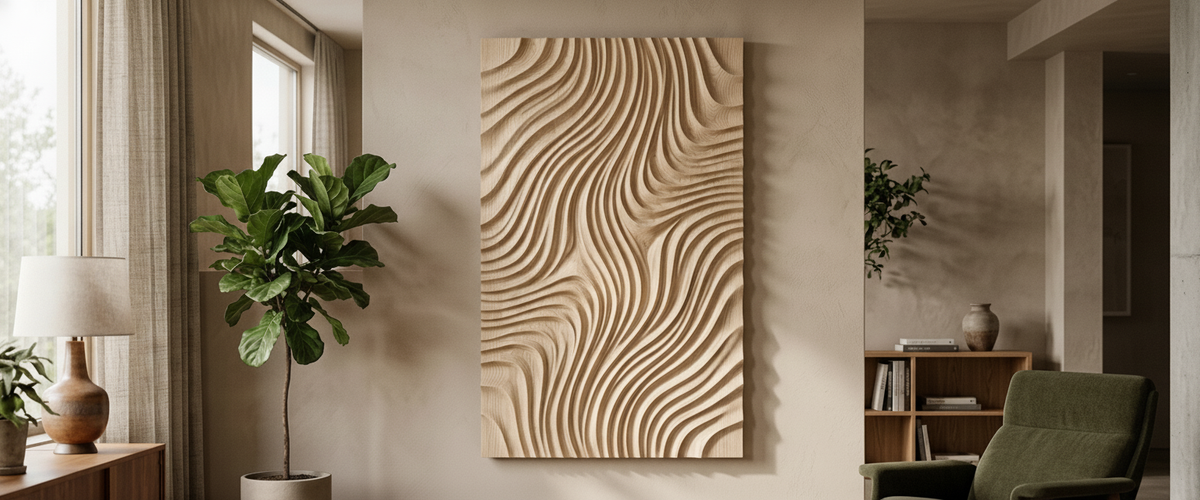

Most wooden wall pieces lose their argument at the doorway. From ten feet (3 m) away, a printed or lightly etched pattern flattens into something close to wallpaper, while a properly carved panel still throws shadow and reads as an object. That gap is the whole case for wood sculpture wall art. It decides whether the long blank wall in a Dallas living room or a Napa tasting room gets a real focal point or one more decoration. Below is how we judge depth, light, species and mounting before anyone in the studio picks up a gouge.

At a Glance
Carving beats surface pattern: real relief reads from across the room, while applied pattern needs you standing close.
Side light is the real frame: a window at 90 degrees to the wall does more than any picture light.
Match depth to timber tone: pale ash shows shadow on shallow cuts, while dark walnut needs deeper carving.
Quiet grain for clean rooms: ash and maple let the carving lead.
Stand it off the wall: a concealed cleat adds a second shadow line around the edge.
Test before carving: a sample under your own window settles most debates.
Carved Relief or Applied Pattern: The Doorway Test
Applied pattern covers anything where the design sits on the surface: paint, stain, pyrography, or a shallow machine skim. It looks rich at arm's length and goes flat the moment you step back. Carved relief, the defining trait of true wood sculpture wall art, changes the plane of the wood, so each ridge catches light on one face and falls into shadow on the other. That light and dark pairing is what the eye registers from the doorway.
Where a room is lit from one side only, a multi-panel carving such as Harmonic Forms tends to hold together better than a single decorated panel, because its rhythm lives in cut depth repeated across separate sections rather than in surface color. Color has its place too, but be honest about which job you are buying for: pattern for close viewing, relief for distance.

Raking Light Beats Any Picture Light
Picture lights were designed for flat canvases. Mounted above a carved panel, they light every ridge from the front and quietly erase the relief. Raking light, which skims across a surface at a low angle, does the opposite and lengthens every shadow. It is the same technique conservators use to read tool marks on old panels.
Before choosing a wall, stand in the room late in the afternoon and watch. A wall running perpendicular to a side window is usually the best home for wood sculpture wall art. A carved panel hung directly opposite a bank of west-facing glass gets flat, frontal light; move it to the return wall beside those windows and by late afternoon the same carving reads noticeably deeper. No side window? An adjustable spot or wall washer set well off to one side gets you most of the way.
Raking light from a side window lengthens every shadow in carved relief.
The color of the light matters as much as its angle once a finish is involved. A warm, sandstone-toned carving such as Arcuza Terracotta III reads very differently under cool northern light than under a California sunset, so judge tinted pieces at the hour you actually use the room.
Shallow, Medium, Deep: How Ash, Oak and Walnut Hold a Shadow
Shadow is contrast, and contrast depends on the tone of the timber. As a working rule in our studio:
Ash, shallow relief (about 1/4 to 1/2 inch, 6 to 13 mm): the pale surface shows a crisp shadow line even on gentle cuts.
Oak, medium relief (about 1/2 to 1 inch, 13 to 25 mm): the mid tone and open grain need a little more depth before the carving separates from the figure of the wood.
Walnut, deep relief (1 inch, 25 mm, or more): dark wood swallows much of its own shadow, so it needs deeper cuts and sharper undercuts to read.
Depth also brings movement. Timber swells and shrinks across the grain as humidity changes, as the USDA Forest Products Laboratory Wood Handbook sets out in detail. Thick, deeply carved stock means more mass on the move, which is why we build larger panels from glued sections with grain direction planned in advance. For pool houses, damp bathrooms or exterior walls, our metal wall art is the better call.

Loud Grain Fights Clean Lines
Heavily figured walnut and cathedral-grain oak look superb on a dining table. On wood sculpture wall art they compete with the carving, because the eye cannot decide whether to follow the grain or the form. Maple has a tight, even grain and ash a straight, regular one; both step back and let the relief do the talking. In a pared-back Manhattan loft with plaster walls and steel windows, a pale ash panel looks deliberate, while a wildly figured one looks borrowed from another house. If you want texture without grain noise, a painted finish over carving does the quieting for you; in very spare interiors, a hand-painted relief such as Elorium White Weave is closer to the right design language than any figured timber.
The Hidden Cleat That Doubles the Shadow
Flush-mounting wood sculpture wall art wastes half its shadow. Set on a concealed French cleat (two interlocking beveled battens), the panel floats roughly 3/4 to 1 1/2 inches (2 to 4 cm) off the wall, and its outer edge casts a second shadow line around the whole piece. The gap also lets air move behind the timber so both faces settle at the same moisture level. For heavier commissions we specify fixings to suit the wall itself, because drywall over studs, masonry and old lath and plaster each behave differently.
A concealed cleat floats the panel and adds a second shadow line around its edge.
Choosing Wood Sculpture Wall Art: A Buyer's Checklist
Doorway test: does the design rely on carved depth or surface decoration?
Light direction: is there a side window or can you add off-axis lighting?
Species and depth: does the relief depth suit the tone of the timber?
Grain and room: will the grain sit quietly against your architecture?
Mounting: is a floating cleat planned, and does the installer know your wall type?
Environment: keep it away from radiators and HVAC vents, which can dry and crack the timber, and from constant direct sun, which shifts tone over time.
Budget: it depends on species, scale, carving depth, panel count, finishing and installation, so ask for a tailored quote rather than guessing.

Test a Timber Sample Under Your Own Window
Every bespoke piece of wooden wall sculpture art we take on can start with a sample: a small block carved at the proposed depth in the proposed species, sent to the client's home. Tape it to the wall for a week and check it morning, noon and evening. An oak sample that looks right at noon can turn muddy after dusk, and switching to ash at the same depth is often all it takes to fix it. Changing timber costs almost nothing before carving and a great deal after.
Samples are just as useful for mixed finishes, where a tonal or painted treatment can shift with the color of your light as much as its angle. Explore our wood wall art collection to narrow the direction, then talk to Giant Sculptures about scale, species and mounting for a commission built around your wall and your light.
For wider placement ideas, Wood Wall Art for the Bedroom Is Judged From the Pillow is useful companion reading before finalising the setting and sightlines.