





































































































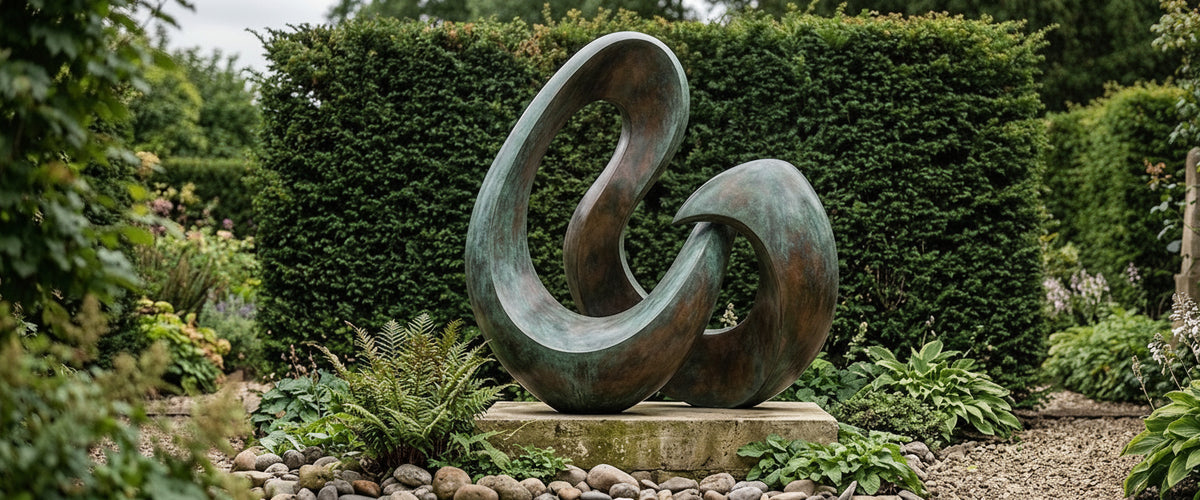

A great abstract form can still land badly. We have watched it happen: a beautifully cast bronze arrives on a client's terrace, gets set down where the delivery crew found level ground, and reads as furniture rather than art. The sculpture was right. The placement was wrong. With large outdoor abstract sculptures, where you put the piece, how high you lift it, and what sits behind it will do as much work as the design itself.
Looking for the full range in this category? Browse our Large Garden Statues collection for every available finish, size, and configuration.
That is the part buyers underestimate. Large outdoor abstract sculptures have no obvious front, no face telling you where to stand, so the setting has to build the story. Get sightlines, scale, and backdrop working together and even a quiet piece holds a garden. Get them wrong and a monumental bronze can look stranded.

Key Takeaways for Placing Large Abstract Sculpture
- Scale is relative. A 6 ft (1.8 m) piece reads large in a courtyard and small on an open lawn. Judge it against sightline distance, not a tape measure.
- Pedestal height changes everything. Lifting a piece even 12 to 18 in (30 to 45 cm) can turn a lump on the ground into a landmark.
- Backdrop is half the design. A polished form needs contrast behind it; a matte one needs light in front.
- Indoor and outdoor placement follow different rules. One rewards intimacy, the other rewards distance.
- Most mistakes are avoidable with a site plan before you commission, not after.

What Large Outdoor Abstract Sculptures Actually Look Like in Different Settings
The same large abstract sculpture behaves differently depending on the space around it. Drop a flowing bronze form into a tight courtyard and it becomes the room's anchor, something you circle and read from a few feet away. Set that identical piece on a broad open lawn and it needs to hold attention across 60 or 80 ft (18 to 24 m) of grass, which asks for either more height, a stronger silhouette, or a backdrop that frames it. This is why large outdoor abstract sculptures never behave the same way twice.
Indoors, scale compresses. A double-height entrance hall can carry a tall vertical abstract that would overwhelm a standard living room. For a room that can swing either way, a mid-scale form such as the Large Modern Abstract Bronze Sculpture, 120cm works as a floor piece in a generous space or on a plinth in a smaller one, because it reads at eye level either way. The trick is matching the vertical mass of the sculpture to the vertical volume of the space.
Abstract pod and cluster forms behave differently again. A grouped composition such as the Large Contemporary Abstract Raindrop Cluster Sculpture, 250cm reads best where people can move around and between the elements. These abstract large pod sculptures reward gardens with a walking route; put one against a wall and you lose half the composition.

Scale, Sightlines and Pedestal Height
Here is a rule we repeat to nearly every client buying large outdoor abstract sculptures: measure the viewing distance before you fix the size. The eye reads a sculpture in proportion to how far away you stand. A piece that feels commanding at 15 ft (4.5 m) can look modest at 50 ft (15 m). If your main sightline is from a kitchen window across a long garden, size up or bring the piece closer.
Pedestal height is the lever most people forget. Lifting an abstract form onto a plinth does three things: it separates the piece from the ground plane, it raises key curves toward eye level, and it signals intent. Something compact like the Large Modern Abstract Bronze Sculpture, 94cm can look almost incidental sitting directly on gravel, but set on a 2 ft (60 cm) stone plinth it becomes a deliberate focal point at the end of a path.
There is a limit. Lift a reclining or horizontal form too high and you lose the pose; a piece like the Large Contemporary Abstract Reclining Figure Bronze Sculpture, 120cm wants a low base so you read the sweep of it from above and to the side. Vertical pieces climb; horizontal pieces spread. Match the plinth to the axis of the sculpture, and you get more from your large outdoor abstract sculptures without touching the design.
A quick sightline checklist
- Identify the two or three points people will most often view the piece from (patio door, driveway approach, seating area).
- Pace out the distance from each and note the height of the eyeline.
- Decide whether the piece is a distant landmark or a close encounter; they need different sizes.
- Test pedestal height with stacked boxes or crates on site before committing.
- Check the view at the times of day you actually use the space.

Indoor Versus Outdoor Placement: When Each Wins
For wider placement ideas, Large Buddha Garden Statues: How Scale and Placement Decide the Whole Effect is useful companion reading before finalizing the setting and sightlines.
Outdoor placement gives you distance, weather, and changing light, which suit large abstract metal sculpture and large abstract garden sculptures with strong silhouettes. Bronze and stainless steel are built for it. Bronze develops a patina over years of exposure, a controlled surface layer that protects the metal beneath, which is why it has been an outdoor sculpture material of choice for centuries (the history of bronze patination is well documented). Stainless steel and Corten give you a more contemporary register, mirror-bright or warm rust respectively, and both work hard as large outdoor abstract sculptures.
Indoor placement wins when you want the piece read up close, protected from frost cycles, and lit deliberately. Where the setting rewards intimacy, a surface-driven form like the Large Contemporary Abstract Female Torso Bronze Sculpture, 140cm lets you catch the modeling and tool marks that distance would flatten. Some buyers ask about large abstract wood sculpture for interiors too; carved timber brings warmth indoors but needs shelter, since untreated wood outdoors moves and checks with humidity.
If a piece will straddle both worlds over its life, tell us at the commission stage. Material choice, fixing, and finishing all change depending on whether large outdoor abstract sculptures live out in a hard winter or in a climate-controlled hall.

Light, Backdrop and Contrast
Light decides how large outdoor abstract sculptures read more than almost anything else. A polished or mirror-finished surface needs contrast behind it; against a pale wall it disappears, against dark planting or a clipped hedge it snaps into focus. A matte or patinated surface needs light landing on it, ideally raking across the form early or late in the day to pull out the curves.
Think about the backdrop as part of the sculpture. A tall vertical piece such as the Large Contemporary Abstract Female Figure Bronze Sculpture, 180cm looks entirely different against open sky, against a wall, or against a mass of green. Sky gives you silhouette. A wall gives you shadow play. Planting gives you seasonal change. None is wrong; each is a decision.
For evening use, plan the lighting before you plant the sculpture. Uplighting from two angles avoids a flat, security-light look and lets a reflective piece throw its surroundings back at you. We often ask clients about their night-time use of a space, because well-lit large abstract garden sculptures become a completely different presence after dark.

Common Placement Mistakes We See in Commissions
The recurring errors with large outdoor abstract sculptures are predictable, which is good news, because they are all fixable before delivery.
- Choosing size from a screen. A piece that looks huge on a product page can vanish in a real garden. Always test footprint and height on site with a mock-up.
- Centering by habit. Dead-center placement can feel static. Off-axis positioning, read on the diagonal, usually gives an abstract form more energy.
- Ignoring the approach. People arrive from a direction. A piece designed to be seen from the terrace often gets first viewed from the driveway, where it looks its worst.
- Skipping the plinth conversation. Buyers order the sculpture and treat the base as an afterthought, then wonder why it sits low.
- Forgetting maintenance access. A dramatic spot surrounded by dense planting is hard to reach for the annual wax or wash a bronze needs.
One commission still sticks with us: a client had picked a spot against a white rendered wall for a mirror-polished stainless piece. On paper it looked clean. In reality the sculpture and the wall canceled each other out. We moved it 20 ft (6 m) to sit against a dark yew hedge and it read as a completely different object: sharper, deeper, alive. Nothing about the sculpture changed. Only the backdrop.

Bringing It Together Before You Commission
Large outdoor abstract sculptures reward planning. Before you commit, walk the site at different times of day, mark your main sightlines, mock up the height, and think hard about what sits behind the piece. If you are commissioning bespoke large outdoor abstract sculptures, share those details with us early. As a studio that builds large-scale and bespoke work in bronze, stainless steel, and Corten, we would rather solve placement on paper than watch a finished piece land in the wrong spot. You can browse the full sculptures and statues collection to see the range of forms and scales, then talk to us about tailoring one to your space.