


























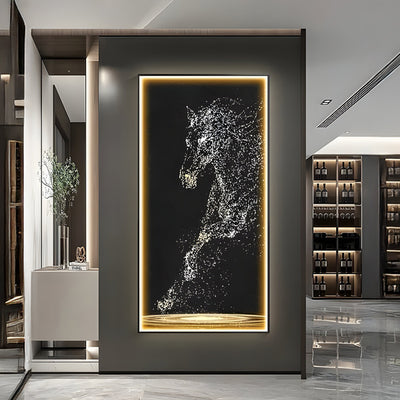
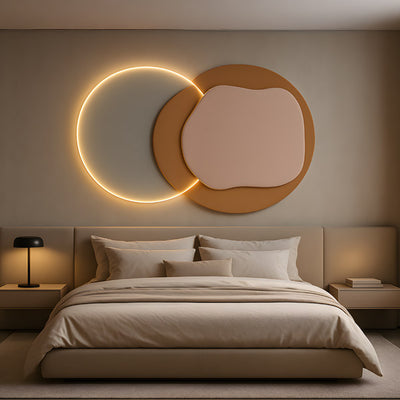
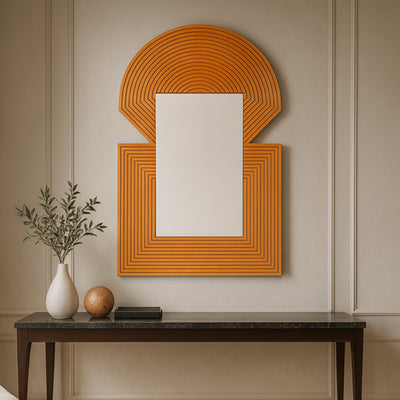
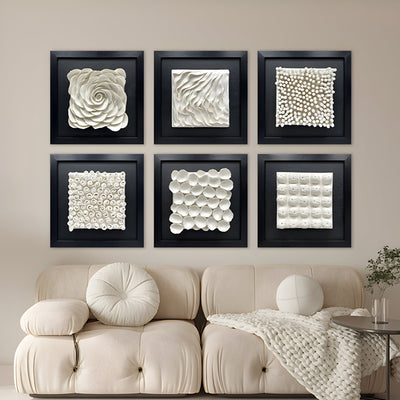
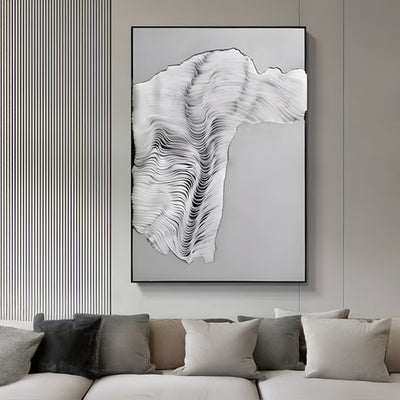
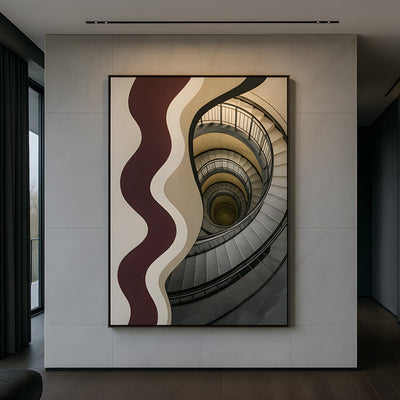
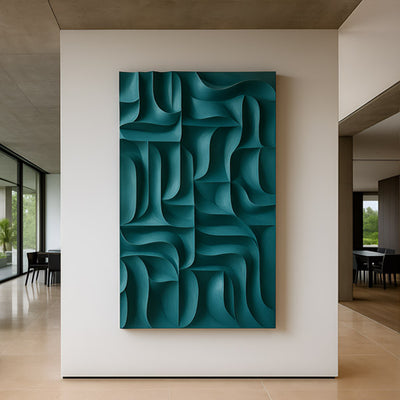
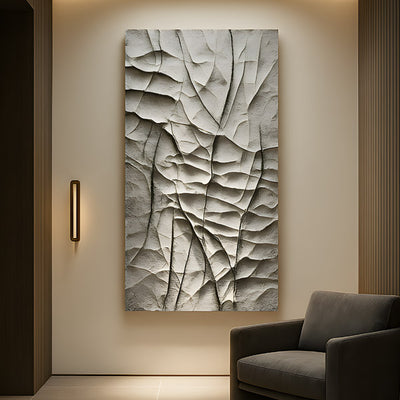










Nine times out of ten, when a client sends us a photo asking why their large metal wall art looks wrong, the piece is fine. The height is not. It has been hung to a builder's eye rather than a viewer's, floating six inches too high above a sofa or a mantel, disconnected from everything around it. Metal is unforgiving that way. A bronze relief or a wide steel panel carries real visual weight, and weight wants to sit low and settled, not hover near the crown molding.
Placement is the whole game. Get the sightline, the backdrop and the light right and a single panel of large metal wall art can carry a double-height entry hall. Get them wrong and you have an expensive object nobody looks at.

Key Takeaways
Center most large metal wall art around 57 to 60 inches (145 to 152 cm) from the floor, then adjust down when the piece sits above furniture.
Fill roughly two thirds to three quarters of the usable wall width above a console, sofa or fireplace. Undersizing is the most common buyer mistake.
Bronze reliefs read best against warm plaster, stone and wood. Polished or brushed steel needs a matte, darker backdrop to stop it disappearing.
Outdoors, material choice drives everything: stainless grade, bronze patina and Corten runoff all behave differently on a wall.
Weight and fixings should be confirmed before you buy, not after the crate arrives.
What Large Metal Wall Art Actually Looks Like in Different Settings
The category covers far more than flat decorative panels. Large metal wall art and decor spans cast bronze reliefs, layered steel abstracts, forged ironwork, sculptural half-figures that project several inches off the plane, and modular multi-panel arrangements that can be spread or tightened to suit a wall.
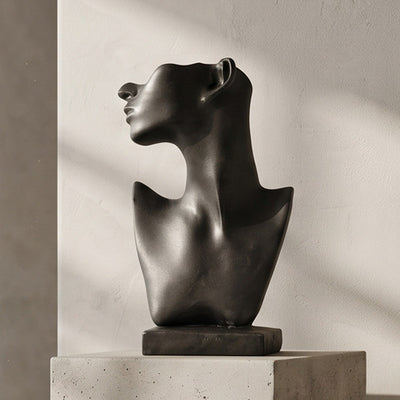
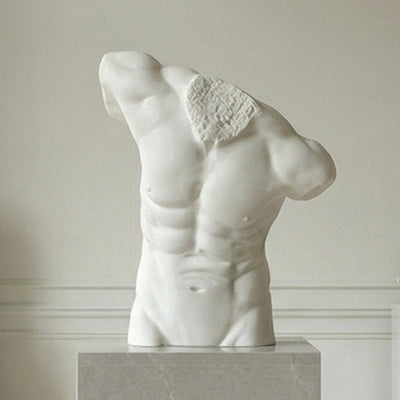
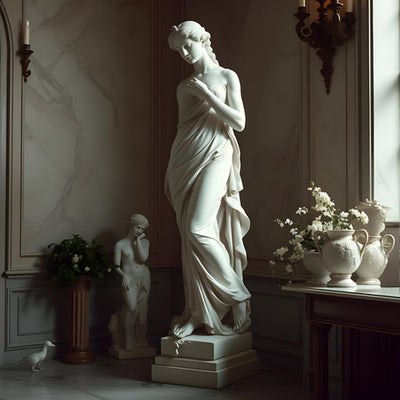
In a Texas ranch-style entry hall with 20-foot ceilings, a single flat panel usually loses. Depth wins. A projecting figural piece such as the Classical Figural Torso Wall Sconce Bronze Sculpture - 90cm, at roughly 35 inches (90 cm), throws shadow across the plaster and reads as sculpture rather than surface decoration. In a tighter Manhattan apartment the opposite logic applies: low-relief work projecting only two or three inches keeps circulation clear while still holding the wall.
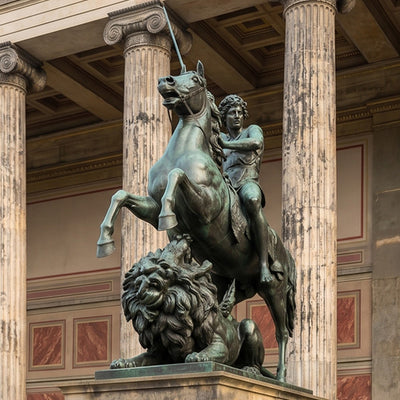
Outdoors, large metal wall art changes vocabulary again. Garden walls, pool house facades and courtyard elevations suit heavier, weather-driven pieces where the surface is meant to change. A Napa client mounted a run of bronze equestrian reliefs along a stone barn wall facing the vineyard rows; five years on, the patina has gone from chocolate to a softer green-brown that reads better against the limestone than it did on day one. That is the argument for real metal over printed panels. It ages into the setting instead of fading out of it.
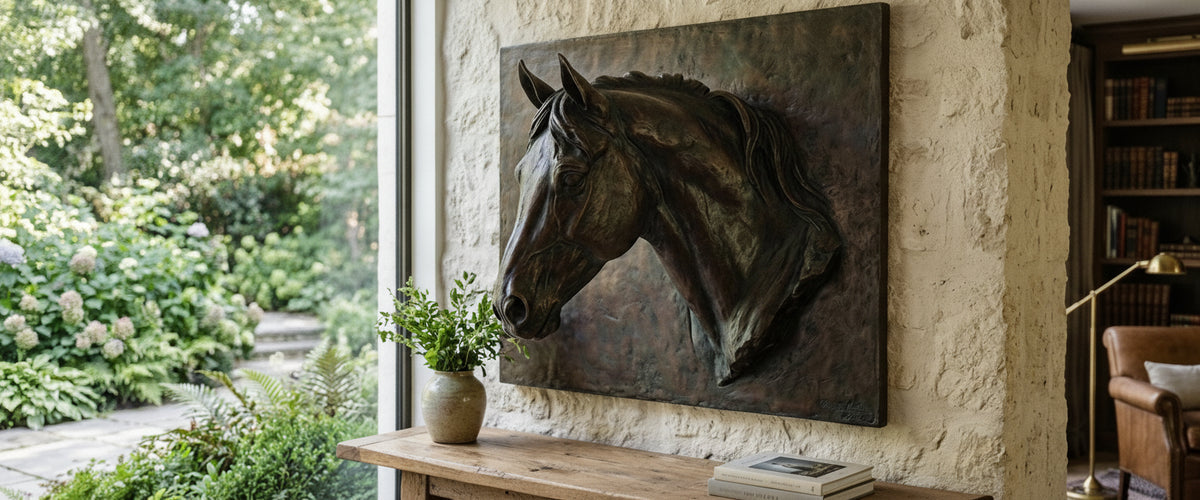
A projecting bronze relief casts shadow across plaster, which is what a tall wall asks for.

Scale, Sightlines and Pedestal Height
Start with the wall, not the piece. Measure the usable field: the area left after you subtract furniture, switch plates, vents and any trim you cannot cover. Large metal wall art should occupy roughly two thirds to three quarters of that field. Anything smaller starts to look like a sample.
For the vertical, gallery standard puts the visual center at about 57 to 60 inches (145 to 152 cm) off the floor. Over a sofa or console, drop it: leave a gap of 6 to 10 inches (15 to 25 cm) between furniture top and bottom edge so the two elements read as one composition. Above a fireplace, the mantel becomes the baseline and the same gap rule applies. In stairwells, forget the floor entirely and set the center to the eye level of someone halfway up the flight.
Pedestal height matters when a wall piece shares a room with freestanding sculpture. If a plinth top sits at 42 inches (107 cm) and the wall work centers at 58 inches (147 cm), the two objects sit in different registers and compete. We usually stagger them deliberately: pull the wall piece higher and shift it laterally so the plinth sculpture reads in front of clear wall, not against a busy relief. In a double-height space, that pairing is also how you occupy the vertical without hanging one enormous object at an unreachable height.

Indoors or Outdoors: Where Large Metal Wall Art Wins
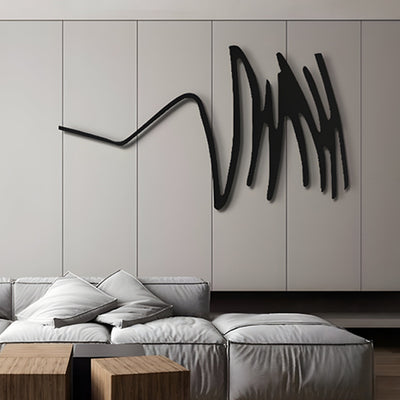
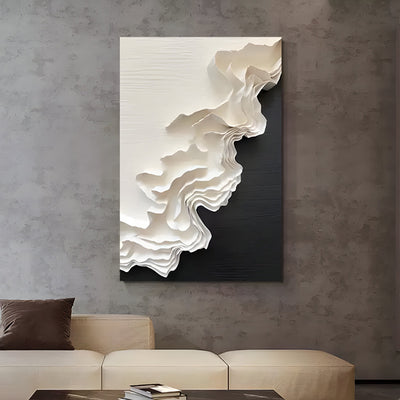
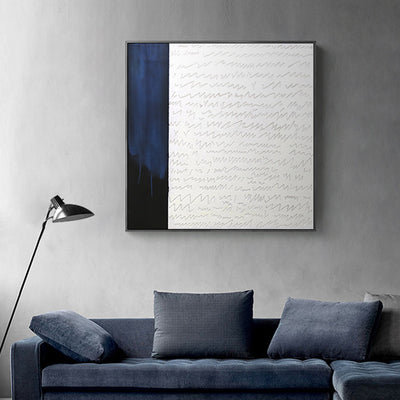
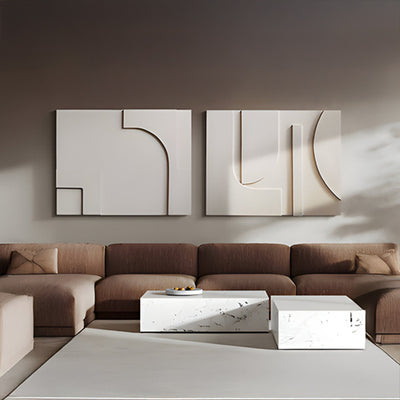
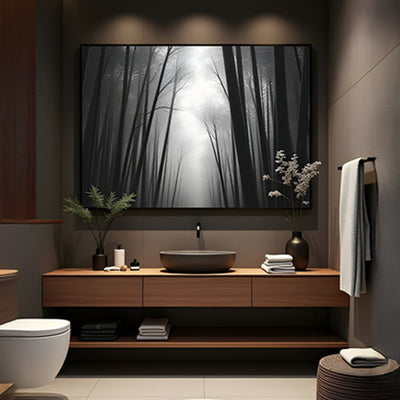
Indoors you control the variables. Light is stable, humidity is stable, and finishes such as polished stainless, blackened steel and waxed bronze hold their appearance with very little intervention. That makes interiors the right home for high-contrast finishes and detailed low relief where a fine surface is the point. Where a room wants a contemporary graphic surface rather than classical weight, a dual-panel composition like Vistarte Monochrome Abstract is closer to the right design language for a dining room or hotel corridor, and it rewards lighting that can be aimed precisely.
Outdoors, the material has to do the surviving. Marine air, freeze-thaw cycles and irrigation overspray all attack fixings before they attack the sculpture. Within a mile or so of the ocean, the grade of stainless steel matters more than the finish; the Nickel Institute's guidance on stainless steel selection is worth reading before you specify anything for a Hamptons or Malibu wall, since 316 behaves very differently to 304 in chloride-heavy air. Bronze is the easier outdoor answer for figurative work, and Corten develops a stable oxide layer but will stain porous stone and light stucco beneath it, so plan for runoff or set the piece proud of the wall on standoffs.
One more outdoor consideration: wind. Large metal wall art with open geometry or projecting elements catches load. Our engineered mounting details for exterior commissions account for that, but a piece designed for a sheltered gallery wall should not be repurposed onto an exposed elevation without review.
Light, Backdrop and Contrast
Metal is a reflector, so the backdrop decides how much of the form you actually see. Three rules we apply to every large metal wall art installation we ship:
Polished and mirror finishes need a matte, mid-to-dark backdrop. Against white gloss they bleach out and the silhouette vanishes. Against charcoal plaster, gray limestone or dark stained oak, the reflections resolve into shape.
Bronze reliefs want warmth behind them. Lime plaster, travertine, warm gray paint and reclaimed timber all sit well. Cool blue-gray walls fight the alloy's undertone.
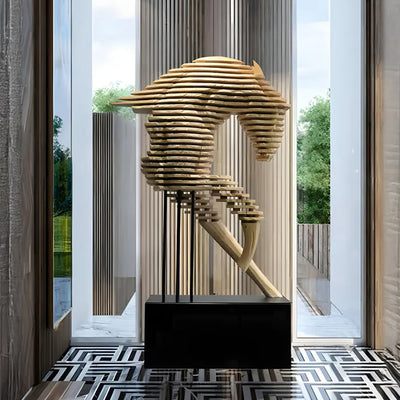
Grazing light beats flat light. Position a fixture 12 to 18 inches (30 to 45 cm) out from the wall and rake the beam down across the surface. Relief work lives on shadow, and front-on lighting flattens it. A cast piece such as the Traditional Horse Head Bronze Relief - 80cm, at around 31 inches (80 cm), gains most of its drama from the shadow line under the jaw and mane, which a badly aimed downlight will erase.
Grazing light from 12 to 18 inches off the wall keeps relief depth visible instead of flattening it.
Tate's definition of relief sculpture is a useful reminder of why this matters: the form is carved or cast from a background plane, and the depth of projection is exactly what your lighting either reveals or destroys.

Placement Mistakes We See in Commissions
For wider placement ideas, Large Abstract Garden Sculptures: A Buyer's Guide to Scale, Metal, and Placement is useful companion reading before finalising the setting and sightlines.
The same errors recur across large metal wall art commissions, whatever the budget.
Buying to the room's budget, not the wall's dimensions. Two modest panels do not solve a 16-foot wall. One large piece, or a properly composed group, does.
Centering on the wall instead of the furniture. If the sofa is off-center because of a doorway, the art centers on the sofa. Every time.
Ignoring viewing distance. Fine surface detail is wasted across a 30-foot great room. At long range, choose bold silhouette and strong contrast; save intricate casting for corridors and intimate spaces.
Forgetting the substrate. Drywall with no blocking, hollow brick, rendered block and timber cladding all need different anchors. We ask for a wall build-up description on every commission, and it has saved more than one client an emergency call to a structural contractor.
Hanging a paired piece symmetrically when the room is not symmetrical. A single strong object, sized generously and hung off-center to suit the furniture, often beats a forced pair on an awkward wall.
Skipping the mock-up. Cut the outline from kraft paper, tape it up, live with it for two days. It costs nothing and it settles arguments.
A Buyer's Checklist Before You Commit
Before you commit to a large metal wall art piece, work through the list below.
Usable wall width and height measured, with furniture and trim subtracted.
Target center height agreed, adjusted for seated versus standing sightlines.
Wall construction confirmed: stud spacing, masonry type, render thickness, cavity.
Total weight and mounting method specified (French cleat, standoffs, through-bolts) before order.
Backdrop color and sheen checked against the intended finish.
Lighting position planned, including whether a new fixture or track is needed.
For exterior sites: distance from salt air, prevailing wind, runoff path, irrigation spray line.
Access route for delivery measured, including doorways, stair turns and crate size.
Long-term care agreed: waxing schedule for bronze, cleaning routine for stainless, expected patina change.
Commissioning Large Metal Wall Art
Most large metal wall art commissions that reach our studio start with a wall that nothing off the shelf fits: a curved stairwell, a 24-foot hotel lobby elevation, a garden wall that needs a piece to sit within a specific run of masonry. Bespoke work solves the fit problem and the composition problem at once, because the artwork is drawn to the sightlines rather than squeezed into them.
The sequence is straightforward. We take dimensions and photographs, agree material and finish, produce concept drawings, then move to maquette or scaled sample before casting or fabrication begins. Foundry-cast bronze, fabricated stainless steel and forged iron each carry different lead times and engineering requirements, and larger pieces may need a mounting frame designed alongside the sculpture. Cost depends on material, scale, relief depth, finishing and installation complexity, so the sensible step is a tailored quote rather than a guess from a catalog page.
If you are still shaping the brief, browsing helps. The metal wall art collection shows the range of scale and relief depth available, while the broader wall art and wall decor selection is useful for comparing materials side by side. For anything with a hand-forged, architectural character, the iron art and wrought iron wall decor range is the place to start. Giant Sculptures builds large-scale and bespoke work for private homes, hotels, wineries and commercial developments, and we would rather help you size a piece correctly at the enquiry stage than fix a hanging height after the crate has landed.