





































































































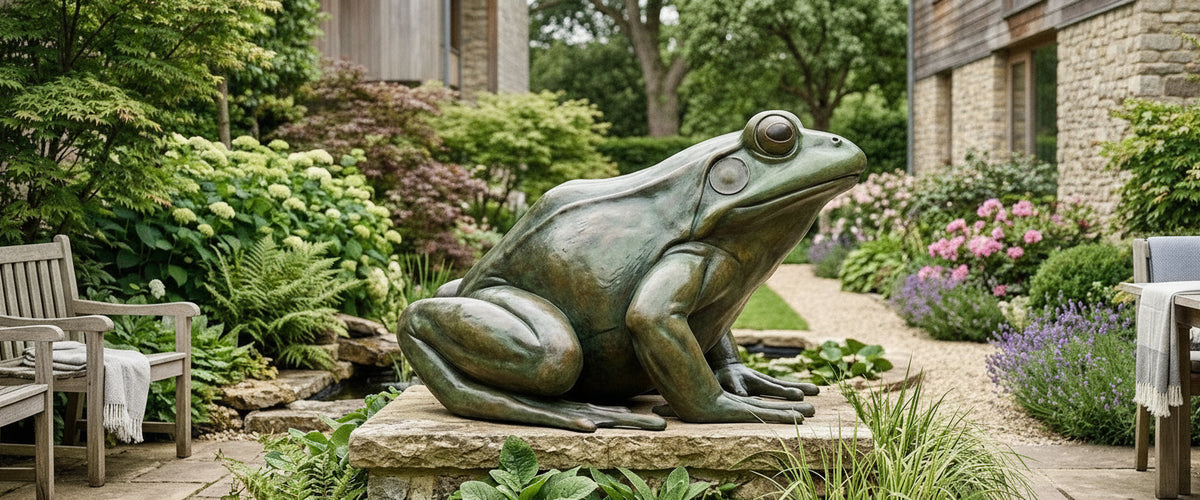

A three-foot bronze frog dropped into the wrong corner of a garden looks like a garden-center leftover. The same frog, sited on a low plinth at the end of a gravel path with a dark hedge behind it, stops people mid-sentence. That gap between forgettable and commanding almost never comes down to the sculpture itself. It comes down to how you place it. A large frog statue garden project lives or dies on scale, sightline, and the surface it sits against, and most buyers underestimate all three.
Looking for the full range in this category? Browse our Large Garden Statues collection for every available finish, size, and configuration.
A raised frog anchors the end of a sightline.
We ship animal sculpture to gardens across California, Texas, and the Hamptons, and the frog is one of the more requested subjects for a reason: it carries wit without tipping into kitsch, and at real scale it holds its own next to serious planting. But scale is exactly where people trip up on a large frog statue garden layout. Below is how to get it right.

Key Takeaways for a Large Frog Statue Garden
Buy for the sightline, not the shelf. A piece that looks big in a warehouse can disappear on an open lawn. Match the sculpture to viewing distance.
Pedestal height changes the entire read. Raising a frog even a foot shifts it from playful ground creature to considered focal point.
Bronze suits outdoor life. It weathers predictably and lasts for generations with light care.
Dark, plain backdrops do the heavy lifting. Contrast makes the silhouette read from across the garden.
Fountains need planning before they need plumbing. A frog fountain is a water feature first and a sculpture second.

What a Large Frog Statue Looks Like in Different Settings
Scale reads differently indoors and out, and a frog is a good test case because the form is low and wide rather than tall. Inside a double-height entry hall or a conservatory, a seated bronze frog around 150cm sits at a comfortable eye-drop height and becomes a talking point the moment someone walks in. For that role, a compact seated pose such as the Large Contemporary Seated Frog Bronze Sculpture - 150cm keeps the footprint tight while still commanding the corner. It is the kind of piece a large frog statue garden buyer often starts with before going bigger.
Outdoors, the same 150cm suddenly feels modest against mature planting and open sky. A frog that dominated a hallway can look like a garden ornament once you set it beside a row of established boxwood. This is the single most common surprise for first-time buyers of large statues for garden settings: outdoor space consumes mass in a way interior rooms never do.
For a large fountain court, a pool edge, or the turn of a long path, you often want to go bigger than instinct suggests. When you plan a large frog statue garden at that scale, a monumental piece past 220cm gives you presence at 40 or 50 feet (roughly 12 to 15 meters), which is the distance most people actually first see a garden sculpture from.

Scale, Sightlines and Pedestal Height
Stand at each viewing point before you fix on a size.
Before you choose a size for your large frog statue garden, stand where people will view the piece from. The front door. The kitchen window. The end of the terrace. Those are your sightlines, and they set the minimum scale. A rough working rule from our studio: for every 10 feet (about 3 meters) of viewing distance, you want noticeably more visual mass, and past 30 feet a sub-150cm piece starts to read as decoration rather than sculpture.
Pedestal height is the lever most people forget when they plan a frog statue for the garden. A frog set directly on the ground reads as naturalistic; it is a creature in the garden. Lift it 12 to 24 inches (30 to 60cm) on a stone or metal plinth and it becomes a deliberate focal point, framed and presented. Both are valid; they just say different things. Where a pose carries vertical interest, a piece like the Monumental Contemporary Flute-Playing Frog Bronze Sculpture - 180cm takes a plinth beautifully, while a low crouching frog often wants to stay grounded.
One caution on plinths: weight adds up fast. A large bronze can run several hundred pounds (well over 100kg), and mounting it higher raises the center of gravity. Plan the footing, drainage, and fixing before delivery day, not after.

Indoor Versus Outdoor Placement
For wider placement ideas, Large Buddha Garden Statues: How Scale and Placement Decide the Whole Effect is useful companion reading before finalizing the setting and sightlines.
Bronze is happy in both settings, which is part of why it remains our default for animal commissions. Outdoors, a bronze frog develops a patina over years of exposure; that surface change is normal and, handled well, is part of the appeal rather than a flaw. The American Institute for Conservation notes that protective wax layers and periodic maintenance are what keep outdoor bronze stable over decades, so factor light annual care into ownership of any large frog statue garden feature.
Indoors wins when you want the finish to stay exactly as delivered, or when the piece is a genuine centerpiece rather than a garden accent. A polished or lacquered bronze frog in an atrium keeps its sheen with almost no intervention. Outdoors wins when you want the sculpture to belong to a living setting: reflected in a pool, half-caught by evening light, surrounded by planting that changes through the seasons. Most frog commissions we ship are destined for a large frog statue garden setting, and the water-loving associations of the subject make that the more natural home.
Light, Backdrop and Contrast
A silhouette needs something to sit against. Set a dark bronze frog in front of dense yew, a weathered stone wall, or a shaded planting bed and the outline snaps into focus. Set the same amphibian against a busy mixed border or a pale gravel expanse and it dissolves into visual noise. Backdrop is doing more work than most buyers of a large frog statue garden credit.
Light matters just as much. Morning and late-afternoon light rakes across a textured bronze surface and picks out every ridge and fold; midday overhead sun flattens it. If the piece will be a headline feature, walk the space at different times of day before you commit to a spot. A single low uplight added later can transform how a frog reads after dusk, turning it into the anchor of an evening terrace.
Frog Fountains: A Different Set of Rules
A frog fountain is a water feature that happens to be sculptural, and it needs decisions made early. Water source, pump, reservoir, splash radius, and winter drainage all shape where the piece can go. For a formal setting that wants a proper basin and a considered plumbing run rather than a quick retrofit into an existing pond, the Large Classical Boy with Frogs Bronze Fountain - 180cm is the kind of piece that repays the planning. Where an open garden calls for more scale and reach, a monumental option such as the Monumental Contemporary Sitting Frog Bronze Fountain - 220cm holds presence across a larger court and turns a large frog statue garden into a proper water feature.
Sound is part of the design too. A tall spout reads as a fountain from a distance; a low trickle is intimate and close-range. Match the water sound to how people will use the space, and keep the pump accessible for maintenance. We would rather have a client tell us the intended spot before casting than solve a plumbing problem on a finished bronze.
Common Placement Mistakes We See
Buying too small for the space. The most frequent regret in a large frog statue garden. When in doubt outdoors, size up.
Centering the piece by default. Dead-center placement often kills tension. Offsetting a frog to the third of a path or terrace usually reads better.
Ignoring the backdrop. A brilliant sculpture against a cluttered background looks half-finished.
Skipping the footing. Heavy bronze on soft ground shifts and tilts. Plan a level, drained base.
Treating a fountain like a statue. Water changes everything, from siting to seasonal care.
Large Fairy Garden Statues and Mixed Whimsical Schemes
Frogs often sit within a broader whimsical scheme, and buyers searching for large fairy garden statues are usually after the same thing: character at scale, placed with intent rather than scattered. The rule holds across subjects. One well-placed, well-sized figure beats a crowd of small ones. If you are building a themed corner around a large frog statue garden, let the frog be the anchor and keep supporting pieces subordinate in scale, or the composition turns into a cluttered shelf.
Where to Buy Large Garden Statues, and How Commissioning Works
Giant Sculptures is a bespoke supplier of large-scale and monumental sculpture, and much of what we ship is either sized up from an existing form or made to a client's brief from scratch. If none of the catalog pieces hits the exact scale, pose, or patina you want for a large frog statue garden, we cast to commission. That is the honest answer to the question of where to buy large garden statues: buy from a maker who can match the piece to your sightlines rather than forcing your garden to fit a stock size.
As for making your own, full metal casting is a foundry process well beyond a home workshop; it involves modeling, mold-making, and molten bronze. Most people asking really want a form built to their taste, which is exactly what a commission delivers without the furnace. Tell us the setting, the viewing distances, and the mood, and we work back from there.
On budget: cost depends on material, scale, complexity of the pose, engineering for fountains, finishing, and installation, so we quote each large frog statue garden project individually rather than publish a figure that would mislead you. A crouching solid bronze and a monumental water feature are different undertakings entirely. Send us the site details and we will give you a tailored quote.