



































































































A blank wall of 12 feet (3.7 m) will swallow a small print without blinking. That is the trap most buyers fall into: they pick a piece they like at a gallery, hang it at home, and watch it float in the middle of the plaster like a stamp on an envelope. Large canvas wall art solves that problem, but only if you get the scale, placement and material right. Buy the wrong size and you will feel it every day.
We build large-scale work for a living, so we tend to look at walls the way a set designer looks at a stage. The question is never just do I like this image. It is: what does this wall need to feel finished, and does canvas do that job better than a metal relief, a carved panel, or a freestanding piece nearby?

Large Canvas Wall Art at a Glance
- Best for: tall stairwells, double-height living rooms, hospitality lobbies, long hallways that need a focal point.
- Typical size that reads as "large": roughly 4 feet (1.2 m) and up on the longest side; genuinely commanding walls often want 6 to 8 feet (1.8 to 2.4 m).
- Strengths: lightweight, easy to ship rolled or stretched, softens hard modern interiors, color does heavy lifting.
- Trade-offs: less physical presence than bronze or steel; sun and humidity are the enemies over decades.
- Consider instead: a bronze or metal wall relief when you want depth, texture and a piece that will outlive the building.

What Large Canvas Wall Art Means and Who It Is For
Large canvas wall art is printed or painted imagery stretched over a wooden frame (a stretcher bar), usually 4 feet (1.2 m) or larger, hung as a single panel or a coordinated set. The appeal is simple. Canvas gives you a lot of visual coverage for relatively little weight, which matters when you are dealing with drywall or a stairway wall that cannot take heavy fixings.
It suits buyers furnishing wide open-plan spaces: a Napa great room with white walls, a Texas ranch hallway, a New York apartment where the ceilings run high and the art needs to keep up. Designers reach for canvas when they want color and mood without committing to the permanence and weight of sculpture. If you want a piece that reads as an artwork from across the room and quietly recedes up close, canvas earns its place.
Where it struggles is presence. A canvas is flat. In a space that wants genuine gravity, a piece with real depth changes the whole room, which is why we often steer clients toward a wall relief once the wall is big enough to carry one.

How to Compare Large Canvas Wall Art Options Before Buying
Run any piece through these before you commit:
- Scale against the wall, not the furniture. Measure the full wall, then aim for art that covers roughly two thirds of the available width above a console or sofa. On an empty feature wall you can go bigger.
- Viewing distance. A canvas seen from 15 feet (4.6 m) in a lobby needs bold composition and few fine details. Something viewed up close in a hallway can carry texture and subtlety.
- Single panel or set. One large canvas gives a cleaner, more confident statement. Where a wide wall wants rhythm across the span rather than a single focal point, a three-part set such as Fantoria 3-Set Animal Fantasy Oil Canvas spreads the composition without leaving gaps.
- Frame edge. A gallery-wrapped edge (image continuing around the sides) reads modern and needs no frame. A traditional framed edge suits classic interiors.
- Longevity. Ask about the ink and coating. Pigment inks and a UV-protective varnish hold color far longer than dye-based prints, which can shift within a few years in a sunny room.
Abstract work tends to be the safest bet at scale because it does not fight the room's own lines. Where the wall needs a strong graphic form without a literal subject dictating the mood, Skull&Stone I Abstract Canvas sits in that register, holding the wall through form rather than narrative.

Materials, Finishes and Scale Decisions
Canvas quality varies more than most buyers expect. A cotton-poly blend on a solid kiln-dried stretcher will stay taut for years; a thin canvas on a cheap frame sags and ripples, especially in humid climates. The Canadian Conservation Institute notes that fluctuating humidity is one of the main causes of slackening and cracking in canvas paintings, so climate matters as much as the print itself (Canadian Conservation Institute).
On scale, the mistake is going too small far more often than too big. If you are unsure between two sizes on a large wall, size up. A canvas that feels slightly bold in the showroom usually lands correctly once it is on an 11-foot (3.4 m) wall with a sofa beneath it.
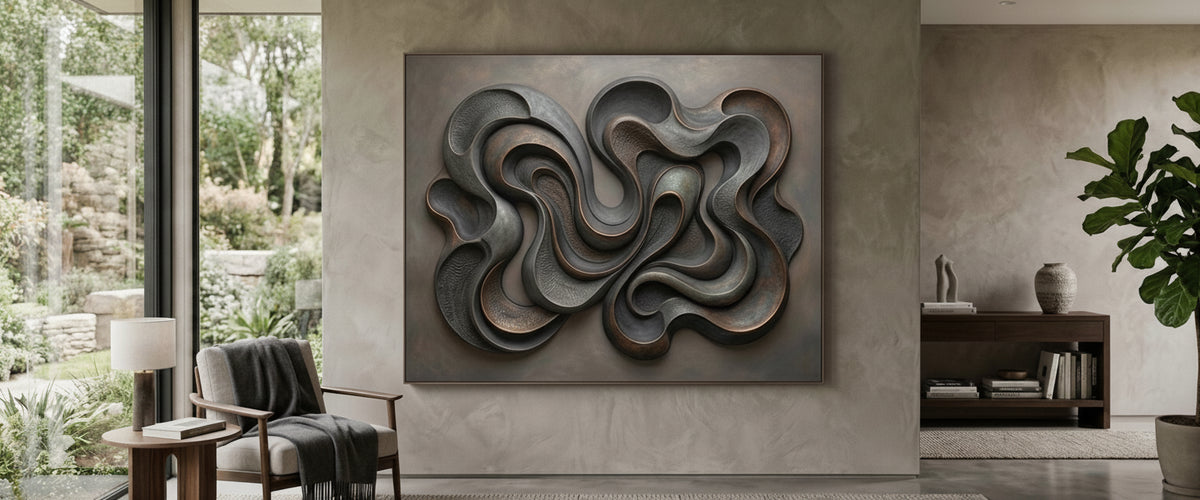
This is also where a canvas has honest limits. If the space is asking for permanence and texture, metal or bronze delivers something flat print cannot. Our metal wall art catches and throws light across the day, and where the setting wants sculptural depth on the wall rather than a painted surface, a bronze relief like the Traditional Horse Head Bronze Relief - 80cm (about 31 inches) reads as an object rather than an image. When a client wants an heirloom rather than a refresh, that is the conversation we have.
Where to Place Large Canvas Wall Art for Real Impact
For wider placement ideas, Large 3d Wall Art: How Scale, Light, and Placement Decide Its Impact is useful companion reading before finalising the setting and sightlines.
Placement decides whether a big piece feels intentional or accidental.
Above a sofa or console: hang so the center sits around 57 to 60 inches (145 to 152 cm) from the floor, the standard gallery eye line, and leave 6 to 10 inches (15 to 25 cm) of breathing room above the furniture.
Stairway side wall: this is the question we get most, and the trick is to follow the slope. For one large canvas on a stairway side wall, position the center at eye level for someone standing mid-flight, not mid-room. Align the bottom edge to step up with the staircase rather than sitting dead level, or the whole thing looks like it is sliding downhill.
Double-height entry or lobby: go tall and vertical. A wide horizontal canvas gets lost on a two-story wall; a vertical piece or a stacked pair pulls the eye up and rewards the ceiling height.
Hallways: long walls suit a set with even spacing, or one confident horizontal piece. Keep it clear of door swings and light switches so the composition stays clean.
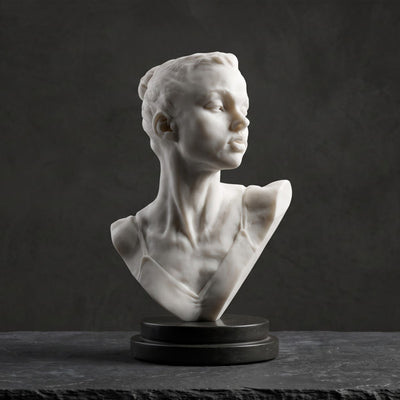
For a landing or alcove where a flat canvas would feel thin, a sculptural wall piece such as the Classical Figural Torso Wall Sconce Bronze Sculpture - 90cm (about 35 inches) gives the recess the weight it needs. Browse the wider wall art and wall decor range if you want to weigh canvas against relief side by side.
Budget, Commissioning and Delivery
Cost for large canvas wall art depends on size, print quality, framing and whether the image is stock or bespoke. Rather than quote figures that would not survive your specific brief, we price each commission around the artwork, the finish, the crating and the shipping distance. Ask for a tailored quote and you get a real number for your project, not a guess.
Canvas ships more easily than sculpture. Large pieces can travel rolled in a tube and be stretched on arrival, which keeps freight cost down for international orders. Metal and bronze relief work needs proper crating and heavier handling, and we build that into the quote and the lead time.
If you are commissioning, send us the wall dimensions, a photo, the ceiling height, and the direction the room faces (light exposure changes how color reads). We would rather flag a sizing or sun problem before production than after.
How Giant Sculptures Helps With Bespoke Projects
Giant Sculptures is a bespoke supplier working at scale, and canvas is one part of a wider wall-art and sculpture offer that runs through to bronze, stainless steel and stone. Our value shows up when a project outgrows a catalog print: a custom size for an awkward stairway, a set matched to a hospitality color scheme, or a switch from canvas to a metal relief once we see the wall.
We have shipped large-format work to homes and venues across the US and beyond, and the recurring lesson is the same. The buyers who send measurements and photos early get pieces that fit the wall on the first try. The ones who guess tend to reorder a size up. Start with the wall, and the art follows.