





































































































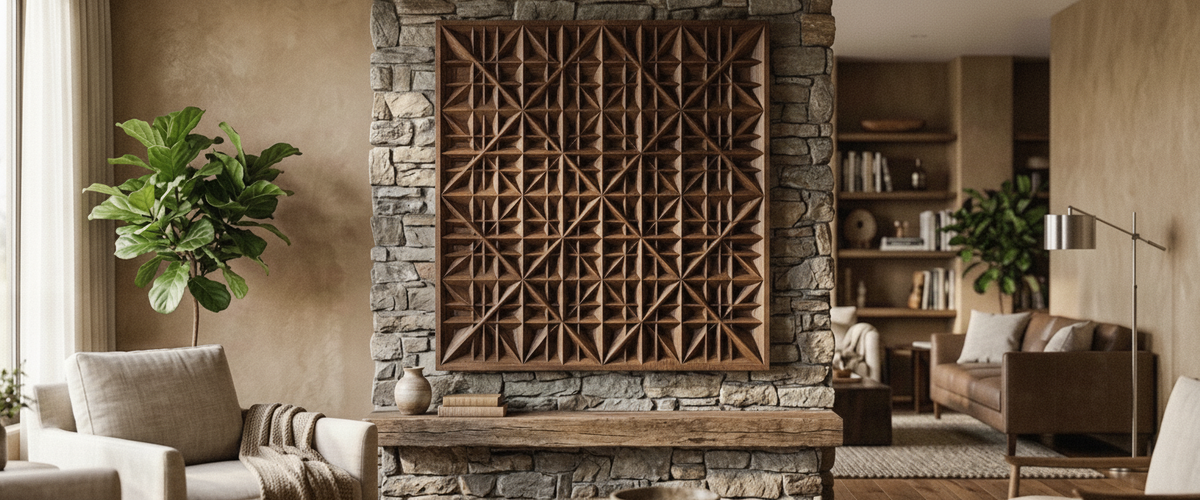

Most large 3D wall art that ends up face-down on a floorboard was hung on an anchor meant for a mirror. A deep relief panel stands off the wall, so its weight pulls outward as well as down, and that small lever works on the fixing every day. Buyers spend weeks choosing finish and form, then give the wall behind it about ten minutes. We would reverse that ratio.

At a Glance
Weight is only half the load. Depth of relief turns weight into use, so a deep piece needs a stronger fixing than a flat one of the same weight.
Know your wall before you order. Hollow drywall, brick and poured concrete each call for different hardware.
Match the fixing to the profile. French cleats suit wide, flat-backed panels. Stand-off pins suit floating forms. Hidden rails suit multi-part work.
Plan the route in. Oversized bespoke panels are often made in sections so they fit stairwells and elevators.
The Wall Anchor Gives Out Years Before the Design Does
A carved or cast surface can look the same after twenty years. A plastic drywall plug that has been carrying an off-center load since installation day may not. Anchors fail slowly. Seasonal movement in the stud wall, a door slammed on the far side, and the occasional knock while dusting all work the fixing loose. The first warning is usually a hairline crack in the paint along the top edge, and most people read it as settling.
For that reason, we treat every piece of large 3D wall art as a small structural job. Before a panel leaves the studio we want the finished weight, the depth from wall to face, and a clear note of where the center of gravity sits. Those three figures decide the hardware.

Metal, Resin and Carved Wood: What Each Asks of Drywall
With large 3D wall art, material sets the weight class. Paper and card relief puts almost no demand on a standard wall, which is why a sculpted paper piece such as TerraLuma Ivory White Bloom Paper Craft 3D Wall Art is the easier choice when you are unsure what sits behind the plaster; a couple of standard drywall anchors are plenty. Resin and composite relief sits in the middle. It is lighter than it looks, but it is rigid, so any flex in the wall goes straight to the fixing points.
Carved hardwood and engineered metal are where drywall (plasterboard) starts to struggle. When a room calls for the shadow depth of cut timber, a panel like Barwick Mocha Grid Abstract 3D Carving Wall Art keeps its mass out from the wall across a wide field, and sheet steel or bronze relief from our metal wall art range adds density on top of that. Drywall alone has limited pull-out strength; the Gypsum Association publishes the fastening guidance installers work from. For anything in the heavier bands we fix into studs or add blocking behind the board, and we say so on the spec sheet.
Hollow Partition, Brick or Poured Concrete: What We Specify First
A hollow stud partition, common in newer homes across Texas and California, needs its studs located and ideally a plywood backer installed during any remodel. Solid brick, still found in older Brooklyn and Boston townhouses, takes masonry anchors well, but old mortar is often soft, so fixings go into sound brick rather than the joints. Poured concrete, familiar from loft conversions and new commercial fit-outs, carries almost anything with the right sleeve anchor, though it punishes a wrong hole with a long drilling session.
We ask clients to photograph a test hole or send the contractor's notes. It takes a day and saves a wasted site visit.

French Cleats, Stand-Off Pins and Hidden Rails
The fixing for large 3D wall art should follow the depth of relief. A French cleat, two interlocking bevelled strips, spreads load along the full width and lets you slide a wide panel level. It suits flat-backed wood and metal work of shallow to medium depth. Stand-off pins hold sculptural forms clear of the wall so shadows fall behind them, and they need precise templating because a single misaligned pin shows. Hidden rails, a continuous concealed channel, let multi-part compositions hang as one line and allow sections to be removed for cleaning or repainting.
A French cleat spreads the load of a wide relief panel across several studs.
Museum hanging practice follows the same logic of spreading load and allowing movement. The Canadian Conservation Institute publishes clear notes on mounting heavy objects that are worth reading before you drill.
Why the Chimney Breast Is the Hardest Wall for Large 3D Wall Art for Living Room Schemes
Ask anyone where large 3D wall art for living room spaces should go and they point at the chimney breast. It is centered, framed by alcoves, and already the focal point. It is also often hollow or partly hollow, it may contain a live flue, and the plaster over old brick can be soft and patched.
On one project, a wide relief was headed for a chimney breast that turned out to be a framed box over a gas insert. The installer found no solid backing where the drawings expected it. The piece went up on a cleat fixed through to new blocking, and the client lost a weekend. Heat matters too. An illuminated relief such as Elysian Striking Glow 3D LED Wall Art needs its driver kept away from a working fireplace and a cable route planned before plastering, so above a live flue it is often better moved to an alcove wall.
The chimney breast draws the eye, but check what sits behind the plaster before drilling.
Splitting a Bespoke Panel So It Survives the Stairwell
A bespoke commission can be made at almost any size in the studio. The hard limit is usually the smallest turn between the truck and the wall. A generous loft living room means little if the freight elevator cannot take the panel diagonally, which is why we now ask for stair, door and elevator measurements at the first design conversation.
Splitting a panel works when the joints follow the design: a groove in carved wood, a seam in a metal field, a natural break in the composition. Each section gets its own fixings on a shared rail, so the weight is spread and any section can come down for repair. The 3D wall art collection is a useful place to see which forms divide cleanly and which read best as a single piece.

Before You Order Large 3D Wall Art: A Hanging Checklist
Confirm the finished weight and the depth from wall to face.
Identify the wall type with a test hole or contractor notes.
Locate studs, flues, cables and pipes behind the chosen wall.
Choose cleat, stand-off pins or rail based on relief depth.
Measure every door, stair turn and elevator on the delivery route.
Agree on sectioning early if the piece is large or bespoke.
Ask for a tailored quote that covers fixings, installation and finishing.
Budget depends on material, scale, complexity, engineering, installation and finish, which is why Giant Sculptures quotes each bespoke piece individually. Send us the wall, the room and the route, and we will design the fixing along with the art. Start with our broader wall art and wall decor range if you are still weighing options.
For wider placement ideas, Large Metal Wall Art for a 30-foot Living Room Wall: A Studio Case Study is useful companion reading before finalising the setting and sightlines.