





































































































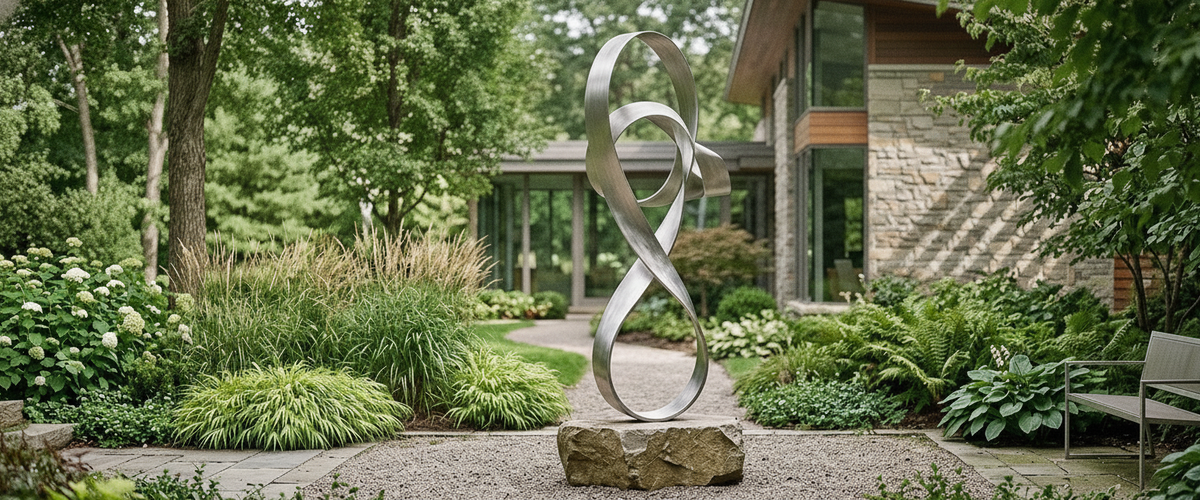

A ribbon sculpture can photograph beautifully and still fall flat once it is bolted down. The fault is rarely the piece. It is the angle people actually walk up from. An abstract metal ribbon sculpture is a line drawn in space, and that line only works when the viewer's path lets the curve open, cross behind itself, and close again. Site it badly and you own a very costly vertical stripe.

Key Takeaways Before You Buy
Six things worth settling before you commission an abstract metal ribbon sculpture:
Every ribbon has dead angles. Walk all four approaches before you commit to a spot, not after.
Movement does the work. A twist reads over six or eight steps, so approach speed matters more than raw height.
Finish changes the silhouette. Mirror polish dissolves at dusk; brushed steel and patinated bronze hold their edges.
Plinth height decides the geometry. Eye level through the loop is a different sculpture to eye level above it.
Ground surface doubles or swallows the form. Still water and pale gravel give you a second sculpture free.
Past roughly 6.5 feet (2m), wind load and footing stop being a matter of taste.
Four Approaches, Two Good Ones: Map the Dead Angles First
Take any looping form and rotate it slowly. You will find one or two views where the curve stacks on itself and the whole thing collapses into a blade. That is normal geometry, not bad design. The job is making sure the collapsed view is not the one your guests get from the front door.
Our practical method: cut a full-height plywood profile, stake it where you want the sculpture, and walk the site at the times people genuinely arrive. Driveway. Kitchen window. The terrace chairs nobody moves. One client ran that test for a week and moved the position nine feet (2.7m) uphill, because the original spot showed the flat edge to everyone stepping out of a car. A single-loop form such as the Bronze Abstract Flowing Ribbon Sculpture Brass - 100cm has one genuinely open face and a much tighter profile behind it, and the gap between those two views is the gap between a focal point and a fence post.
The same curve from two approaches: one view opens the loop, the other flattens it to a blade.

The Twist Only Reads While You Move
An abstract metal ribbon sculpture is a sequential object. The curve reveals a section at a time as you close in, which is why these forms work so well on walking routes and so poorly at the end of a long driveway where people are doing 20mph. Fast approach flattens everything. A slow approach, a curved path, a set of steps, a gate that forces a pause, all of that buys you the frames the sculpture needs.
If the only viewing position is static, say a seated dining terrace, choose a form with strong internal contrast rather than a long sweeping twist. Short, tight curves resolve instantly. Long ones need footsteps.
Mirror Polish Against Brushed Steel: Which Finish Keeps a Curve Alive at Dusk
Mirror-polished stainless is the default request and it is not always right. At midday it is spectacular, throwing sky and planting across the surface. At dusk it goes quiet and sometimes disappears altogether, because there is no directional light left to bounce. Brushed or satin finishes keep a soft gradient down the curve, so the form stays legible in gray weather and low winter sun. Finish grade also affects how the surface behaves outdoors over decades. Marine-grade 316 with a fine, consistently directional finish holds up far better in coastal air than a coarse one, as the British Stainless Steel Association notes on surface roughness and corrosion resistance.
Bronze takes a third route. A patinated surface gives depth without reflection, and it shifts slowly over years rather than hour to hour. Tate's note on patina is a useful primer on why that aging is part of the work. On sites with pale, overcast skies for much of the year, a warm metallic finish at height, along the lines of the Gold Abstract Swooping Bird Stainless Steel Sculpture - 236cm, keeps the leading edge of the curve visible where a cool mirror surface would simply merge into the background.
Plinth Height Decides Whether You See the Loop or Straight Through It
This is the most common thing buyers get wrong. Raise a ribbon too high and the aperture foreshortens against the sky, so the void you paid for reads as solid mass. Set it low and your eye passes cleanly through the opening, catching planting or water behind it.
With the void near standing eye level, the planting behind the piece becomes part of the composition.
Rough rule from the studio: if the open void in an abstract metal ribbon sculpture is the point, keep its center near standing eye level, roughly 5 feet 6 inches (1.65m). If the silhouette is the point, lift it and let the sky do the contrast work. Compact interior forms behave the same way at smaller scale, and a piece like the Bronze Abstract Organic Wave Sculpture Brass - 91cm changes character completely between a low console and a waist-height plinth. It costs nothing to test with stacked books before you commission a base.

Water, Gravel and Lawn: Surfaces That Double a Ribbon or Swallow It
Whatever an abstract metal ribbon sculpture stands on becomes part of the reading:
Still water: the strongest partner. A reflecting pool gives you a mirrored second curve and doubles apparent scale. Keep the water shallow and dark-lined.
Pale gravel: bounces light up into the underside of the form, which matters enormously on curved metal. Also reads as a deliberate frame.
Lawn: beautiful in summer, treacherous in shoulder seasons. Green mass absorbs bronze and mid-tone steel. Mow a defined apron or set a stone pad.
Dark paving: sharpens a polished ribbon, mutes a patinated one.
Atriums Look Down on Ribbons, and Nobody Checks the Top-Down View
Hotel lobbies, office atriums and double-height stairwells give viewers a plan view that garden buyers never think about. From above, an abstract metal ribbon sculpture becomes a flat calligraphic mark on the floor, and many forms designed for eye-level viewing look like a tangle from the balcony. If you are buying for a multi-level space, ask for a photograph or render taken from directly overhead before sign-off. On bespoke commissions we model the top-down silhouette deliberately, because it is often the view held longest.
Past Two Meters, Wind and Footing Stop Being a Free Choice
Above roughly 6.5 feet (2m), an abstract metal ribbon sculpture becomes a structural object. Broad curved planes catch wind like a sail, and the load concentrates at the base weld and anchor bolts. That means an engineered foundation sized to the piece, the soil, and local wind exposure, plus an internal armature rather than a hollow shell relying on skin stiffness.
It also changes logistics. Crane access, gate widths, and whether the crate can turn a corner all need answering before fabrication starts. We once had a 12-foot (3.7m) stainless piece that needed a re-planned lift because of a single mature beech; catching that at the drawing stage saved a very awkward delivery day.

A Short Pre-Commission Checklist
Photograph the site from all four approaches at morning, midday and dusk.
Mock up full height in plywood or cardboard and live with it for several days.
Decide whether the void or the silhouette leads, then set plinth height to match.
Choose finish against your dominant light, not against a showroom photo.
Confirm ground surface and its seasonal color shift.
Check the top-down view if any viewer will be above the piece.
Get foundation, anchoring and access confirmed in writing before fabrication.
Commissioning an Abstract Metal Ribbon Sculpture with Giant Sculptures
Most of the ribbon work we ship is bespoke, because scale and site drive the geometry more than catalog dimensions do. Budget for an abstract metal ribbon sculpture depends on material, overall scale, the complexity of the curve, engineering, installation and finishing, so the honest answer is a tailored quote rather than a headline figure. Start by browsing the abstract sculptures and wider metal sculptures collections to identify the language you respond to, then send us site photographs. If you are drawn toward warmer surfaces, the bronze abstract sculptures range is the better starting point. The sculpture is the easy part. The siting is where the value is won or lost.
For wider placement ideas, Abstract Gold Face Sculpture: How to Read the Finish Before You Buy is useful companion reading before finalising the setting and sightlines.