





































































































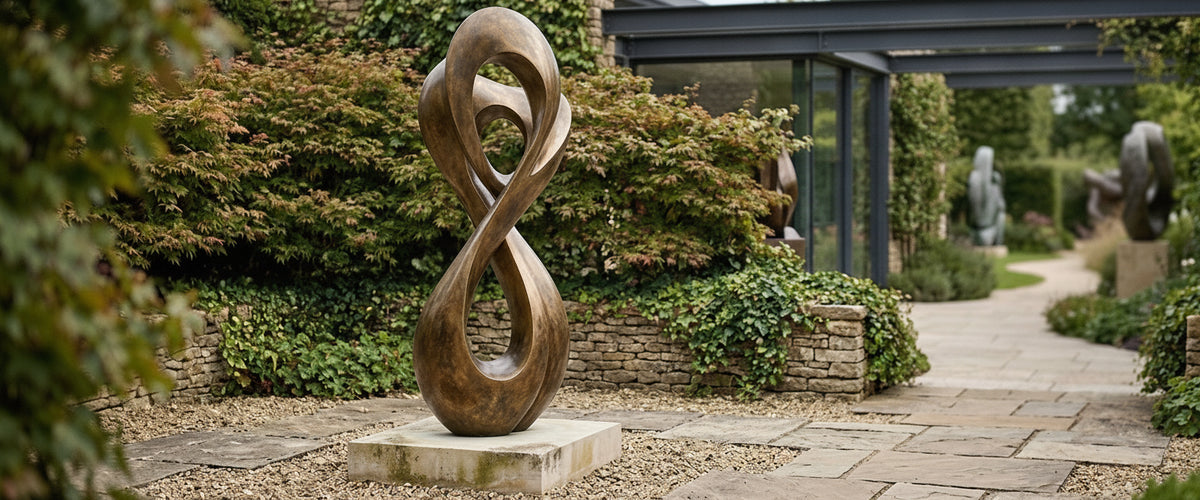

A large abstract metal sculpture can either take charge of a space or quietly disappear into it, and the deciding factor is rarely the piece itself. It is where you put it. We have shipped bronze and steel forms to double-height entryways in California, walled gardens in the Hamptons, and hotel lobbies where the sculpture had to hold its own against forty feet of glass. The successful placements share a few habits. The disappointing ones almost always break the same handful of rules.
Looking for the full range in this category? Browse our Metal Sculptures collection for every available finish, size, and configuration.
So before you commit floor space, a plinth budget, or a foundation pour, here is how a large abstract metal sculpture actually reads in real rooms and real gardens, and how to set one up so it earns its footprint.
A large metal form reads best when it sits at the end of a clear sightline.

Key Takeaways
Scale is relative: a large abstract metal sculpture reads as "large" against its backdrop, not its measured height.
Pedestal height controls whether the eye meets the piece or looks down on it. Get this wrong and the whole thing sags.
Outdoor placement rewards silhouette and sky contrast; indoor placement rewards a clean, contrasting wall.
The most common mistake is centering a piece in a room instead of giving it a sightline to travel along.
Bronze, stainless steel, and Corten each behave differently in light, so choose material for the setting, not just the shape.

What a Large Abstract Metal Sculpture Looks Like in Different Settings
Abstract work carries its meaning through mass, line, and negative space rather than a recognizable subject, which is exactly why placement of a large abstract metal sculpture matters so much. A polished bronze form that feels monumental in a gallery can look modest in a two-story great room, simply because the volume around it is bigger. The reverse is also true. Drop a mid-height piece into a tight courtyard and it fills the space with presence.
Indoors, one of these sculptural forms tends to work as a focal counterweight. Put it at the far end of an open-plan living space and it pulls the eye through the room. For that indoor sweet spot, a large abstract metal sculpture like the Large Modern Abstract Bronze Sculpture - 120cm is tall enough to register from across a room yet contained enough to live on a console or low plinth without crowding the ceiling.
Outdoors, the same logic scales up. Gardens have more competing texture, so a garden piece needs either more height or a stronger silhouette to hold attention. Large abstract garden sculptures read best when they sit against open sky or a plain hedge rather than a busy planting bed. That is where a taller commission earns its keep, and where our large bronze sculptures tend to land.

Scale, Sightlines, and Pedestal Height
Three measurements decide how a large abstract metal sculpture reads, and only one of them is the sculpture's own height.
The first is viewing distance. A form seen from six feet away needs different proportions than one seen from sixty. If the primary view is across a courtyard or down a long hall, you can afford a bolder, simpler silhouette because fine detail gets lost anyway. Up close, the surface work and the way the metal catches light do more of the talking.
The second is sightline. Good placement gives the eye somewhere to arrive. Position a sculpture at the end of a garden path, at the turn of a driveway, or aligned with a doorway so it reveals itself as you move. When the setting can carry real height at the end of an approach rather than a corner it shares with the furniture, the Monumental Contemporary Abstract Female Figure Bronze Sculpture - 220cm is scaled for exactly that kind of arrival.
The third is pedestal height, and it is the one people underestimate most. The aim is usually to raise the visual center of the piece toward eye level for the main viewing position, roughly 57 to 63 inches (145 to 160 cm) off the floor for an indoor seated-and-standing mix. Too low and viewers look down on the work, which flattens it. Too high and it feels remote. For garden work, a low stone or concrete plinth also lifts the base clear of splashback and mowing damage, which matters more than most buyers expect.
Outdoors, a low plinth and an open backdrop let the silhouette carry the piece.

Indoor Versus Outdoor Placement: When Each Wins
For wider placement ideas, Contemporary Abstract Metal Sculpture: A Buyer's Guide to Form, Scale, and Placement is useful companion reading before finalising the setting and sightlines.
Indoor placement wins when you want the large abstract metal sculpture in daily conversation with the room. Controlled light, a stable temperature, and a fixed viewing angle let you show off a polished or patinated surface at its best. Bronze in particular holds a refined interior patina beautifully because it is not fighting weather. For a form that rewards a slow, close look, a figure like the Large Contemporary Abstract Female Torso Bronze Sculpture - 140cm reads intimately in a controlled interior setting.
Outdoor placement wins when you want scale, sky, and changing light to do part of the work. A large abstract metal sculpture in a garden is seen in weather, at dawn and dusk, wet and dry, and that variety is a feature. Metal is well suited to it. Bronze develops a stable protective patina over decades, and the U.S. National Park Service notes that a maintained wax coating is what protects outdoor bronze from the elements over the long term (see the NPS guidance on caring for outdoor bronze). Corten steel, by contrast, is meant to weather to a rich rust-toned surface and suits a rugged, contemporary garden.
If you are torn, ask where the piece will be seen most often. A sculpture admired mainly from inside, through a window, is really an interior decision wearing a garden costume, and it should be sited against a backdrop that reads well from the sofa.
Light, Backdrop, and Contrast
Light is the cheapest way to change how a large abstract metal sculpture looks and the most overlooked. Polished stainless steel and mirror-finished bronze feed on directional light; a raking beam across the surface at a low angle turns a flat form into something with depth. Matte and patinated surfaces prefer softer, even light that shows their texture without harsh glare.
Backdrop is the silent partner. A pale form needs a darker wall or a hedge behind it; a dark bronze needs a lighter plane to lift its edges. The mistake we see most is a beautiful dark patina placed against dark timber cladding, where the whole silhouette dissolves. Contrast is what gives a large abstract metal sculpture its outline, and the outline is the piece.
Cluster-form pieces earn their placement near a pool or reflecting surface. Where the setting has still water to work with, the Large Contemporary Abstract Raindrop Cluster Sculpture - 250cm gains a second life mirrored in it, and the doubling reads as deliberate rather than accidental.
Common Placement Mistakes We See in Commissions
Most placement problems for a large abstract metal sculpture are predictable, which means they are avoidable. Here is the short list we walk clients through.
Centering by habit. Dead-center in a lawn or a room is the default, and it is usually the weakest spot. Offset the piece so it relates to a path, a wall, or a view.
Buying too small for the volume. A sculpture that looks large in the studio can look lost in a double-height space. When in doubt, size up; empty air above a piece reads as under-scaled.
Ignoring the approach. If people see the back of a directional form first, the reveal is spoiled. Orient the strongest face toward the natural line of arrival.
Skipping the base engineering. A tall metal form needs a proper footing or fixing, especially outdoors where wind load is real. We spec foundations and internal armatures for the site, not just the sculpture.
Fighting the backdrop. Match the piece to a contrasting plane behind it before you fall in love with a corner that swallows it.
Beyond Metal: When Wood or a Pod Form Fits
Metal is our default for large statement work because of durability and finish range, but it is not the only answer. A large abstract wood sculpture brings warmth and grain that metal cannot, and it suits sheltered interiors and covered terraces where it will not sit in standing water. Abstract large pod sculptures, with their smooth swelling volumes, tend to soften a hard architectural setting and pair well with planting. The choice comes down to the setting's mood and how much weather the piece will face. For an exposed garden that sees real winters, a weatherproof large abstract metal sculpture remains the practical long-term choice.
Commissioning a Piece for Your Space
When a stock size does not fit the sightline or the volume, a bespoke commission solves the fit properly. We work from the site first: viewing distances, backdrop, light through the day, and the foundation or floor loading available. From there we refine scale, finish, and pose so the large abstract metal sculpture belongs to the space rather than merely occupying it.
Budget depends on material, scale, complexity, engineering, installation, and finishing, so the honest answer is that a tailored quote beats any published figure. If you send us the room or garden, ideally with a rough measurement and a photo of the intended backdrop, we can tell you quickly whether an existing piece from our abstract sculptures works or whether a commission is the smarter route. Either way, the goal is the same: a large abstract metal sculpture that reads as inevitable once it is in place, as if the space were waiting for it.