






































































































A hallway is the first room a guest reads and the last one most people style. It is long, narrow, often short on natural light, and full of doorways that break up the wall. That combination punishes the wrong piece and rewards the right one. When people search for hallway clip art or scroll through hallway art ideas online, they usually pull an image that looked good in a wide, sunny gallery, then hang it in a corridor half that width and wonder why it feels cramped. The trouble with most hallway clip art is that it was never chosen for a corridor in the first place. The fix is rarely a different picture. It is a better read of the space.
We spend a lot of time at Giant Sculptures helping buyers place large-format wall pieces and freestanding work in exactly these awkward runs. What follows is how we think about it before a single fixing goes into the wall, whether you started from a piece of hallway clip art or a full commission brief.

Key Takeaways
- Scale to the walk, not the wall. A hallway is read in motion, so the piece needs to hold at a glance, not reward close study.
- Protect the sightline. The best spot is usually the wall you see from the far end or from the front door, not the wall you brush past.
- Light decides material. Low natural light favors reflective metal and framed pieces with depth; matte finishes can go flat.
- Outdoor entries change the rules. Covered porches and garden approaches open up weather-durable options like Corten and stainless steel.
- Commission when the run is difficult. Odd widths, sloped ceilings, and staircases are exactly where a bespoke piece earns its cost, well past what any hallway clip art can offer.

What Hallway Art Looks Like in Different Rooms and Settings
The phrase covers far more than a framed print, and it runs well past a stock file of hallway clip art. In a wide entrance hall, hallway art might be a single tall wall piece with real relief and metallic depth, sized to fill the vertical run beside a staircase. In a narrow apartment corridor, it is often a series of smaller works spaced to pull the eye along. In a double-height entry, it can be an oversized architectural panel that carries the whole approach on its own.
Outdoors the definition stretches again. A covered breezeway between a garage and a front door, or an approach path through a garden, both function as corridors in behavior even though they are open to the weather. People move through them, glance sideways, and form a first impression fast. No flat hallway clip art holds up in that kind of setting.

Scale, Sightlines and Pedestal Height
Three choices decide whether hallway wall art feels intentional or apologetic. Get these right and almost any competent piece will work, from a print to a real sculpture.
Scale to the movement
People do not linger in hallways. They pass through. That means a piece needs to land in the two or three seconds someone spends looking at it. Small, busy works with fine detail get lost in transit; a larger piece with a clear silhouette and one strong idea reads instantly. This is where downloaded hallway clip art tends to fail, because it was drawn for close reading. As a rough starting point, a single wall piece can take up roughly two-thirds of the usable wall width between door frames. Go smaller and it floats; go larger and it crowds the walk.
Find the real sightline
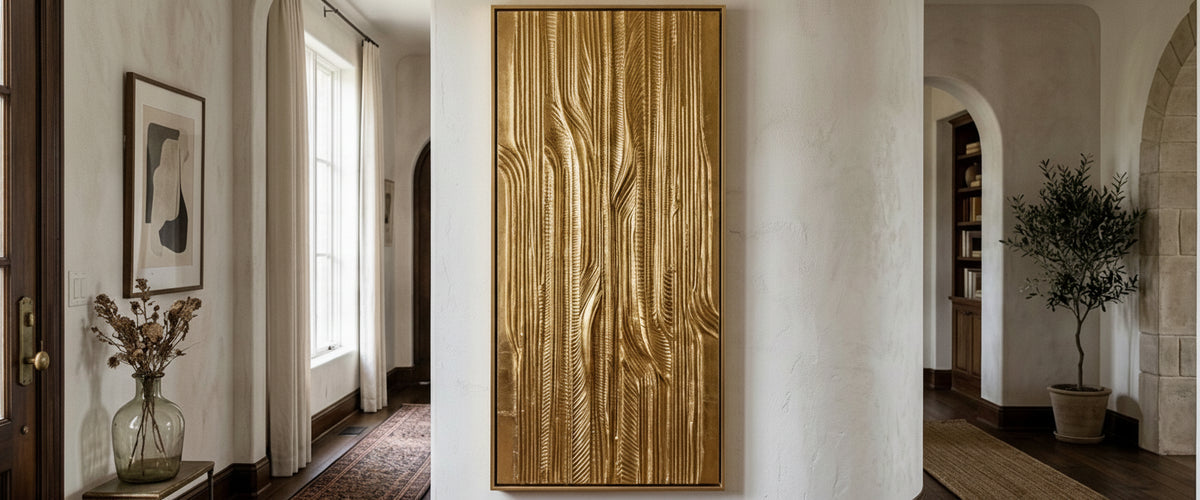
The wall you walk past is not usually the wall to dress. The wall you see head-on, from the front door or the far end of the corridor, is the one that carries the space. Stand where a guest first enters and note what your eye lands on. That end wall, or the wall at a turn in the run, is your primary spot. Where the head-on wall is tall and narrow, a strong vertical anchor such as the Ecliptica Abstract Architectural Column Gold Frame Wall Art draws the eye up along the run rather than fighting the tight floor plan, and its gold frame carries enough presence to hold a long approach without a cluster of smaller works around it. Side walls take supporting pieces, hung so they reveal in sequence as you move rather than competing for the same glance.
Hanging height and pedestal height
For wall pieces, the museum convention of a center point around 57 to 60 inches (145 to 152 cm) from the floor works well in most homes, though you should raise it if your household is tall or the ceilings are high. If you are placing a freestanding sculpture in a wider entrance hall, the pedestal height matters as much as the piece. A plinth that lifts the work toward eye level reads as considered; one that leaves a piece sitting low and easy to knock reads as an afterthought. In tight runs, wall-mounted work almost always beats freestanding, simply because it keeps the floor clear.

Indoor Versus Outdoor Placement: When Each Wins
For wider placement ideas, Abstract Wall Art That Holds a Room: A Placement Guide is useful companion reading before finalizing the setting and sightlines.
Indoors, you get to control the variables. Stable temperature, no rain, no UV load, and you can use framed pieces, mixed media, and finishes that would never survive outside. This is where most corridor art lives, and where subtle materials pay off because people occasionally do stop and look. It is also where a printed piece of hallway clip art can at least survive, even if it rarely holds a wall the way real work does.
Outdoor entries and covered approaches ask a harder question of the material. A piece on a shaded porch deals with freeze-thaw cycles; one on an open path takes full sun for hours a day. For those settings we steer clients toward weather-durable metals. Corten steel develops a stable rust-like patina that protects the metal beneath, which is why it holds up so well in exposed garden runs. Stainless steel keeps its finish through rain and salt air and bounces available light back into shaded approaches. The US National Park Service has documented how weathering steel forms that protective surface layer over time, which is part of why it has become a staple for outdoor architectural work (nps.gov).
The honest rule: if the approach ever gets wet, treat it as an outdoor placement and choose the material accordingly. A framed indoor piece hung in a humid, unheated porch will not last, no matter how good it looks on day one.
Light, Backdrop and Contrast
Hallways are famously short on daylight, and that single fact should drive half your decisions. In a dim corridor, matte and dark works can disappear into the wall. Reflective surfaces do the opposite; polished stainless steel and metallic-framed pieces catch whatever light exists and give the run some life. If you have a picture light or can add discreet track lighting, you open up far more options, including textured stone and bronze relief that need raking light to show their form. It is a level of depth flat hallway clip art simply cannot give you.
Backdrop contrast is the other lever. A pale piece on a pale wall reads as a smudge. Put the same piece against a deep charcoal or a saturated color and it snaps into focus. Before committing, hold a large sheet of the piece's dominant tone against the wall and step back to the far end. If it blends, change the wall color or change the piece. One of those two has to give.
If you want to browse how different framed and metallic works behave against tight walls, our Hallway Art collection is organized around exactly these narrow-run problems, and it is a far better starting point than generic hallway clip art.
Common Placement Mistakes We See
Certain errors show up again and again in the briefs that reach our studio. Most are easy to avoid once you know to look for them, and several start with someone picking hallway clip art and hoping scale sorts itself out.
- Hanging too high to dodge furniture. A console table below does not mean the art should float near the ceiling. Keep the center at eye level and let a small gap sit above the furniture.
- Buying one size too small. The most frequent mistake by a distance. Undersized work leaves a wall looking unfinished. When in doubt, size up.
- Ignoring the door swing. A freestanding piece placed where a door opens onto it will get knocked within a week. Map the swing arcs first.
- Matching everything. A row of identical frames at identical spacing can read as clinical rather than curated. Vary scale slightly and let one piece lead.
- Forgetting the fixing. Large-format work needs proper anchors into studs or masonry, not a single picture hook. We size fixings to the weight of the piece and the wall it lands on, and we flag when a wall needs reinforcement.
- Treating an outdoor approach as indoor. Covered does not mean dry. If wind-driven rain reaches the wall, you need an outdoor-rated material.
When to Commission Rather Than Buy Off the Shelf
Standard pieces work beautifully in standard runs. The moment your hallway stops being standard, a bespoke commission usually earns its place, and hallway clip art stops being a serious option at all. Sloped staircase walls, double-height entries, unusually long corridors, and curved approaches all benefit from work built to the exact geometry. We have shipped commissions where the client sent us the wall dimensions, the ceiling slope, and a photo of the light at three different times of day, and we sized and finished the piece around all of it.
Budget for a bespoke corridor piece depends on material, scale, complexity, the engineering behind the fixing, installation, and finish. There is no useful flat figure, which is why we quote each commission individually rather than publishing a band that would mislead you. If you send us the constraints, we can tell you what is realistic for your run, whether you want real sculpture or something closer in spirit to the hallway clip art you started with.
Whether you buy ready-made or commission, the discipline is the same. Read the space in motion, protect the main sightline, respect the light, and size up rather than down. Do that, and even the hardest hallway becomes the one guests remember first, long after the last piece of hallway clip art has been forgotten.