





































































































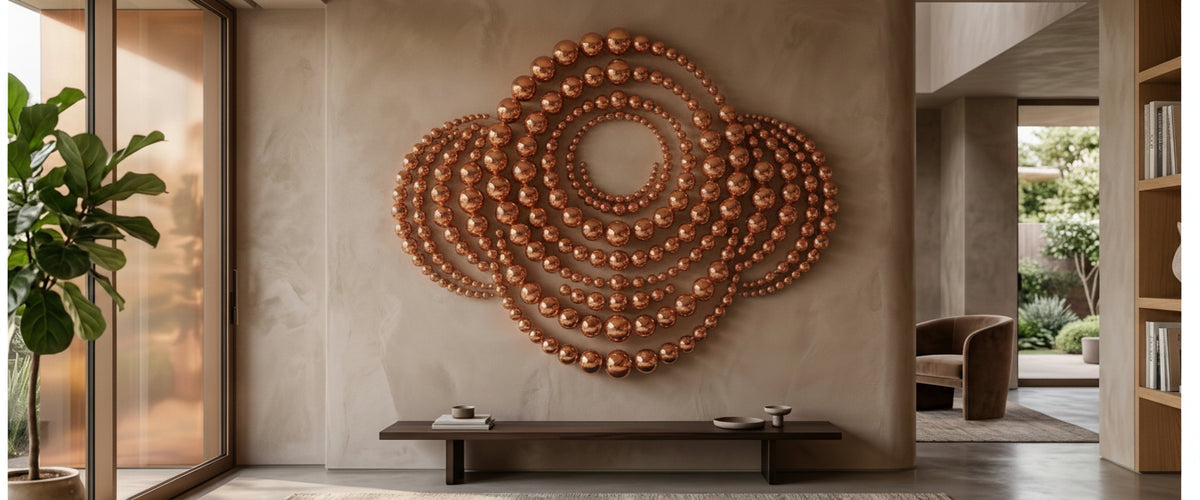

A piece of abstract wall art can either anchor a room or vanish into it, and the difference usually has nothing to do with the artwork itself. It comes down to where it sits, how high, against what backdrop, and under what light. We have watched a strong metal panel lose all its punch because it was hung too high above a fireplace, and we have seen a modest piece read like a headline because someone gave it a clean wall and let it breathe.
So this is a placement guide first and a shopping guide second. If you already know you want abstract wall art and you are trying to work out where it belongs, start here.
A large piece scaled to a double-height wall, centered on the eye line.

Key Takeaways
Scale beats quantity. One large abstract wall art piece almost always reads better than a cluster of small ones.
Eye line rules everything. Center the visual weight around 57 to 60 inches (145 to 152 cm) from the floor in most rooms.
Backdrop and light decide impact. Contrast against the wall and a raking light source make a piece look intentional.
Outdoor changes the material conversation. Weather, UV, and mounting all shift what you can hang and where.
Bespoke solves the awkward wall. When stock sizes fight your space, a commission fixes proportion at the source.

What Abstract Wall Art Actually Looks Like in Different Rooms
Abstract wall art covers a wide range, from flowing metallic silhouettes to layered spheres that catch light from every angle. In a double-height entry hall, a large abstract wall art panel can carry an entire wall that would otherwise feel like dead space. In a lower-ceilinged living room, the same instinct backfires; you want a piece scaled to the sofa below it, not to the whole wall.
Modern abstract wall art tends to work hardest in rooms with restraint elsewhere. A pale plaster wall, a low console, and one confident piece above it will outperform a busy gallery arrangement every time. When clients ask us about abstract metal wall art specifically, they are usually chasing that quality of light play: the way a curved or faceted metal surface shifts as you move past it. Where a room needs warmth and reflected color rather than flat pigment, a layered piece such as the Eclat Sphere Copper Abstract Metal Wall Art throws warm color across the wall around it as daylight moves through the room.
Abstract canvas wall art and abstract wall art paintings behave differently. Canvas absorbs light rather than bouncing it, so it sits quieter and calmer, which suits bedrooms and studies. Metal projects. Knowing which effect you want should drive the material choice before color ever enters the conversation.

Scale, Sightlines, and Height: The Choices That Change How a Piece Reads
The single most common fix we make is scale. People buy small because small feels safe, then the piece looks lost. As a rough working rule, an abstract wall art piece hung over furniture should span roughly two-thirds to three-quarters of the width of the furniture below it. Over a 7-foot (2.1 m) sofa, that means the artwork or arrangement wants to be somewhere near 4.5 to 5.25 feet (1.4 to 1.6 m) wide.
Span two-thirds to three-quarters of the furniture width, with the base 6 to 10 inches above the sofa back.
Height is the next trap. Gallery convention centers a work with its visual midpoint around 57 to 60 inches (145 to 152 cm) from the floor, which matches average standing eye level. In rooms where you mostly sit, drop that slightly so the piece meets a seated sightline. The mistake is anchoring to the fireplace mantel or the ceiling instead of to human eyes.
Then there is sightline: what you see as you walk toward the piece. A metallic silhouette read head-on is one thing; the same work caught at a slight angle from a hallway approach reads completely differently. Where a wall is met on the diagonal from a hallway rather than straight on, a form like the Astrid Metallic Abstract Silhouette Wall Art rewards that angled approach, because the silhouette edges catch light as you move. Walk your own route through the room before you commit to a wall.

Indoor Versus Outdoor: When Each Wins
Indoor abstract wall art gives you the widest choice, because you are not fighting weather. You can run brighter pigments, delicate finishes, and canvas without worrying about UV fade or moisture. This is where abstract wall art paintings and colored metal pieces shine.
Outdoor is a different discipline. Sun, rain, salt air near the coast, and freeze-thaw cycles all attack finishes over time. If you want abstract metal wall art on a garden wall or beside a pool deck, the material and coating matter far more than the design. Powder-coated aluminum and stainless steel handle exposure well; raw or lightly finished steel will weather and streak unless that patina is the intended look. The U.S. General Services Administration's guidance on preservation and metal finishes is good background on how coating systems protect metal substrates outdoors, and it is worth understanding before you hang anything permanently exposed.
Mounting also changes outdoors. Wind load on a large metal panel is real, and fixings need to be rated for the substrate, whether that is masonry, render, or timber cladding. This is one area where we always ask about the wall build before shipping a large outdoor piece, because a beautiful panel on the wrong anchor is a liability.
Light, Backdrop, and Contrast: What Decides Visual Impact
A piece needs contrast against its wall to register. Deep bronze or black abstract wall art against a dark charcoal wall can look sophisticated in a magazine and muddy in reality, because there is not enough separation. If your wall is dark, lean toward reflective or lighter pieces. If your wall is pale, you have room to go bold and saturated.
Light direction is the lever most people never touch. Flat, even ceiling light makes everything look like a catalog photo, which is to say a little dead. A raking light, angled across the surface from one side, brings out texture, edges, and the three-dimensional play in metal work. A single adjustable spot aimed across a cool-toned, faceted piece such as the Eclat Sphere Teal Blue Abstract Metal Wall Art will do more for it than any amount of color tweaking. Museum lighting leans on directional, controlled light for exactly this reason: it reveals form.
Reflections cut both ways. Metal near a window catches daylight beautifully, but a glossy piece opposite a bright window can throw glare that washes it out at certain times of day. Note where the sun tracks before you decide.
Placement Mistakes We See in Commissions, and How to Avoid Them
For wider placement ideas, A Placement Guide for Large 3D Metal Wall Art Panels is useful companion reading before finalising the setting and sightlines.
These are the recurring problems, drawn from pieces we have shipped and installed:
Hanging too high. Furniture-mounted art creeps up toward the ceiling. Bring it down toward eye level and keep roughly 6 to 10 inches (15 to 25 cm) between the top of the sofa back and the base of the artwork.
Buying too small for the wall. A postage-stamp piece on a broad wall reads as an afterthought. Size to the space, not to the box it ships in.
Ignoring the backdrop. Order a sample of your wall color, or at least photograph the piece against the actual wall tone before committing.
Skipping the light plan. Add a directional fixture. It is the cheapest upgrade you can make.
Forcing a stock size onto an awkward wall. If the proportions never quite work, that is your cue to commission.
When to Commission Bespoke Abstract Wall Art
Stock pieces solve most rooms. But some walls simply refuse to cooperate: a stair void, a very wide chimney breast, a commercial reception wall that needs a specific span to feel deliberate. That is where bespoke earns its keep. As a maker of large-scale and bespoke work, Giant Sculptures can scale, recolor, and reengineer abstract wall art to a wall's exact proportions, including outdoor-rated finishes for exposed installations.
Commissioning also lets you match a palette to a scheme rather than hunting for a near-enough color. If you are drawn to the flowing metal forms of the Astrid Azure Flow Gold Abstract Wall Art but need it wider, taller, or in a different metallic, that is a conversation rather than a compromise.
On budget: cost depends on material, scale, complexity, engineering, finishing, and installation, so the honest answer is to request a tailored quote rather than trust a generic figure. A small indoor canvas and a large outdoor stainless panel are not the same project.
If you are still comparing options, browse the full abstract art range and the wider metal wall art collection to get a feel for scale and finish before you narrow down. Then measure your wall, plan your light, and buy once.