





































































































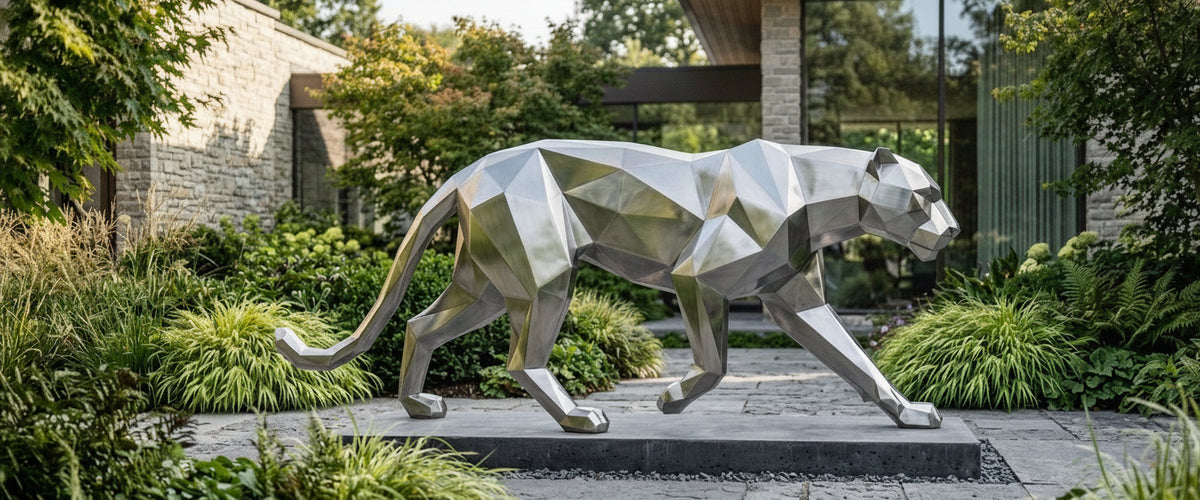

A faceted bronze panther can look electric on an entry console and completely dead six feet to the left. Same piece, same room, wrong spot. Geometric sculpture decor lives or dies on placement more than almost any other style, because the whole appeal is the way flat planes catch and drop light as you move around them. Get the angle and the backdrop right and the surface does the work. Get it wrong and you have paid for a shape that reads as a lump.
We ship geometric sculpture decor into homes and commercial spaces regularly, and the questions that come up before delivery are almost never about the object itself. They are about where it goes, how tall the base should be, and whether it will hold up outdoors. So here is the placement thinking we walk clients through.

Key Takeaways for Geometric Sculpture Decor
- Facets need travel. Angular surfaces reward movement, so place the piece where people walk past or around it, not where it is only seen head-on.
- Sightline beats square footage. A single strong viewing axis matters more than the size of the room.
- Light is a material. Directional light reveals the geometry; flat overhead light erases it.
- Pedestal height sets the read. A few inches change whether a piece feels grounded or floating.
- Material follows location. Bronze and stone indoors or sheltered; stainless steel and Corten for full exposure.

What Geometric Sculpture Decor Looks Like Room by Room
Geometric sculpture decor covers a wide field, from a small polished cobra head on a shelf to a monumental sprinting figure built from welded planes. What ties it together is reduction: the subject is stripped back to intersecting surfaces rather than rounded, literal form. That abstraction is why faceted work slots into contemporary and transitional interiors so well. It reads as a statement piece without demanding a specific style commitment.
In a living room, a mid-size faceted animal on a low plinth gives a coffee-table grouping a vertical anchor. In an entry, where guests approach a piece, pass it, and see it from three or four angles in a few steps, a compact bronze such as the Contemporary Geometric Cobra Head Bronze Sculpture - 45cm at around 18 inches (45 cm) suits the tight sightline better than anything full-height. Dining rooms want restraint; a single piece of geometric sculpture decor on a credenza beats a cluster. And outdoors, the same design language scales up dramatically. A geometric horse or panther in stainless steel becomes a focal point across a lawn, catching sky and reflecting the color of the day back at you.

Scale, Sightlines, and Pedestal Height
Buyers ask about scale first and usually undershoot it. Indoors, the common mistake is choosing geometric sculpture decor that suits the tabletop rather than the wall behind it. A sculpture reads against its backdrop, so measure the visual field, not the surface it sits on. A 30-inch piece can look right on a console under a tall ceiling and look toy-like in the same spot with a 20-foot glass wall behind it.
Pedestal height is the lever most people forget. The general aim is to bring the strongest facet of the piece toward standing eye level, roughly 55 to 62 inches (140 to 158 cm) to the visual center for a figure meant to be read at a glance. Drop a piece too low and viewers look down onto flat tops, which kills the interplay of planes. Raise it too high and you lose the underside geometry entirely. We often supply or recommend a plinth spec alongside a geometric sculpture commission for exactly this reason.
Sightlines matter more than square footage. Before deciding where a piece goes, walk the room the way a guest will. Where does the eye land when you enter? Is there a clear approach path? An angular piece placed on the primary sightline, ideally with a few feet of clear travel toward it, earns its keep. Tucked into a dead corner off the traffic pattern, even a beautiful object goes quiet.

Indoor Versus Outdoor: When Each Wins
Indoors wins when you want a controlled, intimate read: warm bronze patina, a specific spotlight, a piece you pass daily at close range. Bronze and stone are the natural choices for indoor geometric sculpture decor because you control the environment and can enjoy the finish without weathering.
Outdoors wins when you want scale and daylight. Sky, foliage, and shifting sun do things to faceted metal that no interior lighting rig can match. For gardens in the Hamptons, Napa, or Aspen, we steer clients toward mirror-polished or brushed stainless steel and Corten. Stainless throws reflections and reads bright against greenery; where the setting calls for a clean silhouette from a distance that dissolves into reflective planes up close, the Panther III Geometric Steel Outdoor Sculpture at around 55 inches (141 cm) is exactly the kind of geometric sculpture decor that survives full exposure while holding its line across a lawn.
Corten takes a different route. It develops a stable russet oxide layer that protects the steel beneath, which is why it suits coastal and exposed sites where you want warmth rather than shine. The relevant standard for this weathering-steel behavior, which makes the finish predictable rather than a gamble, is published by ASTM International. For very large outdoor commissions we always confirm internal structure and anchoring; a monumental figure is a wind load, not just an object.
Light, Backdrop, and Contrast
Directional light is the single biggest factor in whether geometric sculpture decor looks sharp or flat. Flat, even ceiling light spread across a faceted surface removes the shadows that define each plane, and the piece loses its edges. One raking light source from the side restores them. Indoors, an adjustable spot or a well-placed window does this. A studio lesson worth repeating: we once had a client convinced a bronze piece had arrived dull, and it turned out the room had only recessed downlights directly overhead. We added one angled fixture and the geometry snapped back into focus. Nothing was wrong with the sculpture.
Backdrop and contrast decide legibility. A dark bronze piece needs a lighter wall behind it or it merges into shadow. A polished stainless piece needs something with texture or color to reflect, otherwise it mirrors a blank wall and looks empty. Outdoors, evergreen hedging is a reliable dark backdrop for bright metal, while a pale stone wall flatters darker patinas. Think in terms of contrast against what sits behind the piece, not the piece in isolation.
Common Placement Mistakes We See
For wider placement ideas, 3d Wall Art Decor That Actually Reads From Across the Room is useful companion reading before you finalize the setting and sightlines for geometric sculpture decor.
The same handful of errors come up across commissions:
- Centering by habit. Dead-center placement on a mantel or table often kills tension. Offset placement with breathing room usually reads better.
- Ignoring the approach. Placing an angular piece so it is only ever seen straight on wastes the facets. Give it an approach path.
- Overhead-only lighting. Covered above. Add one directional source.
- Undersizing outdoors. A piece that felt big in the studio shrinks against a lawn and open sky. Size up for exterior settings.
- Wrong material for the site. Choosing an untreated indoor finish for an exposed garden leads to disappointment. Match material to exposure from the start.
- Skipping the plinth spec. A great sculpture on the wrong-height base loses half its impact.
Commissioning a Bespoke Geometric Piece
When a stock piece is close but not quite right, a bespoke commission solves scale, finish, and site specifics in one move. We work with buyers to set final dimensions against the actual sightline, choose between bronze, stainless steel, and Corten based on where the geometric sculpture decor will live, and engineer the internal structure for large outdoor work. If you are after a monumental focal point, a piece in the register of the Monumental Contemporary Geometric Sprinting Figure Bronze Sculpture - 260cm at around 102 inches (260 cm) is a useful gauge of how far the faceted language scales before it loses clarity.
Budget on a bespoke geometric sculpture depends on material, scale, complexity, engineering, installation, and finishing, so the honest answer is to request a tailored quote rather than work from a guessed range. Tell us the location, the primary viewing distance, and whether it is sheltered or fully exposed, and we can shape the recommendation from there. The full geometric sculptures collection shows the range of subjects and finishes worth reviewing before you commission a geometric sculpture home decor centerpiece of your own.