





































































































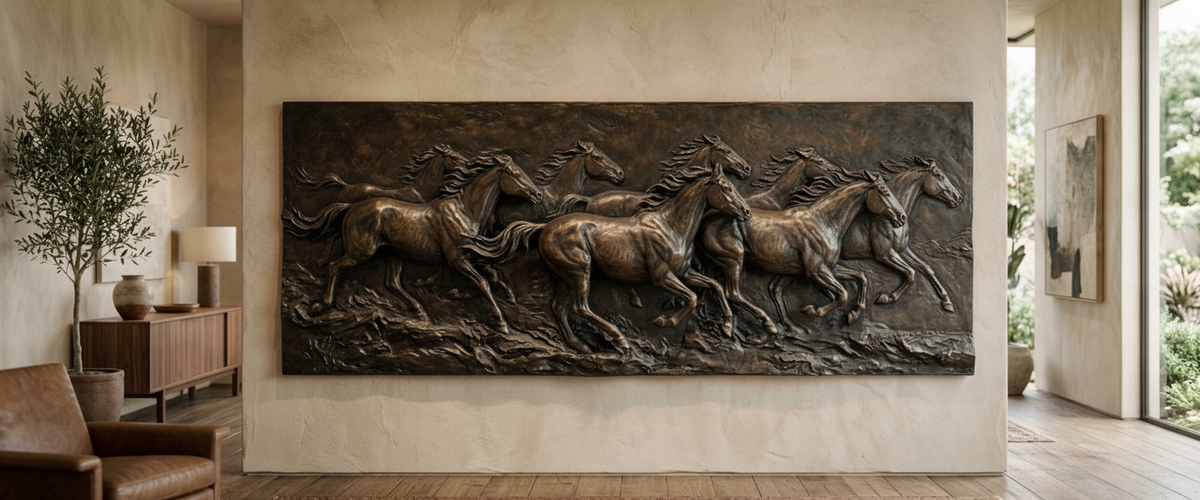

The wall is almost never the problem. The turn at the top of the stairs is. We have had clients fall in love with extra large wall art, clear the space, book an installer, and then discover the piece cannot make the 90-degree pivot from a hallway into a living room without going in on its edge. Measure the wall by all means. Then go measure everything between the curb and that wall, because that is the number that decides what you can actually buy.

Key Takeaways
Route before span. Doorway width, stair turns, and freight elevator depth cap the largest single panel of extra large wall art you can get inside, not the available wall.
Around 6 ft (1.8 m) is the hinge point. Above it, multi-panel construction usually beats one continuous piece for handling and hanging tolerance.
Wall build dictates fixings. Plasterboard, brick, and blockwork all carry weight differently, and heavy relief work wants solid backing or engineered anchors.
Metal travels better than stretched canvas. A bronze or steel relief arrives as it left; a large stretched print arrives with whatever the crate did to it.
Size for the far wall. In double-height and open-plan rooms, judge scale from across the room, not from the sofa.
Budget varies widely with material, scale, relief depth, engineering, finish, and installation. Ask for a tailored quote rather than guessing from a size.
Measure the Route First, Then the Wall
Write down five figures before you shortlist anything: narrowest doorway width, narrowest hallway width, the diagonal clearance on any stair turn or landing, the internal depth of the elevator, and ceiling height along the route. A relief panel can tilt, but it cannot fold. On a recent tasting room install, the freight elevator was the binding constraint at just under 7 ft (2.1 m) deep, which quietly ruled out the one-piece span the client had already measured for on the wall itself.
Route clearance, not wall width, sets the ceiling on extra large wall art.
Also check the handling reality at the other end. A panel that needs four people, a scaffold tower, and 12 ft (3.7 m) of standoff space in front of the wall is a different proposition from a piece that two installers can lift onto a French cleat. Ask how it is meant to be lifted, not only how it is meant to hang.

The Span Where One Panel Gives Up
Somewhere around 6 ft (1.8 m), the arithmetic behind extra large wall art flips. Below it, a single continuous panel is usually cleaner, stiffer, and simpler to hang level. Above it, weight per lift climbs, crate sizes leave standard freight brackets, and any wall that is not perfectly flat starts to fight a rigid one-piece back frame.
Multi-panel work solves most of that. Three panels on a shared centerline give you handling you can manage indoors, a little forgiveness on wall flatness, and a gap rhythm you can tune to the room. The trade is discipline: gaps must be set with a laser and a story stick, because an uneven reveal reads as a mistake from 20 ft away. If you want the drama of a long span without the risk, spec the piece as a modular set from the start rather than cutting a single design in half later.
Plasterboard, Brick or Blockwork: What Your Wall Will Carry
Hanging heavy relief on plasterboard alone is where most problems begin. In framed construction, the reliable answer is fixing into studs or a timber batten spanning several studs. Hollow-wall anchors carry published load ratings, but those ratings drop sharply under shear and dynamic load; the Gypsum Association publishes technical guidance worth reading before you trust a plasterboard plug with a cast panel. Brick and dense blockwork will take resin or sleeve anchors happily, but old lime mortar and hollow block both need testing rather than assuming.
For genuinely heavy extra large wall art, marble relief included, we specify the hanging system alongside the sculpture. Stone carries its own rules: a carved panel with the mass of Adam and Eve in Eden Marble Relief Wall Panel, 120cm wants solid masonry behind it and a load-rated cleat or bracket set, not whatever hardware came in the box. If your wall is stud-framed and you cannot add blocking, that is a legitimate reason to choose a lighter aluminum or carved wood relief and keep the visual span.
Why Extra Large Metal Beats an Extra Large Print
Scale punishes fragile construction. A 7 ft stretched canvas or acrylic face-mount travels as a large, thin, easily flexed plane; one corner impact in transit and the whole surface telegraphs it. Cast bronze, fabricated stainless, and aluminum relief behave like the sculpture they are. Cast metal relief has been outlasting its buildings since antiquity, which is why architectural bronze panels in collections such as the Metropolitan Museum of Art still read crisply centuries on.
Raking light across a deep cast relief keeps a long span alive through the day.
Metal also gives you something a print cannot: real shadow. Deep modeling of the kind found in Galloping Herd Bronze Relief Wall Art, 120cm reads one way at breakfast and another at dusk as light moves across it, so the wall stays interesting rather than becoming background. The metal wall art range is where that depth lives, while the 3D wall art collection covers carved and sculpted alternatives.

Double-Height and Open-Plan Rooms: Size for the Far Wall
Standard advice says hang art so the center sits at eye level. In a double-height great room, or an open-plan living area under a 20 ft ceiling, that advice produces a piece marooned in the lower third of the wall. Judge the composition from where people actually stand, which is usually the kitchen island or the entry, and raise the center accordingly so the mass sits within the upper visual field.
As a working rule, extra large wall art should occupy roughly two thirds to three quarters of the usable wall width above a sofa or console. Go wider and it crowds the returns; go narrower and it looks like a sample. Where the wall runs full height, treat the piece as architecture: align the top edge to a mezzanine line, a window head, or a beam, so it belongs to the building instead of floating.
Split It or Crate It: Freight Above 6 Ft
Past roughly 6 ft (1.8 m), crating for extra large wall art changes character. You move from parcel-scale carriage into palletized or custom-crate freight, often with dedicated bracing, corner protection, and foam-blocked faces. That is normal for sculpture and it is worth paying for, but it also brings truck access, tailgate lift, and site delivery windows into the conversation. Ask early whether the driveway takes a full-size truck.
Splitting a design into panels typically reduces crate footprint, spreads weight into liftable units, and removes single-point risk. Crating one piece keeps the surface continuous and avoids gap alignment on site. Neither is automatically right, which is why we talk it through per project before the piece is made.
Where Extra Large Metal Wall Art for Living Room Walls Earns Its Span
It earns it on the long uninterrupted wall opposite the seating, on a chimney breast with real width either side, above a low-profile media unit, and on stairwell walls read from two levels. It fails elsewhere: extra large wall art swamps narrow piers between windows, walls broken by switch plates and thermostats, and any surface where a door swings within 18 in (46 cm) of the frame edge.
Texture is the other lever. Where the room is already busy with pattern and polished metal would only add glare, a matte carved surface such as Barwick Taupe Flow Abstract 3D Carving Wall Art is closer to the right design language, holding scale quietly while reflective finishes suit calmer, cooler interiors. The wood wall art collection is the sensible starting point when weight limits or acoustics matter.

Pre-Order Checklist
Route measured: doorway, hall, stair diagonal, elevator depth, ceiling height.
Wall build confirmed: stud spacing located, or masonry type identified and test-drilled.
Standoff space available in front of the wall for lifting.
Single panel or multi-panel decision made, with gap spacing agreed.
Fixing system specified and load-rated for the finished weight.
Light source mapped, since raking light is what makes relief work.
Delivery access checked: truck size, lift gate, install crew, floor protection.
Finish chosen for the environment, including humidity near pools or open kitchens.
Commissioning a Piece to Fit the Wall You Actually Have
Most walls that need extra large wall art are awkward in some specific way, and that is exactly where a bespoke approach pays. Giant Sculptures makes large-scale and commissioned work to measured spans, so panel counts, relief depth, patina or powder-coated color, and the hanging system are all set against your drawings rather than a catalog size. Send wall dimensions, photographs with the light at two different times of day, construction details, and access notes, and we will come back with material options and a tailored quote. Cost depends on scale, material, relief complexity, engineering, finishing, and installation, so a quote based on your real constraints beats any ballpark figure. For inspiration while you gather the numbers, the full wall art and wall decor collection shows how span, material, and depth behave together.
For wider placement ideas, Large Abstract Wall Art for Hallways: Bold Lines Win at Walking Speed is useful companion reading before finalising the setting and sightlines.