





































































































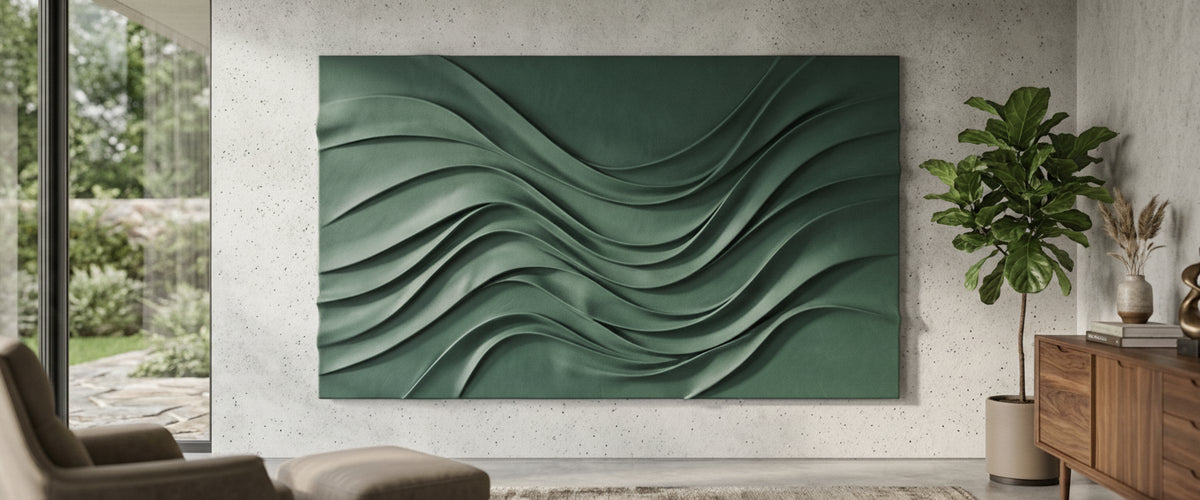

Most DIY leather wall art fails on the wall, not at the workbench. The cutting goes fine. The gluing goes fine. Then the finished panel goes up above a sofa, reads about a third too small, catches a hard shaft of afternoon sun, and within two summers the edges have curled away from the substrate. We see the aftermath often, usually when someone emails our studio asking whether we can make a larger, permanent version of something they built themselves.
That instinct is right. Handmade leather panels are a genuinely good entry point into textured wall decor, and for a hallway or a home office they can hold their own. But leather is an organic material that keeps reacting to heat, light and moisture, and the room decides whether those reactions become a problem. Below is how we think about placing DIY leather wall art, what changes when you scale up, and where a bronze, steel or engineered leather commission earns its keep instead.

Key Takeaways
Leather is an interior material. Sheltered porches are a maybe; open gardens are a no.
Most DIY leather wall art panels are undersized. Aim to fill roughly two-thirds to three-quarters of the wall zone you are decorating.
Direct sunlight and radiant heat are the two fastest ways to ruin a leather panel.
Faux leather wall art holds color better in bright rooms; full-grain hide reads richer under warm, controlled light.
Deep relief needs raking light. Flat lighting kills the shadow that makes 3D leather work.
Big spans, structural mounts and repeatable finishes are where a bespoke commission beats a weekend build.

What DIY Leather Wall Art Actually Looks Like, Room by Room
DIY leather wall art covers more ground than people expect. At the simple end you have stretched hide over a timber frame, edges wrapped and stapled, hung like a canvas. One step up, you get cut-and-layered work: discs, ribbons or overlapping scales built into low relief. Then there is leather face wall art, where a mask or portrait form is molded over a substrate, and leather wall hanging art, where strips or panels hang loose from a rod and move slightly when a door opens across the room.
Each behaves differently in a room. Flat stretched panels suit bedrooms and reading corners, where you want warmth and sound absorption rather than drama. Layered relief belongs in circulation spaces: entry halls, stair landings, the wall you see from the kitchen island. Hanging strip work needs air and a clear floor beneath it, so it fails in tight corridors where shoulders brush past. A client in Austin learned that the hard way with a strip piece next to a mudroom door; six months of coats and backpacks left one section noticeably darker than the rest.
Layered disc DIY leather wall art earns its place in circulation spaces, where light rakes across the relief.
Scaled-up leather wall art decor is a different discipline again. Multi-panel compositions work because the spacing between panels is designed, not improvised, and because each element sits at a depth that throws a consistent shadow. That control is the difference between a wall feature and a craft project pinned to plasterboard.

Scale, Sightlines and Mounting Height
Height is where DIY leather wall art most often goes wrong. The gallery convention puts the visual center of a work at roughly 57 to 60 inches (145 to 152 cm) from the floor, which suits a standing viewer. That rule breaks the moment the piece hangs above furniture. Over a sofa or a console, leave about 6 to 10 inches (15 to 25 cm) of breathing space above the furniture line and let the piece sit lower than instinct suggests. Over a fireplace, the mantel shelf becomes the baseline and the whole composition rises with it.
Width matters more than height for perceived quality. A 24-inch (61 cm) panel on an 11-foot (3.35 m) wall looks like a placeholder. As a working rule, the piece or grouping should occupy two-thirds to three-quarters of the usable wall width. That is why so many homeowners who start with one handmade square end up wanting three, then wishing they had planned the gaps first. A pre-composed set such as the Centria Multicolour Disc 4-Panel 3D Leather Wall Art fixes those gaps and the relief depth in advance, so the grouping spans a long wall as one composition rather than three separate objects that happen to share a color.
Sightlines deserve a walk-through before you drill. Stand where people actually stand: the doorway, the head of the stairs, the seat at the dining table that faces the wall. In double-height spaces, a piece placed at standing-eye level disappears from the mezzanine, which is why we often push relief work higher and increase the depth so it still reads from 20 feet (6 m) back. Depth is your friend at distance. Detail is not.

Indoor Versus Outdoor Placement: When Each Wins
For wider placement ideas, Sculpture 3d Wall Panels: A Buyer's Guide to Relief Art That Holds a Room is useful companion reading before finalising the setting and sightlines.
Leather is tanned animal skin, and even the best-finished hide stays responsive to relative humidity. Swings between damp and dry cause the fiber structure to expand and contract, which shows up as curling, cracking and lifted adhesive over time; conservation guidance from the Victoria and Albert Museum is consistent on keeping leather objects out of direct sun and away from heat sources. In practice that rules out most American exteriors for a DIY leather wall art panel. Phoenix summers, Gulf Coast humidity and Chicago freeze-thaw cycles will all find the weak point in a glued build.
Covered outdoor rooms are the gray area. A deep loggia in Santa Barbara with no driving rain and no direct sun can carry a faux leather wall art panel for years, because good synthetics tolerate UV and moisture better than natural hide. Ask two questions before you try it: does rain ever reach the wall, and does the sun ever land on it. One yes is enough to move indoors.
Where the wall genuinely lives outside, cast bronze gives you the shadow depth of DIY leather wall art without the weather risk.
When the wall genuinely lives outside, switch material rather than fighting physics. Cast bronze relief handles weather for generations and develops a patina instead of degrading, so on a stable courtyard or pool house wall where leather would not survive a season, an 80 cm work like the Traditional Horse Head Bronze Relief - 80cm gives you the same modeled shadow with none of the maintenance anxiety. Corten steel and marine-grade stainless cover the same brief in a more contemporary register; our metal wall art range exists largely for clients who fell for a textile or leather look and then remembered their wall faces west.

Light, Backdrop and Contrast
Three-dimensional DIY leather wall art is a shadow medium. Light it flat and it flattens. Light it from an angle, ideally with an adjustable spot aimed roughly 30 degrees off vertical, and the relief comes alive. Wall washers do the opposite job; they erase depth. The principle behind good accent lighting applies here: you want a clear contrast between the piece and its surround, not even illumination across the whole plane.
Backdrop color decides whether the piece reads modern or muddy. Tan and cognac hides need cool or pale grounds to separate; against a beige wall they turn to soup. Deeper tones, including the jade and forest greens that dominate leather wall art modern styling right now, carry beautifully on off-white, warm gray or plaster finishes. Integrated illumination changes the equation again: the Vanguard Jade Surge Leather 3D LED Wall Art carries its own edge glow, which lets it sit confidently on a dark ground that would swallow an unlit panel of the same size.
Watch heat, not only brightness. Halogen fittings mounted too close, or a recessed can directly above a panel, will dry leather unevenly. LED sources with a low forward heat output are the safer choice for any leather art wall installation.
Common Placement Mistakes We See with DIY Leather Wall Art
Above the range or a working fireplace. Cooking grease and radiant heat are both absorbed by leather, permanently.
Bathrooms and steam rooms. Even with an extractor, the humidity cycle is brutal on adhesives.
Fixing into plasterboard alone. Layered relief panels weigh more than people assume once a substrate is included. Find studs or use proper cavity anchors rated well above the actual load.
Ignoring the ceiling. A tall composition that stops two inches under a cornice looks squeezed. Leave a deliberate margin.
Matching the sofa exactly. A leather panel the same tone as the leather couch below it reads as upholstery offcut. Shift value or texture.
Buying the piece before measuring the route. We have sent a large panel to a pre-war Manhattan building where the freight elevator, not the wall, set the final size. Panelized designs solve this; single rigid boards do not.
A Pre-Hang Checklist for DIY Leather Wall Art
Tape a paper template of the full footprint to the wall and live with it for 48 hours.
Check the wall at different times of day for direct sun and note when it lands.
Measure furniture height first, then set the visual center from that line.
Confirm stud positions and pick fixings rated for at least twice the piece's weight.
Test the light angle with a portable lamp before you commit to a fitting.
Seal or condition the leather before mounting, not after, so edges are protected on all sides.
Leave a small air gap behind the panel; battens or a French cleat let the back breathe.
Photograph the finished install and note the fixings used, which makes any later move straightforward.
When to Commission Rather Than Build
DIY leather wall art has a ceiling, and it usually arrives at around 4 feet (1.2 m). Beyond that span you are dealing with substrate movement, joint alignment across panels, consistent dye lots across multiple hides, and a hanging system that has to be engineered rather than improvised. This is the point where clients call us. Personalized leather wall art from a studio also solves the repeatability problem: a hotel ordering the same motif across 40 guest rooms needs tolerances a hobby build cannot hold.
Giant Sculptures builds bespoke wall pieces the way we build freestanding sculpture, starting with the wall, the viewing distance and the environment, then choosing material. Sometimes that means leather. Often, for a Napa terrace or a Texas ranch entry, it means bronze relief or brushed stainless with a leather-inspired texture instead. Our leather art collection shows the range of relief depths and palettes available, and the wider wall art and wall decor range covers the metal and timber alternatives worth comparing before you commit.
Budget on a commission depends on scale, material, relief complexity, mounting engineering and finishing, so the honest answer is that we quote per project rather than per square foot. Send dimensions, a photo of the wall and a note on light and humidity, and we can tell you quickly whether leather is the right call or whether your wall wants something that will still look correct in 30 years.