



















































Most dining room wall art is chosen standing up and then looked at sitting down. That single mismatch explains why so many panels feel oddly high, oddly flat, or oddly small once the chairs are pulled out and dinner is served. A seated eye line sits roughly 12 to 16 inches (30 to 40 cm) lower than a standing one, the viewing distance shrinks, and light from a pendant rakes across the wall at a completely different angle. Get those variables right and a piece holds a room for twenty years. Get them wrong and you will quietly stop noticing it within a month.

Key Takeaways
Hang to a seated eye line, not a gallery standard. Center height around 54 to 58 inches (137 to 147 cm) suits most dining rooms.
Width should read against the table, not the wall. Two-thirds to three-quarters of table length is a reliable starting point.
Relief depth of around 1.5 inches (40 mm) does more work at close range than extra width.
Pendant clearance and wall build belong in the written spec, not in a phone call after delivery.
Ask for an on-wall mockup at true scale before you approve anything.
The Three Numbers Our Studio Asks for Before Any Dining Room Wall Art Commission
When a client sends us a dining room wall art brief, the first reply is almost always a request for three measurements. Table length, chair-back height, and wall setback. Table length sets the visual width the panel has to hold its own against; a 10 foot (3 m) table under a 30 inch (76 cm) canvas looks like a postage stamp on a garage door. Chair-back height tells us where the bottom edge can safely sit without a guest's head clipping it or a chair scuffing the finish during a dinner party. Wall setback, meaning the distance from the wall to the nearest table edge, tells us the real viewing distance.
That third number is the one people forget. A piece viewed from 4 feet (1.2 m) away is read as texture and shadow. The same piece at 12 feet (3.7 m) is read as silhouette and tone. Dining rooms are almost always the first case, which changes what we recommend before we have even discussed style.

Why Relief Depth Beats Extra Width at Seated Distance
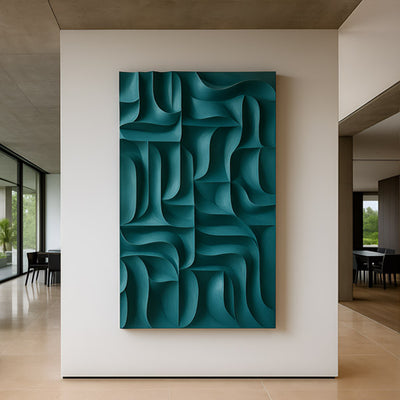
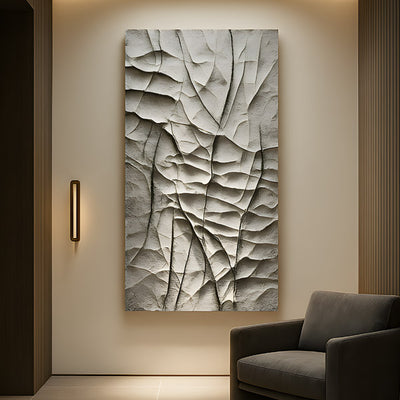
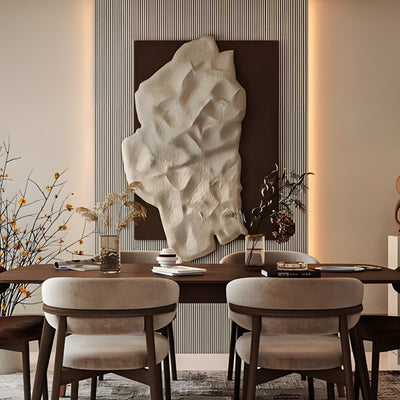
At close range, depth is what gives a wall panel presence. A relief profile of around 1.5 inches (40 mm) throws a genuine shadow line that shifts as the light changes through dinner, which is why carved and built-up surfaces outperform wider flat prints in a room where people sit for two hours. The piece stays interesting because it never looks identical twice. It is also the main reason a dining room wall art brief so often moves from flat canvas to carved relief once we have talked through viewing distance.
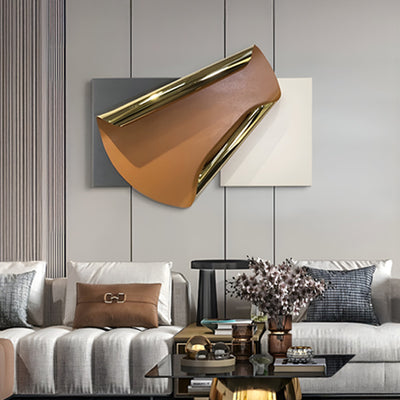
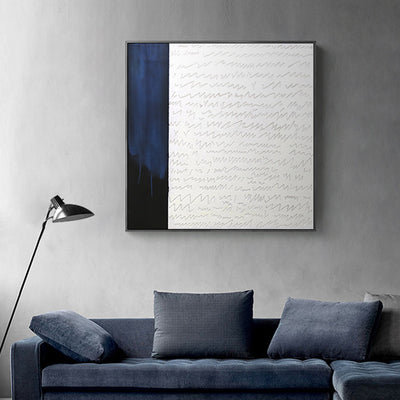
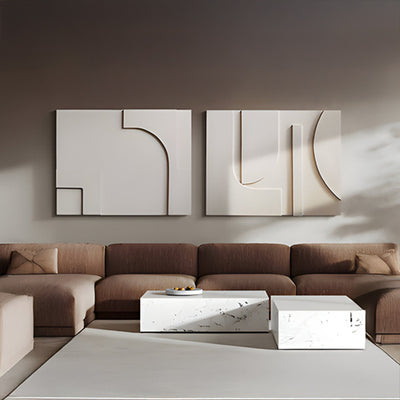
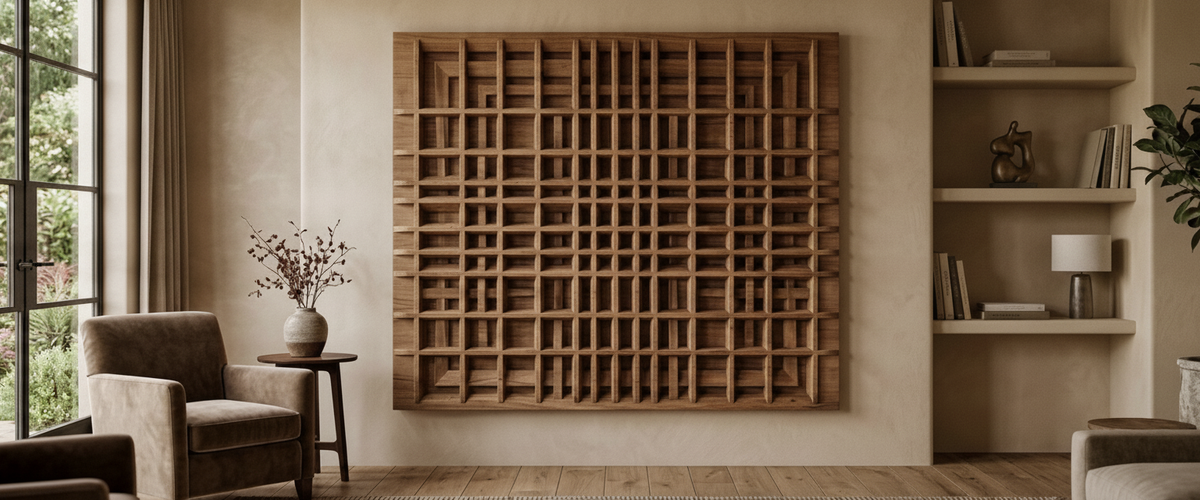
Deep carved grids make the point plainly. A panel such as the Barwick Mocha Grid Abstract 3D Carving Wall Art earns its place over a dining table because the cut depth carries the composition: from the far end you read rhythm, and from the nearest chair you read the tooling. Flat art has to rely on subject matter alone at that distance, and subject matter gets boring faster than shadow does.
Deep relief reads as rhythm from the far end of the table and as tooling from the nearest chair.
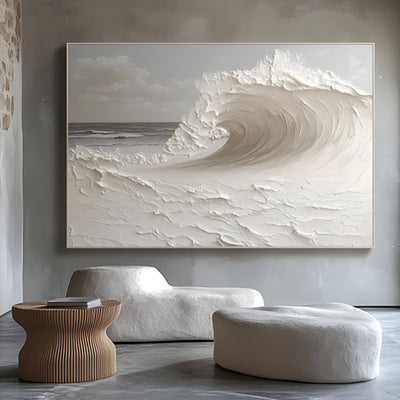
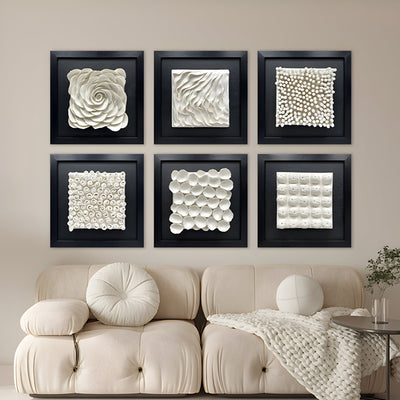
Where the wall wants softer relief with the same close-range payoff, mosaic and shell-set surfaces scatter light rather than block it. The Sandmere Shell Mosaic Abstract 3D Wall Art sits at that shallower, more granular end of the profile range, reading as quiet from across the room and detailed from the seat beneath it. Comparing profile depths side by side across the 3D wall art collection is the fastest way to calibrate how much relief your viewing distance actually needs.

Brushed Metal, Sealed Carved Wood, or Cast Composite
For wider placement ideas, Stainless Steel Wall Art That Won't Rust Orange in Three Years is useful companion reading before finalising the setting and sightlines.
Dining rooms are wiped down more than any other room in the house except the kitchen, so dining room wall art has to survive a cloth as well as a photograph. That reality should drive material choice harder than color does.
Brushed stainless or bronze-finished metal. The most forgiving surface for weekly cleaning. Grain direction hides micro-scratching, and splashes wipe off without lifting a coating. Best choice behind a serving console.
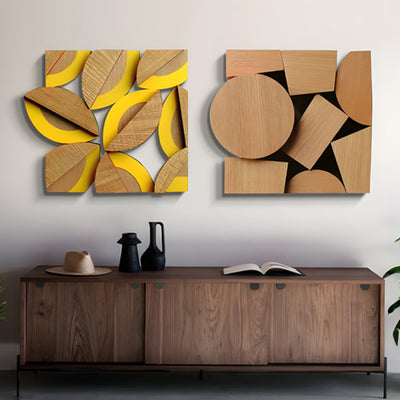
Sealed carved wood. Warm, acoustically kind, and excellent for deep relief. Wood does move with humidity, so a properly sealed panel matters. The USDA Forest Products Laboratory's Wood Handbook documents how dimensional change tracks moisture content, which is exactly why we finish all six faces of a carved panel rather than just the visible one. Our wood wall art pieces are built with that in mind.
Cast resin and composite. Useful when you want crisp repeated geometry at a lighter weight, particularly on stud partitions. Specify a sealed, non-porous topcoat if the panel sits within arm's reach of the table.
Paper-craft and unsealed textile surfaces look beautiful in photographs and are a genuine risk within splash range of a dining table. Put them on the far wall, not behind the carver.
Pendant Clearance Is a Spec Line, Not an Afterthought
A pendant or linear fixture over the table casts light downward and slightly outward. If your dining room wall art sits directly in that wash, the top third gets bleached and the bottom third goes dark. We ask for fixture height, drop length and beam spread so we can angle relief cuts accordingly, or recommend a shallower profile that will not create a heavy shadow shelf across the middle.
Fixture drop and beam spread decide whether relief cuts read cleanly or bleach out at the top.
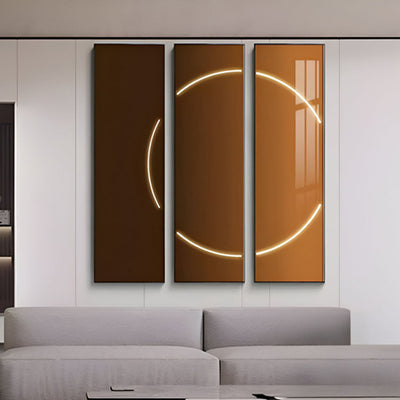
Illuminated pieces need even more care. An emissive panel like the Elysian Striking Glow 3D LED Wall Art only holds up if its output is balanced against the pendant above the table, and if the power feed has been planned into the wall before the plaster goes on. Any quote worth signing should state cable exit position and driver location in writing.
The Maquette Stage: Clients Change the Finish, Rarely the Form
Here is a pattern we see on nearly every bespoke commission. Clients approve the form quickly and then change the finish two or three times. A Napa client last year kept the carved geometry exactly as drawn and went through four sample boards before landing on a warmer, low-sheen tone that matched their walnut table under evening light. That is normal, and it is why we make finish samples in the actual panel material rather than on a generic swatch card. Sheen behaves differently on carved timber than it does on flat MDF.
Build the sample round into your schedule. It costs a week and saves a reorder.

Fixings, Wall Build, and Weight: What a Vague Quote Hides
Ask what the wall is before you ask what the dining room wall art costs. Solid masonry, stud partition, lath and plaster, and concrete each need a different fixing strategy, and a heavy relief panel on a poorly specified stud wall is a real failure risk. A complete quote should name the hanging system (French cleat, batten, standoff, or concealed bracket), the total hung weight, the number of fixing points, and whether you or the installer supplies anchors. If any of those four lines are missing, the number you have been given is not a full price.
Budget for a bespoke piece depends on material, scale, relief complexity, finishing, engineering and installation, so ask for a tailored quote against your measured wall rather than a headline figure.
Dining Room Wall Art Checklist Before You Sign Off
Table length, chair-back height and wall setback recorded and shared.
Center hanging height confirmed against a seated eye line.
Relief depth specified in inches and millimeters.
Finish sample produced in the final material, viewed in the room at night.
Pendant position, drop and beam direction noted on the drawing.
Wall construction confirmed and fixing method named.
Hung weight and fixing point count stated.
Scaled on-wall mockup approved, showing the piece with chairs pulled out.
That last point matters more than it sounds. A proper mockup should be a true-to-scale outline taped or rendered onto your actual wall, with furniture in position, photographed from the head and foot of the table. If a supplier will only show you a floating render on a white background, you have no way of judging whether the piece works as dining room art in your room. For more dining room wall art ideas across materials and profiles, our dining room art collection is the practical place to start, and the broader wall art and wall decor range covers pieces sized for adjacent hallways and open-plan sightlines.
Giant Sculptures works on bespoke commissions as often as on catalog pieces, and the questions above are the ones we ask before a single cut is made. Send us three measurements and a photograph of the wall, and the conversation starts in the right place.