





































































































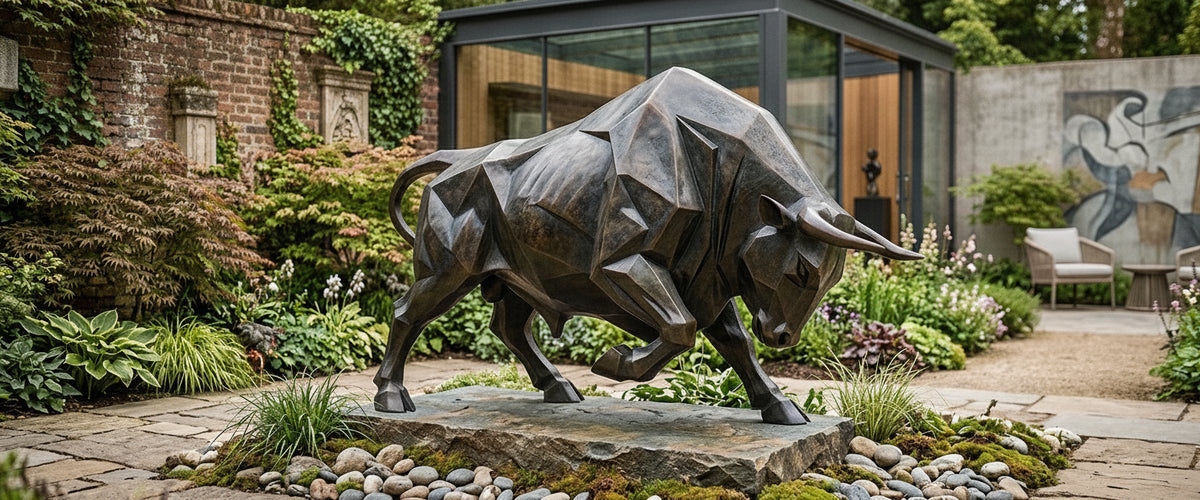

A cubist bronze charging bull is a piece designed to be caught mid-movement, and that changes everything about where you put it. The faceted planes throw hard shadows, the forward lean implies a direction of travel, and the whole form wants space to charge into. Set it in the wrong corner and all that energy stalls. Set a cubist bronze charging bull well and it reads with real force from thirty feet away and rewards a close look from three.
We have shipped charging bulls into corporate lobbies, private courtyards and a vineyard terrace, and the same lesson keeps coming back: the sculpture is only half the work. The other half is the sightline you give it.


At a Glance: Placing a Cubist Bronze Charging Bull
- Give it room ahead: the implied charge needs clear space in the direction the head points.
- Match scale to viewing distance: long approaches want a larger piece; tight interiors reward a compact one.
- Set pedestal height by eyeline: too tall and you lose the muscular top planes; too low and it reads as a floor object.
- Control the backdrop: a faceted cubist bronze charging form needs contrast, not a busy background fighting the shadows.
- Plan the first view: decide which angle people meet first and build the placement around it.
What Cubist Bronze Charging Reads Like in Different Settings
Cubist treatment breaks the animal into planes and angles rather than smooth naturalistic muscle. That geometry does two things. It catches light in sharp bands, and it exaggerates motion, so a cubist bronze charging bull looks faster and more aggressive than a traditional cast of the same size. In a minimalist interior, all concrete and glass, those planes echo the architecture and the piece looks like it belongs to the building. In a planted garden, the hard edges push against soft foliage and the contrast does the heavy lifting.
For a desk or console where the viewer is always close and the detail carries the moment, a compact faceted piece such as the Contemporary Charging Bull Bronze Sculpture - 30cm holds its own without crowding the room. At the other end, a large cubist bronze charging bull at 230cm (roughly 7.5 feet long) is an architectural gesture; it needs to be read across a room or a forecourt, and it will dominate anything smaller nearby.
Traditional casts sit differently again. Placed beside a Large Traditional Charging Bull Bronze Sculpture - 120cm, the trade becomes clear: the traditional bull reads as weight and realism, the cubist bronze charging bull reads as speed and idea. Neither is better. They just ask for different rooms.
Scale, Sightlines and Pedestal Height
Scale is the decision buyers get wrong most often, and it is almost always undershooting. A bull that looks huge in a photograph or a small studio can vanish in a double-height lobby or across a wide lawn. Our rule of thumb: measure the distance people will most often stand from the piece, then choose a length that still fills a comfortable slice of their view at that range. A bronze charging bull statue meant to anchor a 40-foot approach needs real length, closer to a life-size cast, or it becomes a lawn ornament.
Pedestal height is the quiet lever. A cubist bronze charging bull built with a lowered head and driving shoulders shows its best planes when the shoulder line sits near adult eyeline, around 4.5 to 5 feet (1.4 to 1.5 m) off the ground for a compact piece. Raise it too high on a tall plinth and viewers stare up at the belly and lose the aggression in the top of the back. Where the site calls for an animal that seems to close on the viewer across the ground, a life-size cast such as the Life-Size Charging Bull Bronze Sculpture - 210cm set almost at grade on a low stone base is closer to the right approach.
Sightlines matter as much as height. Face the head toward an open path, a lawn, a stair or an entrance, so the implied charge has somewhere to go. Corner a cubist bronze charging bull into a wall and you cancel the motion the sculptor built in.
Indoor Versus Outdoor: When Each Wins
Indoors, a cubist bronze charging bull becomes a controlled event. You govern the light, the backdrop and the distance, so a mid-size piece can carry a whole room. Lobbies, glass-walled galleries, stair landings and long hallways all give you the run-up the pose wants. The main constraint is floor loading and access; a solid bronze at life-size can run into the hundreds of pounds (well over 100 kg), and it has to get through the door before it gets onto the plinth.
Outdoors is where these pieces earn their reputation. Bronze is a genuinely long-lived outdoor material; the patina protects the metal beneath and, with sensible care, cast bronze survives outdoor display for generations, which is why museums and public collections rely on it. The Smithsonian's outdoor sculpture conservation guidance is a useful primer on why bronze weathers so well and what maintenance keeps it looking right. In a coastal garden or at a ranch entrance, an outdoor cubist bronze charging bull reads against sky and planting and gains drama from natural, moving light through the day.
Browse the wider bronze bull statues range if you are weighing indoor against outdoor; the pose and finish choices shift depending on where the piece will live.
Light, Backdrop and Contrast
A faceted cubist bronze charging form is a light instrument. Each plane takes a different value depending on where the light comes from, so lighting direction is a design decision, not an afterthought. Raking light across the flanks, roughly 30 to 45 degrees off the surface, pulls the geometry into sharp relief and gives the piece its punch. Flat frontal light kills it; the planes flatten into a single dull mass.
Outdoors, note where the sun tracks. A bull that faces roughly north or east will get side-raking morning light that models the form beautifully, while a due-south placement can wash out under harsh midday sun. Backdrop is the other half. A dark bronze patina needs contrast behind it: a pale render wall, a clipped hedge, open sky. Set a dark patinated bull against a dark yew hedge in shadow and it disappears at exactly the distance you wanted it to command.
Indoors, a single directional wash on a track head does more than a bank of even downlights. Aim for one strong key light and let the shadow sides read as shadow. That is what gives a cubist bronze charging bull its weight after dark.
Common Placement Mistakes We See in Commissions
For wider placement ideas, The Bronze Charging Bull Statue: A Buyer's Guide to Scale, Pose, and Placement is useful companion reading before finalising the setting and sightlines.
Every commission for a cubist bronze charging bull teaches us something, and the same avoidable errors turn up again and again.
- Charging into a dead end. The head points at a wall, a fence or a shrub. The motion has nowhere to go and the sculpture reads as stuck. Always give the head open space.
- Over-tall plinths. A dramatic base sounds impressive and then hides the best planes above adult eyeline. Model the eyeline before you build the base.
- Undersizing for the site. A piece chosen from a phone screen looks generous in the hand and small on a 60-foot forecourt. Tape out the footprint on site first.
- Busy backdrops. Mixed planting, patterned brick or reflective glass all compete with the faceting. Simplify what sits behind the bull.
- Ignoring the second view. People walk around outdoor sculpture. A pose that reads well head-on can look awkward from the side or rear. Check every approach before you fix the position.
One commission we shipped to a courtyard was almost derailed by the last point. The client had planned a head-on view from the front door and forgotten that the main daily route passed the bull from behind. We rotated the piece fifteen degrees so the driving shoulder led the side view, and the whole courtyard changed.
Commissioning a Bespoke Charging Bull
Stock sizes cover a lot of situations, but a bespoke cast lets you match scale, pose and patina to the exact site. If you want a specific head angle, a galloping stance with the head raised or a lowered driving charge, that is a design choice worth making early rather than compromising with an off-the-shelf pose. As a large-scale bronze specialist, Giant Sculptures handles the engineering that comes with a cubist bronze charging bull at size: internal armature, fixing points, base design and freight, whether the piece is going to a gallery or a garden.
Budget for a cubist bronze charging bull depends on material, scale, complexity of the cubist facets, engineering, installation and finishing, so the honest answer to how much is a tailored quote rather than a headline figure. Tell us the site, the viewing distances and the light, and we will steer the pose and scale from there. For inspiration on finish and form across the wider catalog, the full bronze sculptures collection shows the patina and casting range we work in.