





































































































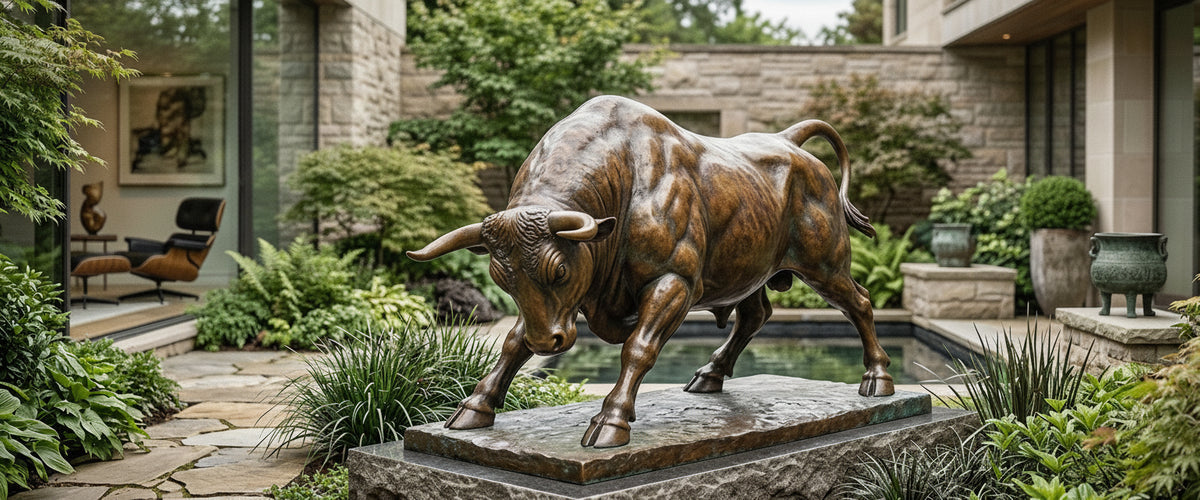

A charging bull is one of the few sculpture subjects that argues for itself the moment it lands. Lowered head, planted forelegs, muscle bunched under the shoulder; the pose reads as momentum before anyone knows the artist or the price. That is exactly why a bronze charging bull statue works so hard in the right setting, and why it falls flat in the wrong one. Get the scale and pose right and the piece anchors a whole courtyard. Get them wrong and a heroic animal looks stranded on a lawn.
This guide walks through the decisions that actually change the result: what the subject signals, how bronze behaves over decades, the pose and scale trade-offs, and how to place and commission a bronze charging bull statue so it earns its footprint.
A life-size charging bull anchors a plaza when the approach gives it room to be read as motion.

Key Takeaways
A charging bull signals drive and resilience, which is why it suits finance districts, ranch estates, and bold private entrances.
Cast bronze is the material of record for this subject; it holds fine muscle detail and lasts for generations outdoors.
Pose matters as much as size: head-lowered charge, galloping with head raised, and planted stance each read differently.
Scale must be set against sightlines and approach distance, not against the room you first imagine it in.
Budget depends on size, casting complexity, finishing, and installation, so a tailored quote for your bronze charging bull statue is the honest starting point.

What a Bronze Charging Bull Statue Means, and Who It Suits
The charging bull carries a specific message. It reads as force in motion, not a pastoral grazing animal or a calm heraldic figure standing guard, which is why the motif took hold in financial settings and why it works so well at the entrance to a corporate campus or a trading-adjacent office. A cast bull like this says the owner backs momentum and does not flinch.
In private hands the same energy translates differently. On a Texas ranch or a Napa estate, a bronze charging bull statue nods to livestock heritage and land. Outside a Manhattan penthouse lobby it becomes a statement of nerve. We have shipped bulls to clients who wanted a family emblem for a working ranch and to a developer who used one as the signature piece at the head of a residential drive. The subject is confident, so it suits buyers who want a focal point that commands rather than decorates.
If your taste leans quiet and contemplative, a bronze charging bull statue will fight the mood. This is a piece for people who want presence.
Materials, Finishes, and Scale Decisions
Bronze is the natural home for this subject, and there is a technical reason beyond tradition. Cast metal captures the tension in a bull's musculature, the flare of the nostrils, and the strain across the shoulders in a way few materials manage, and it does so while surviving decades of weather. A traditional copper-tin alloy develops a stable protective patina over time, which is why so many outdoor monuments from centuries ago are still standing. The Getty Conservation Institute's guidance on maintaining outdoor bronze explains how that surface film both protects the metal and needs periodic care to stay even.
Patina is a real decision: a warm brown reads classical, while a near-black finish looks contemporary against glass.
Finish is a real decision, not a default. A warm brown patina on a bronze charging bull statue reads classical and settles into planting and stone. A darker near-black patina looks contemporary and graphic, especially against glass or pale render. Some clients want polished highlights on the horns and back to catch light. Ask any studio to show you patina samples on metal, not renders, because the same recipe shifts with alloy and hand.
Scale is where buyers most often misjudge. For close viewing on a desk or console, something like the Contemporary Charging Bull Bronze Sculpture - 30cm rewards a hand's-length look but does nothing for a driveway. Step up to a piece such as the Large Traditional Charging Bull Bronze Sculpture at 120cm and you have a form that holds a garden bed or a large reception hall. For a true landmark you want a life-size bronze charging bull statue or larger, where a piece like the Life-Size Charging Bull Bronze Statue - 220cm reads as an actual bull from across a plaza. The jump from 120cm (roughly 47 inches) to 220cm (roughly 87 inches) is not incremental; it changes the piece from ornament to architecture, and it changes the weight, the base engineering, and the delivery plan.
Pose: The Detail Most Buyers Skip
Two bulls at the same height can read completely differently depending on stance. Where viewers approach head-on and you want that direct confrontation, a piece like the Life-Size Traditional Charging Bull Bronze Sculpture (Head Lowered Charge) - 200cm points energy forward and low, aggressive and grounded. Where the setting calls for speed and triumph rather than threat, the Life-Size Traditional Charging Bull Bronze Sculpture (Galloping, Head Raised) - 200cm sits better in a garden or a celebratory entrance, without an animal that looks like it is about to gore a guest.
Think about the line the pose draws and where that line points. A bronze charging bull statue aimed at your own front door can feel oppressive. Aimed across a lawn or out toward a view, it pulls the eye through the space. We always ask clients to walk the approach path before we lock a pose.
Where to Place a Bronze Charging Bull Statue for Maximum Impact
For wider placement ideas, Bronze Lion Statue Buying Guide: Poses, Placement, and Getting the Scale Right is useful companion reading before finalizing the setting and sightlines.
Placement is a viewing-distance problem first. A bronze charging bull statue needs room to be read as motion, so a cramped niche kills it. Give the piece a clear approach of at least two or three times its length and the pose comes alive as you walk toward it.
Strong placements we have seen work:
Head of a drive or plaza: the classic landmark position, with the bull angled slightly across the approach rather than pointing straight at the arriving car.
Terraced garden edge: set on a low plinth where a lawn drops away, so the animal reads against sky. A charging bull silhouetted on a lawn at dusk is a genuinely arresting sight.
Corporate forecourt: off-center to the entrance, on a stone or granite base, so it becomes a wayfinding and identity marker.
Water feature or reflecting pool: the reflection doubles the drama and suits the galloping pose especially well.
Base and foundation are not afterthoughts. A life-size bronze charging bull statue is heavy, and on soft ground it needs a proper footing to stay level and secure. In exposed coastal or high-wind sites, anchoring matters more than owners expect. Sort the groundworks before the piece arrives, not after.
Budget, Commissioning, and Delivery
Honest answer on cost: it depends. The price of a bronze charging bull statue is driven by size, the complexity of the casting (a mid-charge pose with a raised leg needs more internal armature and clever gating than a planted stance), the finishing hours, and the logistics of getting a heavy bronze to your site. Rather than quote a misleading range, we price each project on its actual specification and give a tailored quote. That is the only figure worth trusting.
A few things that move the number:
Scale. Bronze usage rises fast with size, and larger pieces need heavier bases and stronger internal structure.
Edition versus bespoke. An existing model reproduced to your finish costs less than a fully original commission modeled from scratch.
Finishing. Multi-tone patinas and selective polishing add skilled hand-hours.
Installation and shipping. Crating, freight, crane hire, and site access all vary by destination. Shipping a 220cm bronze to a mountain estate is a different job from delivering to a ground-floor city lobby.
On timelines, a bespoke bull is a build, not a stock pull. Modeling, mold-making, casting, chasing, and patination each take real time, and worldwide freight adds to that. Plan the commission for your bronze charging bull statue around your project deadline early, and confirm site access and craning needs before the piece leaves the studio.
How Giant Sculptures Handles Bespoke Bull Commissions
Giant Sculptures is a bespoke supplier of large-scale sculpture, and the bronze charging bull statue is a subject we know well. If one of our existing models fits, browse the full bronze bull statues range, or the wider bull statues and sculptures collection for other poses and treatments. If you want something specific to your site (a particular scale, a custom patina to match your architecture, or an original pose), we work from your brief through maquette to finished cast.
The most useful thing we do is early: we help you match pose and scale to the actual site before anything is committed, because that is the decision that determines whether the finished bronze charging bull statue looks inevitable or awkward. If you are weighing a charging bull against other subjects for a garden, the broader bronze garden statues range is a good place to compare presence and mood.
Quick Buyer's Checklist
Confirm the viewing distance and approach angle before choosing size.
Choose the pose for the message: head-lowered charge for force, galloping for speed and triumph.
Pick a patina against real samples, viewed near the intended backdrop.
Insist on cast bronze for outdoor longevity and fine muscle detail.
Plan the base and anchoring for weight and wind before delivery.
Get a tailored quote covering casting, finishing, and installation.
Book timelines around your project deadline, allowing for casting and freight.
A charging bull is a commitment. Chosen well, it is the piece visitors mention before they mention anything else on the property, and a well-cast bronze charging bull statue will still be doing that job long after the render on the wall behind it has been repainted.