





































































































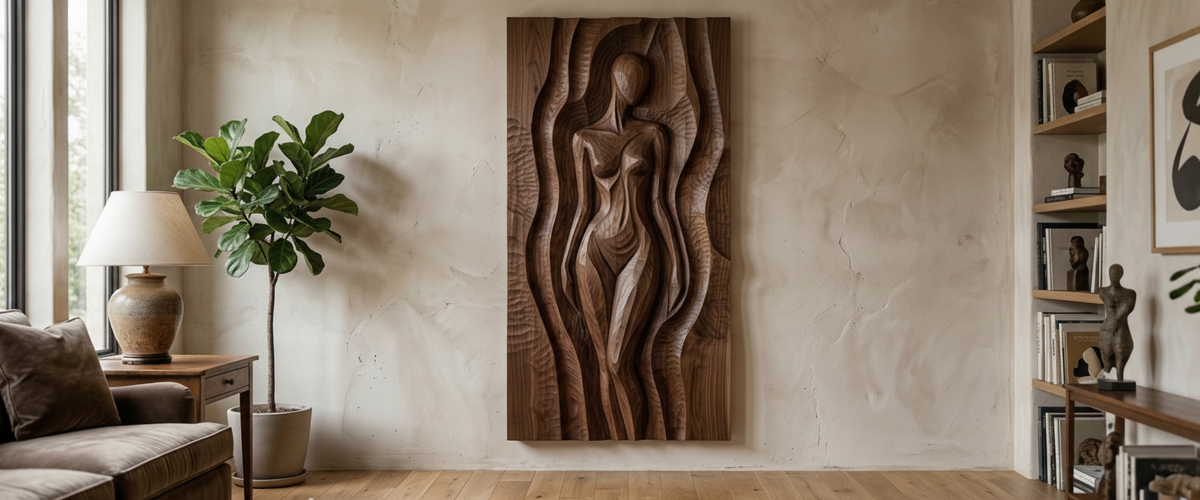

Most disappointing carved wood wall art is not badly made. It is badly lit. A panel that looked sculptural under angled workshop light goes flat on a north-facing wall in a Napa dining room, and the client is left wondering where the depth went. The carving did not change. The light did. Once you understand that carved wood panels are a shadow medium first and a wood medium second, every buying decision gets easier: how deep to cut, which wall to use, what finish to specify, and how high to hang.

Key Takeaways
Carved wood wall art is a shadow medium, so settle depth and light before you fall for a pattern.
Relief depth below roughly 5/16 in (8 mm) disappears under overhead light; around 3/4 in (20 mm) or more holds a shadow all day.
North-facing walls give soft, even light and need deeper cuts. East and west walls swing dramatically between morning and evening.
Front-on spotlights are the single most common mistake. Graze the surface at a shallow angle instead.
Matt and oiled finishes protect shadow. High-gloss lacquer competes with it.
Hang the panel where the light hits it, not where the furniture symmetry suggests.
Why 3/4 in of Relief Carries a Wall and 5/16 in Vanishes by Lunchtime
Shadow length is a function of cut depth and light angle. A shallow 5/16 in (8 mm) groove throws a visible line early and late in the day, then loses it entirely when the sun climbs or when a ceiling downlight sits nearly overhead. At around 3/4 in (20 mm), the same groove keeps a dark edge under almost any realistic interior light. Push past that into 1 1/2 in (40 mm) or deeper on a large abstract panel and the piece starts behaving like a relief sculpture: it reads from across an open-plan room, not just from six feet away.
Cut geometry matters as much as raw depth. A square-bottomed groove only holds shadow while the light sits off to one side, whereas angled facet cutting, of the kind used on Barwick Mocha Angled Abstract 3D Carving Wall Art, keeps one plane in light and one in shade across a much wider range of sun positions.
Grazing light on a 3/4 in (20 mm) relief: the shadow inside each cut goes black rather than gray.
Scale amplifies the problem. A small panel in a hallway can survive shallow carving because you view it close up. A 6 ft (1.8 m) run above a sideboard cannot. We have watched the same client reject two sample boards and approve a third purely on depth, with no change to the pattern. When you are choosing carved wood wall art from a range like our wood wall art collection, read the relief profile in the photography: look for whether the shadow inside each cut goes black or stays gray. Black means the cut is deep enough to hold.

North, East or West: What Each Wall Does to a Carved Figure Panel
North-facing walls in the US receive soft, indirect, almost shadowless light. Beautiful for paintings, punishing for carving, and the place where carved wood wall art most often underperforms. On a north wall you want maximum relief depth and a tonal contrast built into the piece itself, which is why gradient-finished carved wood panels wall art with an abstract figure motif holds its own there. On a wall the sun never touches, a piece such as Wenlock White & Earthy Gradient Wood Relief 3D Wall Art carries color contrast through the surface itself, so the composition still reads when the shadows will not do the work.
Carved wood panels wall art: an abstract figure motif carried by tonal gradient, so the panel still reads without raking sun.
East-facing walls get hard, low, raking morning sun. Carving looks spectacular at 8am and quiet by 2pm. West-facing walls do the reverse, which is worth planning around if the room is used mainly in the evening. South walls get the most consistent daylight but also the most UV, and prolonged direct sun will lighten walnut and darken some oaks over time. Position accordingly, or accept the patina as part of owning a natural material.
The Spotlight Mistake: Front-On Beams Flatten Every Cut You Paid For
Interior lighting plans default to aiming a downlight straight at the center of the artwork. That is correct for a flat canvas and wrong for carved wood wall art. A beam arriving perpendicular to the surface fills every recess with light and erases the shadow you commissioned. Grazing light does the opposite: mount the fixture close to the wall, roughly 8 to 12 in (200 to 300 mm) out, and let the beam skim down the face at a shallow angle. Museum lighting practice treats beam angle as a compositional tool rather than a brightness setting, and guidance from bodies such as the Illuminating Engineering Society is worth reading before the electrician sets your ceiling fixtures.
One practical test: hold a phone flashlight at the intended angle before the fixture is installed. If the carving loses its edges, move the light, not the artwork.
Grain Direction Versus Light Direction
In carved wood wall art, grain and shadow can either reinforce each other or fight. Oak has strong open pores and a loud figure; when the grain runs across the direction of the light, the surface texture chatters and can blur fine relief. Walnut is tighter and darker, so it absorbs light and lets the carved geometry lead. For a bold graphic pattern, closed-grain species keep the lines clean. For a warmer, more textural piece, let the oak grain do some of the work and cut deeper to compensate.
Wood also moves. Timber expands and contracts with the humidity of the room it lives in, which is why panel construction, moisture content at manufacture and acclimatization before hanging all matter more than buyers expect. The USDA Forest Products Laboratory publishes the standard technical work on wood moisture behavior. In practice: let a panel sit in the room for a week before you hang it, and keep it away from a fireplace wall or an unshaded south-facing window.

Matt, Oiled or Waxed: How Sheen Helps or Kills the Shadow
Finish is a shadow decision. A matt or hardwax-oil finish scatters light and keeps recesses reading dark. Waxed surfaces sit in the middle, with a soft luster that flatters warm evening light. High-gloss lacquer throws specular highlights that bounce across the relief and visually fill the cuts, which is why glossy carved panels often look busier and shallower than the same piece in matt. Painted finishes behave differently again: a pale top surface against a darker recess holds contrast even when the light fails, which is the logic behind a graphic painted relief such as Barwick Charcoal Grid Abstract 3D Carving Wall Art.
Same cut, two finishes: the matt sample keeps its recesses dark while the gloss sample fills with highlight.
Hanging Height as a Light Decision, Not a Symmetry Decision
The standard advice of 57 to 60 in (1450 to 1520 mm) to center is a gallery convention, not a rule for relief. If your ceiling lights sit forward of the wall, hanging slightly lower can pull the panel into a better grazing angle. Over a sofa or console, raise it enough that the bottom edge is not lost in shadow cast by the furniture itself. In double-height entry halls, the panel often needs to sit higher than instinct suggests, so the daylight from a clerestory strikes it rather than the wall above it.
Before You Hang: A Quick Checklist
Note the wall's compass orientation and when the room is actually used.
Check the relief depth against the viewing distance. Longer views need deeper cuts.
Test the light angle with a handheld beam before committing to fixtures.
Confirm the finish sheen: matt or oiled for maximum shadow, gloss only when you want reflection.
Acclimatize the panel in the room for several days before fixing.
Specify fixings rated well above the panel weight, and use two points minimum on anything over 4 ft (1.2 m) wide.
Dust along the grain with a soft brush; avoid wet cloths and silicone sprays.

The Same Panel, June Morning and December Afternoon
A west-facing wall in the Hamptons in June gets a long, warm 7pm rake that makes every cut look twice as deep. The same wall in December gets a low, weak 3:30pm wash and the panel goes quiet. Neither is a fault. Good carved wood wall art is designed to survive its worst light rather than only flatter its best, and that is the argument for specifying deeper relief and tonal contrast at the outset instead of trying to fix it with fixtures later.
Commissioning Carved Wood Panels at Scale
For larger walls, standard sizes run out fast. Bespoke carved wood wall art lets you set relief depth to the room's light, match species and finish to existing joinery, and run a pattern, whether a strict grid or a loose abstract figure, across multiple panels so the composition reads as one piece. We have produced multi-panel carved runs for hospitality interiors where the brief was driven entirely by one skylight, with the depth set on site using mock-ups before a board was cut. Budget depends on species, panel size, carving complexity, finishing and installation, so the honest answer is to send us the wall dimensions, the light conditions and a photo, and ask for a tailored quote. Giant Sculptures works on bespoke wall and sculptural commissions worldwide, and the 3D wall art range is a useful starting point for gauging the depth and pattern language you respond to.
For wider placement ideas, Large Wood Wall Art That Survives Its First Winter is useful companion reading before finalizing the setting and sightlines.