

























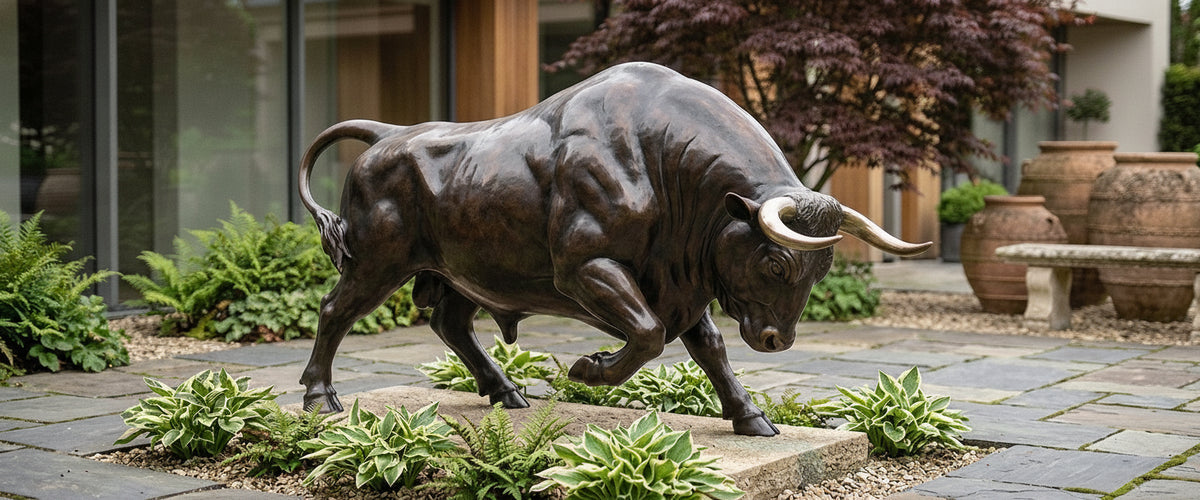

Tourists queue at Bowling Green in Lower Manhattan to touch the horns of a bronze bull, and the metal there is worn bright from decades of hands. That is the reference point almost every client has in mind when they ask us for a bull sculpture New York buyers would recognize. What they usually underestimate is the space around it. The Charging Bull sits in a public plaza with open approach lines, which is exactly why it looks unstoppable. Drop the same form into a tight courtyard and the animal stops charging and starts crowding. Most bull sculpture New York projects we quote are won or lost on that one variable.
Open approach lines are what let a charging pose read as movement rather than mass.

Key Takeaways Before You Choose a Bull
Approach distance beats height. A charging pose needs clear sightline of at least twice the sculpture's own length, so a 7 foot (about 2.1 m) bull wants around 14 feet of open approach.
Pose changes placement. A lowered head wants a frontal view; a raised head and galloping stance reads better in profile.
Bronze is the default for good reason. A cast bronze bull sculpture handles freeze-thaw winters, coastal salt and heavy public contact.
Pedestal height sets the mood. Ground level feels confrontational and human; a 24 to 36 inch (60 to 90 cm) plinth feels civic and formal.
Budget is driven by scale, wall thickness, patina complexity, engineering and installation, so ask for a tailored quote on your bull sculpture New York project rather than working from a guess.
What Bull Sculpture New York Buyers Actually Want in Real Spaces
The Wall Street bull sculpture created the visual shorthand: head down, shoulders bunched, tail whipping, dark patina with rubbed highlights. Clients then apply that idea to very different rooms. In a double-height Tribeca lobby, a full life-size bronze bull sculpture in New York works because the ceiling can absorb the mass and visitors approach it at an angle from the entrance doors. In a Napa winery forecourt, the same piece reads as agricultural heritage rather than finance. On a Texas ranch gate, it becomes a property mark you can see from the county road.
Interior placements usually call for restraint in size and boldness in position. Most of the indoor bull sculpture New York work we do lands well under life size. Where a desk-side presence matters more than mass, a piece at the scale of the Contemporary Charging Bull Bronze Sculpture, 30cm does the work; we shipped one to a private office in Midtown where it sits on a walnut credenza behind the desk, landing neatly in the frame on video calls. Same subject, entirely different job. A hedge fund client in Connecticut, by contrast, wanted a bull and bear sculpture pairing for a boardroom threshold, because the two animals together tell a story about markets that a single bull cannot.
Buyers looking for a bull sculpture in New York also tend to want the piece to read as intentional, not decorative. That is a placement decision more than a purchasing one. A bull parked politely against a wall looks like furniture. A bull angled across a circulation route, so people walk into its line of movement, holds the room.
Scale, Sightlines and Pedestal Height
For a bull sculpture New York staff or visitors will pass every day, start with viewing distance and work back to size. As a working rule in our studio, the primary viewing distance should be at least twice the length of the sculpture. A 7 foot (about 2.1 m) bull wants roughly 14 feet of clear approach; a monumental piece needs considerably more. If you cannot give it that, size down or change the pose.
Pedestal height then decides emotional register. Set the hooves at grade and a visitor stands eye to eye with the animal, which is why the Bowling Green bull invites touching. Lift it onto a granite plinth and it becomes monument rather than encounter. For estate driveways in the Hamptons and Aspen, we usually recommend a low plinth of 12 to 18 inches (30 to 45 cm), enough to keep bronze clear of mower splash and de-icing salt without turning the piece into a war memorial.
Group compositions change the math again, and a multi-animal bull sculpture New York commission needs width more than depth. A herd in motion, of the kind you get with the Monumental Three Charging Bulls Bronze Sculpture, 450cm, has to be read laterally rather than head-on. Put that piece at the end of a lawn axis or along a corporate approach road and the stampede reads. Push it into a corner and the animals fight each other for space.

Indoor Versus Outdoor Placement: When Each Wins
For wider placement ideas, The Bronze Charging Bull Statue: A Buyer's Guide to Scale, Pose, and Placement is useful companion reading before you fix the setting and sightlines for a bull sculpture New York commission.
Indoors wins when you want detail and finish to carry the piece. Under controlled lighting you can appreciate hand-chased hair texture, the modeling around the shoulder, the crisp edge of a hoof. Interior pieces also stay cleaner, so a lighter or more nuanced patina stays true for far longer.
Outdoors wins when you want scale and silhouette. Bronze belongs outside, and its durability comes from the stable surface layer that forms on the metal itself rather than from any factory coating. Conservation guidance from institutions that maintain public bronzes stresses regular washing and waxing rather than aggressive cleaning, and that same routine works for a private garden bull. A bull sculpture New York winters will test needs that discipline most of all, and a cast bronze piece in a coastal garden on Long Island will need wax more often than the same casting in Arizona, simply because salt-laden air accelerates surface change.
One practical note from delivering a bull sculpture New York clients ordered for a Manhattan lobby: the building, not the garden, is usually the constraint. Freight elevator dimensions, loading dock height limits and stairwell turns have forced more size revisions than any aesthetic concern. We ask for those measurements before we ask what patina you like.
A pale backdrop and two low uplights keep the modeling of the shoulder and neck readable after dark.
Light, Backdrop and Contrast
Dark patinated bronze disappears against dark backgrounds. That is the single most common visual failure we see. A near-black bull sculpture in New York, set in front of a yew hedge or a charcoal stone wall, loses its edges entirely once the light drops. Give it a light limestone facade, a pale render wall, a sky backdrop on a rise, or a gravel forecourt that bounces light back into the underside of the body.
Directional light matters more than brightness. Two low-level uplights set roughly 45 degrees off the front quarters will model the shoulder and neck muscles the way a photographer would. A single flat floodlight from the front flattens everything into a shadow puppet. Warm light around 2700K to 3000K flatters brown and mahogany patinas; cooler light pushes them gray.
If your setting is genuinely dark and you still want mass, consider a lighter patina, a verdigris finish, or a polished stainless steel treatment instead. Our team can also apply selective highlight rubbing on horns, spine and hooves, which mimics the way the Wall Street bull sculpture gleams wherever hands have polished it.
Placement Mistakes We See in Bull Sculpture New York Commissions
Every one of these has come up in a real commission conversation.
Buying for the room and forgetting the approach. The piece fits the space but nobody can stand far enough back to see it whole.
Aiming the horns at a doorway. A charging bull pointed straight at where people enter reads as aggression, not confidence. Angle it across the route instead.
Ignoring sprinkler heads and irrigation. Repeated hard-water spray leaves mineral staining on bronze that is tedious to remove.
Skipping the base engineering. Large sculpture needs a proper footing and internal armature fixing. Slab thickness, frost depth and wind loading are engineering questions, not decorating ones.
Choosing scale from a photograph. Cut a full-size silhouette from plywood or tape the footprint on the ground and live with it for a week.
Pairing mismatched sets. A bull and bear sculpture pairing needs matched patina, matched finish quality and matched plinth height, or the composition looks accidental.
Your Pre-Commission Checklist
Measure the primary viewing distance and the widest clear sightline.
Photograph the backdrop at three times of day to test contrast.
Confirm delivery access: gate widths, dock height, elevator size, crane or forklift room.
Decide pose and orientation before you fix size.
Agree plinth material and height with your landscape designer or architect.
Specify patina with the lighting plan in hand, not after installation.
Plan for a wash and wax cycle, and budget for it as ownership cost.
Request a tailored quote for your bull sculpture New York installation covering casting, finishing, crating, freight and installation.

Commissioning a Bespoke Bronze Bull
Bulls are cast, not carved, which means the design stage is genuinely open. Our foundry partners work from clay models, so stance, horn angle, musculature, tail position and base profile can all be adjusted before anything is committed to metal. Clients have asked us to raise a head, shorten horns for a public plaza, widen a stance for wind stability, and add a breed-specific dewlap to match a working herd. Asking for the Monumental Charging Bull Bronze Sculpture, 300cm at a reduced height, on a wider base, or in a lighter patina is a normal starting point for a bull sculpture New York commission rather than an exception.
The Chicago comparison is worth thinking about too. A bull sculpture Chicago buyers commission for trading-floor heritage often leans traditional and heavy-set; a New York bull sculpture more often wants the taut, forward-driving silhouette. Both start from the same casting process and end up looking quite different. Browse the range of bronze bull statues to see how pose changes the character, then look at the wider bull statues and sculptures selection for scale options from tabletop to monumental.
What a bull sculpture New York clients commission actually costs, or one anywhere else, depends on scale, bronze weight and wall thickness, patina complexity, structural engineering, crating and site installation. Send us the setting, the sightlines and the access details, and we will price the piece properly rather than guessing at it.