

































































































Hang a big canvas art panel on a west-facing wall and watch it at four in the afternoon. Low sun rakes across the surface, looks for something to catch, and finds nothing. The image is still there. The object has gone. That moment is the honest test of any large flat work, and it is the reason two pieces with identical footprints can feel like a focal point and a paint swatch.
We sell canvas and we sell sculpture, so we have no reason to flatter either. What follows is what we tell clients weighing big canvas art against a sculpted relief for a 10-foot wall.

Quick Answer: What Big Canvas Art Can and Can't Do
Big canvas art wins on color saturation, shipping, weight, and wide horizontal coverage for the money.
Canvas loses the moment side light hits. Flat surfaces have no self-shadow, so they read as surface, not object.
Depth is the variable, not size. A 3-inch-deep relief panel outperforms an 8-foot (2.4 m) flat print in raking light every time.
Lighting decides half the outcome. Recessed downlights kill canvas. Wall washers and angled spots revive it.
Stairwells, double-height halls and lobbies punish flatness because viewers see the wall from multiple angles and distances.
The Flatness Tax
Every flat artwork pays a tax in oblique light. Your eye reads three-dimensionality through shadow gradients, and a stretched canvas offers roughly 1.5 inches (38 mm) of edge depth and nothing else. In full frontal light, no problem. In the late-afternoon slant that most good living rooms get, the piece flattens into the plaster behind it.
The tax is highest where the viewing angle is widest. A gallery wall you approach head-on from 15 feet is forgiving. An apartment corridor where you pass within 3 feet of the surface is not, because at that angle you are seeing the wall almost edge-on and the weave has nothing to offer the eye. This is the single most useful thing to know before you commit to big canvas art: size buys presence only where the light lands square on.
The 4pm test: raking light finds nothing to catch on a flat surface.

Print, Impasto, Relief Panel: Three Depths, Three Different Artworks
Treat depth as a spec, the same way you would treat patina on bronze.
Flat Canvas Art Prints
A canvas art print is a giclée or pigment image printed onto primed cotton or polyester canvas and stretched over a timber bar frame. Zero surface relief beyond the weave. Excellent for saturated graphic imagery, album art canvas pieces in a media room, or anywhere the image itself is the point.
Impasto and Hand-Finished Art Canvas
Hand-applied oil or acrylic ridges, sometimes over a printed base. You get maybe 1/8 inch (3 mm) of relief, which sounds trivial and is not. That is enough to throw micro-shadows and keep the piece alive under a raking wall washer. Where you want that worked surface and a wide horizontal span, a triptych such as Fantoria 3-Set Abstract Portrait Oil Canvas Wall Art handles both at once: the oil texture catches side light, and the gaps between panels cast shadow lines of their own.
Relief and Sculpted Panels
Now you are in our territory. Layered paper, sculpted fabric, welded metal, carved composite. Depth measured in inches rather than millimeters. Once a wall piece is allowed to project, the work changes as you walk past it, which a print never does.

Why Big Canvas Art Vanishes Under Downlights
Most interiors are lit from ceiling recessed cans placed roughly 12 to 18 inches (300 to 450 mm) off the wall. That beam hits a flat canvas at a steep angle, creates a hot band across the top third, and leaves the bottom in a gray fall-off. Nothing about that flatters art.
Wall washing is the fix. Lighting designers aim for even vertical illuminance across the full plane, and the Illuminating Engineering Society's guidance on interior lighting practice is worth handing to your electrician before the ceiling is cut. For a hand-finished or relief surface, do the opposite on purpose: pull the light source closer to the wall and let it graze across the texture. Move one adjustable spot 8 inches (200 mm) nearer the plaster and a textured panel can look like a different painting.
Keep light levels sane while you are at it. The Canadian Conservation Institute's notes on light damage to museum objects are blunt about cumulative fading in pigments and dyes, which matters for big canvas art hung opposite a wall of glass.
Scale Won't Rescue a Flat Surface
There is a persistent belief that if a wall feels empty, the answer is simply a bigger picture. We have watched an 8-foot (2.4 m) canvas go up in a double-height great room and do almost nothing, because the viewers were standing 30 feet back and two stories of light were washing it from above. Scaling up big canvas art scales up the flatness with it.
Two things genuinely scale well: contrast and depth. For a wall read from 30 feet, high-contrast graphic work such as Skull&Stone I Abstract Canvas Wall Art survives the distance because the composition still works when it is reduced to shapes. Everything subtle dies at that range unless it has physical relief.
Rooms Where Flat Is Right, and Stairwells Where It Never Is
Good for canvas: bedrooms with soft ambient light, dining rooms lit by pendants rather than spots, media rooms where you want color without glare, offices with even overhead light.
Bad for canvas: stairwells and double-height halls (multiple viewing angles, harsh raking light), long corridors, entry walls facing west or south glazing, any wall where the viewer passes within 3 feet.
In those problem zones, look through mixed media art before you commit to big canvas art. You want something that behaves differently from each angle.
Hanging for Shadow: A Checklist
Center at 57 to 60 inches (1450 to 1525 mm) to the middle of the work for standard ceilings. Raise it for double-height rooms, but no higher than the point where the bottom edge clears sightlines.
Use standoffs. Pushing the panel 1.25 inches (32 mm) off the wall creates a shadow gap that reads as depth even on a flat piece.
Aim spots at 30 degrees from vertical for prints. For textured work, tighten toward 20 degrees so the beam grazes.
Check the 4pm test before you drill. Hold a sample or a cardboard mockup at the intended height at the worst light hour.
Fix to studs or use proper anchors. Large stretched works catch air movement from HVAC and swing on single-point hooks.
Leave a 2 to 3 inch (50 to 75 mm) gap between multi-panel sets so each panel casts onto the wall, not onto its neighbor.

When a Sculptural Panel Beats a Canvas of the Same Footprint
Same wall area, different behavior: the relief panel makes its own shadow.
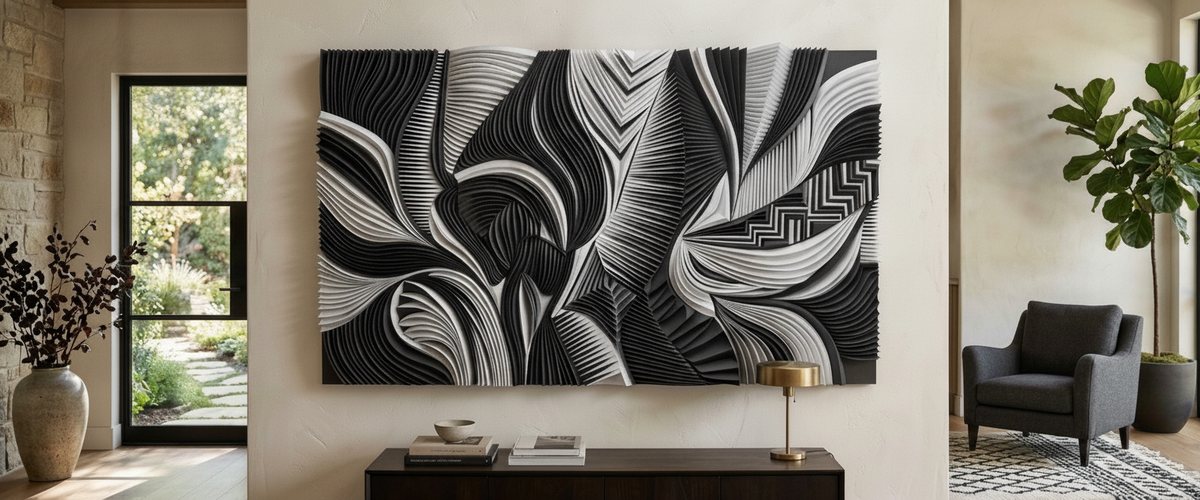
Swap like for like and the difference is obvious. A layered work such as Stratura I Black & White Layered Paper Canvas Wall Art takes up the same wall area as big canvas art of identical dimensions but generates its own shadow field, so it stays legible whether the room is lit from the ceiling, the floor or a window. That is the whole argument. Same footprint, more information for the eye.
If you are already committed to a flat piece for color reasons, the ranges in our canvas art collection are the right starting point, and we will still tell you where to put the lights. If the wall is difficult, a bespoke metal or carved relief panel is the better spend.
Commissioning Depth to Fit the Wall
Bespoke wall pieces are where Giant Sculptures spends most of its time. We build to a measured wall rather than to a catalog size, which means depth, projection, weight distribution and fixing method all get specified together. Budget depends on material, scale, engineering complexity, finishing and installation, so we quote each commission individually rather than publishing bands that would mislead you.
Send us the wall dimensions, the ceiling height, a photo at the worst light hour of the day, and the fixture positions if they exist. That is usually enough to tell you whether big canvas art will hold that wall or whether you need something that casts a shadow.
For wider placement ideas, Paper 3d Wall Art: How to Buy a Panel That Holds Its White is useful companion reading before finalising the setting and sightlines.