





































































































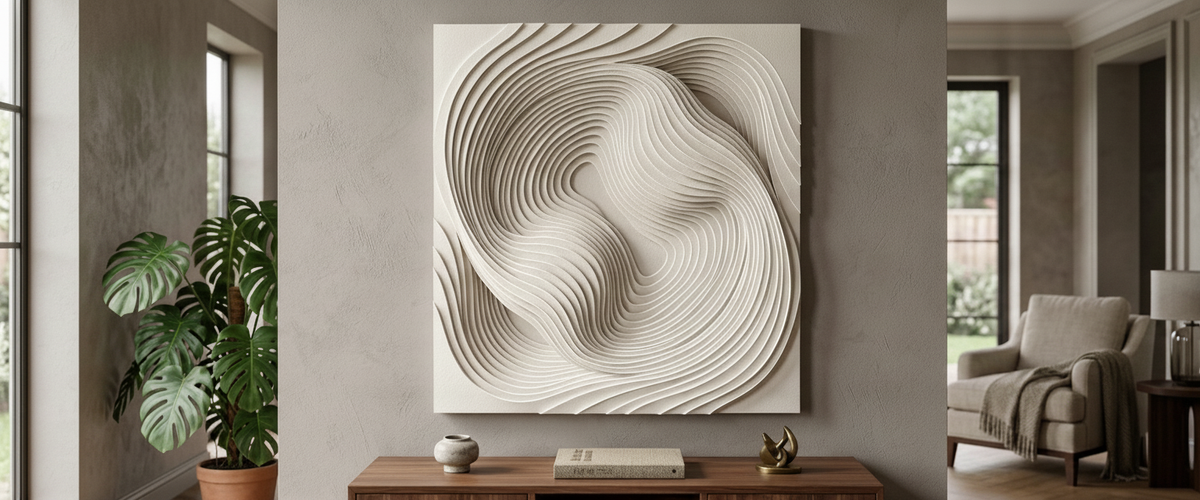

A cut-paper panel can arrive looking museum-grade and turn dishwater-beige by the following August. That is the honest risk with paper 3D wall art, and it has almost nothing to do with what you paid. It comes down to fiber source, internal sizing, pH, stock weight and the wall you chose. Get those right and a paper relief will still read crisp white in fifteen years. Get them wrong and you own a very expensive sun-fade record.

At a Glance
Fiber matters most: 100% cotton rag holds its tone for decades; cheap wood-pulp stock ambers fast because of residual lignin.
Two spec lines to demand: alkaline (buffered) pH and internal sizing. They predict yellowing better than price does.
Depth needs weight: 300gsm and above throws a hard, legible shadow. 160gsm curls and reads flat from across a room.
Glaze or lose it: UV-filtering acrylic in a deep shadowbox protects paper 3D wall art far better than any spray sealant.
Two killer walls: above a radiator, and a south-facing landing with unshaded glass.
Where paper 3D wall art wins: low weight, light fixings, soft acoustics, and walls you cannot drill deeply.
Rag Versus Pulp: One Holds Its White, One Goes Amber
Every long-lived piece of paper 3D wall art starts with fiber choice. Cotton rag paper is made from cellulose with the lignin already stripped out. Lignin is the compound in wood pulp that oxidizes under light and heat and turns brown, which is exactly why a newspaper left on a windowsill goes tan within days. A 100% rag sheet has no meaningful lignin load, so its baseline color drifts slowly and predictably.
When you shop for paper 3D wall art on marketplaces, the listing usually says "premium cardstock" and stops there. Push for the mill and the grade. If the seller cannot tell you whether the stock is rag, alpha-cellulose or standard pulp board, assume pulp. In a shaded interior hallway that may be fine for a few years. On any wall touched by daylight, pulp is a countdown.

Sizing and pH: The Two Spec Lines Buyers Skip
Sizing is the treatment that controls how much moisture the sheet absorbs. Internally sized paper resists humidity swings, holds a folded edge, and does not go soft at the crease line after a humid summer. That is the split between paper 3D wall art that keeps its edges and a panel that quietly sags. Surface-only sizing looks similar in the shop and behaves worse on the wall.
pH is the other line. Acidic paper attacks itself over time; buffered alkaline paper with a calcium carbonate reserve neutralizes acids as they form. The permanence benchmark to ask about is ISO 9706, the standard for permanent paper, which sets requirements for pH, alkali reserve and lignin content. A maker of paper 3D wall art who quotes that standard has thought about longevity. A seller quoting only thickness has not.
Cut Depth and Stock Weight: Why 300gsm Beats 160gsm
Relief work lives on shadow. The whole visual payoff of a layered panel is the dark line where one plane lifts off another, and that line is produced by edge thickness plus lift height. Most paper 3D wall art that disappoints fails right here. At 160gsm the sheet is too flexible to hold a clean vertical face, so the shadow softens and the piece flattens out beyond about eight feet (2.4m) of viewing distance. At 300gsm and up, each cut edge stands square and the shadow stays hard.
Heavier stock keeps each cut edge square, which is what holds the shadow line at distance.
Match depth to viewing distance. A panel read from two or three feet away can work with 1/4 inch (6mm) of layer separation. A large piece over a sofa or in a double-height stairwell needs 3/4 inch to 1-1/2 inches (20mm to 40mm) of relief before it registers as three-dimensional at all. The same physics governs carved timber: on a panel like the Barwick Charcoal Flow Abstract 3D Carving Wall Art, it is the depth of the groove rather than the color that carries the form across a big room, and paper 3D wall art has to earn that legibility through stock weight instead of mass.

UV Glazing, Sprays and Shadowboxes, Ranked
Protection for paper 3D wall art, ranked by what it genuinely prevents:
UV-filtering acrylic glazing in a sealed shadowbox. Cuts the damaging end of the spectrum, blocks dust and airborne grease, and stabilizes humidity around the sheet. This is the only option that addresses all three threats.
Deep open shadowbox with no glazing. Good for shadow quality and air flow, useless against dust, which is the usual reason white paper relief looks gray within a few years.
Spray sealants and fixatives. They can slow surface soiling slightly. They also add sheen, can stiffen fine cuts, and often shift the white toward cream on application. Test on an offcut first, always.
A sealed, UV-glazed box handles light, dust and humidity at once; sprays handle none of them well.
None of these stops fading from over-exposure; they only slow it. Conservation guidance is blunt: light damage to paper is cumulative and irreversible, which is why museums rotate works on paper rather than leave them lit permanently. The Northeast Document Conservation Center covers this well. Treat light exposure as a budget you spend once, and site your paper 3D wall art accordingly.
Two Walls Paper Never Recovers From
Two walls in a normal house will finish off paper 3D wall art faster than anything else. The radiator wall is the first. Rising dry heat pulls moisture out of the sheet in winter, the fibers shrink unevenly, and layered cuts cup or lift at the corners. Reverse the humidity in summer and the panel does not return to flat. The second is a south-facing landing with unshaded glass. Stairwell landings usually get the most direct light in the whole house, and nobody stands there long enough to notice the fade until it is severe.
Both walls want a harder material. Carved timber tolerates the swing far better, and above a radiator a piece such as the Barwick Mocha Grid Abstract 3D Carving Wall Art keeps its geometry through seasonal movement that would cup a sheet of paper 3D wall art within a year. If the wall gets real sun, our advice is metal every time; browse the metal wall art range and put the paper somewhere kinder.
Where Paper 3D Wall Art Genuinely Outperforms Metal
There are three situations where we would specify paper 3D wall art over metal without hesitation. The first is rented apartments and party-wall constructions where you cannot drill deep anchors: a large paper relief may weigh only two to six pounds (1kg to 3kg), so it hangs on light fixings a steel panel could never use. The second is acoustically live rooms, where a layered fibrous surface takes the edge off slap-back that a flat metal sheet amplifies. The third is bedrooms and media rooms where you want zero reflected glare.
Paper also gives you textural range that metal cannot match at close viewing distance. Where a room needs that hand-made, light-catching surface but the wall is too demanding for cut paper, the Sandmere Shell Mosaic Abstract 3D Wall Art occupies the middle ground: the same fine-grain relief, in a material that wipes clean and holds its shape through humidity swings. Compare the options across our 3D wall art collection before committing a whole wall.
Sample Before the Panel Is Cut
Every commission we run through the studio starts with material samples in the client's own room, and paper 3D wall art needs this more than any other medium because whites are ruthless under artificial light. A cool 4000K downlight makes a warm white paper look dirty. A 2700K lamp makes a bright white look yellow.
The pre-commission checklist:
Get at least three whites or tones as loose swatches, not photos.
View them on the actual wall, at the actual height, under your own bulbs, day and night.
Ask for one small cut sample at the proposed relief depth to check the shadow from your normal seating position.
Measure surface temperature near heat sources and note peak direct sun hours on that wall.
Confirm glazing type, box depth and the fixing system before the full sheet is cut.
Ask what happens if a layer is damaged in transit; panel work is repaired by replacement, not touch-up.
One client fitting out a Napa guest suite wanted a 7-foot (2.1m) paper relief on a wall that took two hours of hard afternoon light. We sampled it, walked them through the fade risk, and moved the paper piece to the corridor. The sunlit wall got engineered metal instead. That is the sort of call we would rather make before fabrication than after.

Commissioning at Scale
Giant Sculptures builds bespoke wall and freestanding work for homes, hotels and commercial venues, and the same rules apply to paper 3D wall art as to a bronze: size the piece to the wall, specify the material for the environment, and plan the fixings early. Budget depends on scale, material grade, cut complexity, glazing, engineering and installation, so we quote each commission individually rather than publishing a figure that would mislead you. Send wall dimensions, a photo, light conditions and your target proportions, and we will tell you honestly whether paper is the right answer or whether the wood wall art route will serve you better for the next twenty years.
For wider placement ideas, 3d Wall Art for Office Spaces: The Two Distances That Decide Everything is useful companion reading before you fix the setting and sightlines for a piece of paper 3D wall art.