





































































































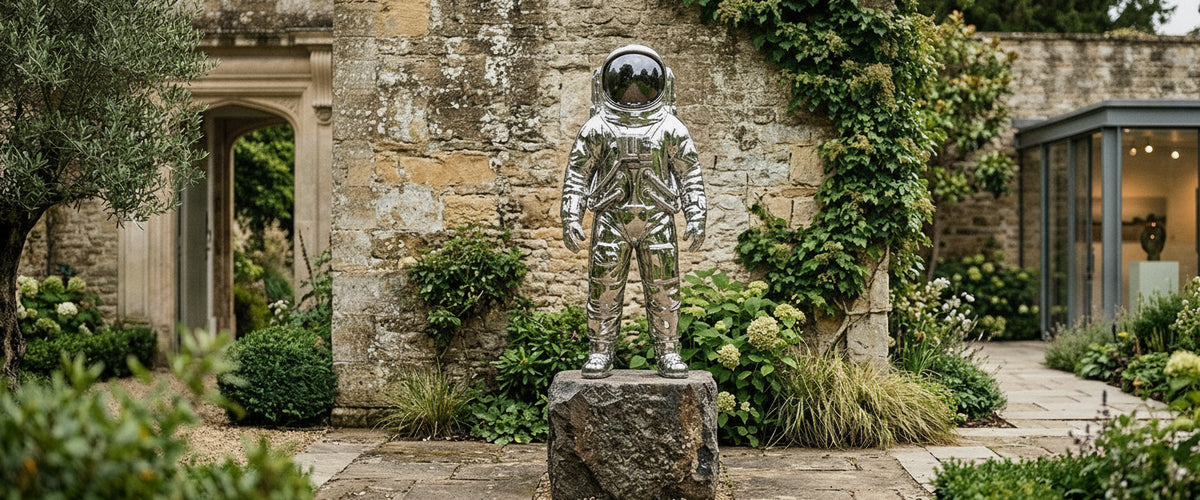

Put a spacesuit under a stone vault and something strange and good happens. The oldest architecture we build meets the newest thing we have made, and visitors stop talking and start looking. An astronaut sculpture in a church works because the two references are separated by centuries yet share the same instinct: reaching toward something bigger than us. Salamanca Cathedral in Spain famously carries a carved astronaut on its facade, added during 1990s restoration work, and it has drawn curious eyes ever since (Atlas Obscura). That single carving is proof the pairing pulls attention. The question for a buyer placing an astronaut sculpture in a church is how to make it land on purpose rather than by accident.
Looking for the full range in this category? Browse our Astronaut Sculptures & Space Art collection for every available finish, size, and configuration.
Below is what we have learned shipping large figurative pieces into converted chapels, event venues, and private spaces with serious ceiling height.

Key Takeaways
- The pairing works on contrast: soft stone and old light against a hard, reflective spacesuit form.
- Ceiling height and sightlines matter more than raw sculpture size; a tall nave swallows small pieces.
- Pedestal height decides whether the figure reads as grounded or floating.
- Indoor stone settings favor metal and polished finishes; true outdoor placement demands weatherproof materials like bronze, stainless steel, or Corten.
- Budget for an astronaut sculpture in a church depends on material, scale, engineering, and installation, so ask for a tailored commission quote.

What an Astronaut Sculpture in a Church Actually Looks Like
The effect changes completely with the room. In a deconsecrated church converted to a gallery or event space, a full spacesuit figure standing mid-nave becomes the natural focal point because the eye already travels down the aisle toward the far wall. The architecture does the framing for you. In a smaller chapel or a private space with lower stone arches, the same figure feels crowded, and a seated or reclining pose reads far better than a tall standing one. Even a compact astronaut sculpture can anchor a side chapel when the scale suits the alcove.
Finish is doing quiet work here too. Where the setting has aged stone and colored glass, a polished silver piece such as the Lunar Silver Astronaut Glow Moon Sculpture - 86cm picks up the warm tone of the walls and the spill from the windows, so the surface never looks static. A matte or gold figure absorbs more of that light and sits heavier in the space. Neither is wrong; they simply pull the room in different directions. This is where an astronaut sculpture in a church earns its place, playing the surface against the setting.
Outdoors, the same subject changes character again. Set in a courtyard garden beside a church wall, a spacesuit reads as a landmark from across the lawn rather than an object you inspect up close. If you want that reach across a large garden or estate, plan for weather-rated metal and a base engineered for wind load, not an indoor display piece moved outside.

Scale, Sightlines and Pedestal Height
Most disappointing installations we see are not the wrong sculpture; they are the right sculpture at the wrong height. A figure that feels commanding on a studio floor can vanish under a 40-foot (12 m) vault. The rule we use for an astronaut sculpture in a church: the taller and more open the ceiling, the larger the footprint the piece needs to hold its own, or the higher the pedestal has to sit to bring the figure back into the eyeline.
Sightlines come first. Walk the space the way a visitor enters it. Where does the eye land from the door? From halfway down the aisle? A spacesuit helmet catches attention when the visor sits roughly at or just above standing eye level, around 5 to 6 feet (1.5 to 1.8 m) from the floor. Drop it too low and people look down on it; raise it too high and the pose loses its human read.
Pedestal height is the lever that changes everything. A low plinth grounds the figure and suits a walking or moonwalk pose, and something like the Celestial Gold Astronaut Glow Moonwalk Sculpture - 110cm at 110 cm reads as motion across the floor rather than a static object on a column. A tall column or a suspended mount sells the illusion of floating, which is exactly the effect a smaller Cosmic Sky Astronaut Glow Hover Sculpture - 60cm is built for. If you are commissioning an astronaut sculpture in a church at larger scale, we design the pedestal and internal armature together so the proportions never fight each other.

Wall-Mounted and Themed Variations
Not every setting calls for a floor piece. An astronaut wall sculpture suits a corridor, a narthex, or a stretch of plain stone where a floor figure would block the flow of foot traffic, and it keeps the sightline clean while still catching light. Themed treatments open the idea up further. The Aztec astronaut sculpture, inspired by the carved lid of King Pakal's tomb at Palenque, brings a mythic reading that sits surprisingly well against sacred stone, while a headless astronaut sculpture uses the empty suit as a symbol of the human absent from the machinery of exploration. Each variation shifts the mood of an astronaut sculpture in a church, so choose the one that matches whether you want the piece to feel heroic, ancient, or quietly conceptual.

Indoor Versus Outdoor: When Each Wins
Indoor stone interiors give you controlled light, no weather, and a backdrop that flatters reflective finishes. That is where glow-accented and polished pieces earn their keep, and why an indoor astronaut sculpture in a church tends to favor a mirror-bright surface. The trade-off is access: getting a large figure through medieval doorways and around pillars is a genuine logistics puzzle, and we plan the route before we plan the finish.
Outdoor placement wins when you want the sculpture to be a destination in a garden or courtyard, visible from the house and from the approach. Here material choice is not cosmetic. Bronze develops a stable patina, stainless steel resists corrosion and keeps its shine, and Corten steel forms a protective rust layer that suits rugged settings. The Smithsonian's conservation guidance notes that outdoor metal sculpture needs planned maintenance to stay sound over decades (Smithsonian's Museum Conservation Institute), so factor care into the decision, not just the purchase.
If you are undecided, the large astronaut sculptures collection is a good place to see how pose and scale shift the reading before you commit to a setting.
Light, Backdrop and Contrast
A church interior hands you two gifts: directional light from high windows and long stretches of plain stone. Both are contrast machines that flatter an astronaut sculpture in a church. Position a reflective figure where a shaft of daylight crosses it during the hours the space is used, and the helmet becomes a moving highlight through the day. Set the same figure in a dead corner with flat overhead light and it goes quiet.
Backdrop matters as much as light. A busy carved reredos or a wall of memorial plaques competes with the figure; a clean stone wall or a single tall window lets it stand alone. When we advise on placement, we often move the piece 6 to 10 feet (2 to 3 m) sideways rather than change the sculpture, because a plain backdrop can double the perceived impact.
Color of light is the sleeper factor. Stained glass throws warm and cool patches that will tint a silver or gold surface. If your space has strong colored glass, walk it at different times before you fix the position, because a figure that glows gold at noon can read greenish by late afternoon.
Common Placement Mistakes We See
For wider placement ideas, Fallen Astronaut Sculpture: How to Place a Space Figure so It Actually Lands is useful companion reading before finalizing the setting and sightlines.
- Buying for the studio photo, not the room. A piece that looks dramatic on a plain white backdrop can disappear against carved stone. Judge your astronaut sculpture in a church in situ, or against a photo of the actual wall.
- Ignoring the approach. Visitors form the first impression from the doorway. If the figure only works from three feet away, you have lost the biggest sightline in the building.
- Under-scaling under a high vault. A 36 cm desk figure like the Lunar Silver Astronaut Beats Figure - 36cm is a lovely object on a console or in a side chapel, but it will not anchor a full nave. Match footprint to ceiling.
- Forgetting the floor. Polished stone reflects the base and can make a low plinth look like it is sinking. A slightly taller plinth or a matte base plate fixes it.
- Treating an indoor finish as weatherproof. Glow and painted display finishes are not built for a courtyard. If it lives outside, it needs an outdoor-rated material and a proper foundation.
A Quick Placement Checklist
- Walk the space from the main entrance and note where the eye lands.
- Measure ceiling height and pick a footprint that holds it.
- Set the helmet or focal point near standing eye level unless you are deliberately floating the piece.
- Choose a plain backdrop over a busy one.
- Check the light at the hours the space is actually used, including colored glass.
- Confirm the delivery route and doorways before you finalize size.
- For outdoor sites, specify weatherproof metal and an engineered base.
Commissioning at the Right Scale
Off-the-shelf figures suit console tables, foyers, and side chapels. When you need a piece to command a converted church interior or a large garden, that is commission territory. At Giant Sculptures we build a bespoke astronaut sculpture in a church to a set sightline and pedestal plan, in durable materials chosen for the setting, whether that is a polished stainless steel astronaut for an interior or a patinated bronze landmark for a courtyard. Scale, engineering, finish, and installation all move the number, so we quote each astronaut sculpture in a church commission individually rather than pretend to a fixed price. Tell us the room, the ceiling height, and the approach, and we will work back from how you want it to read.