

























































































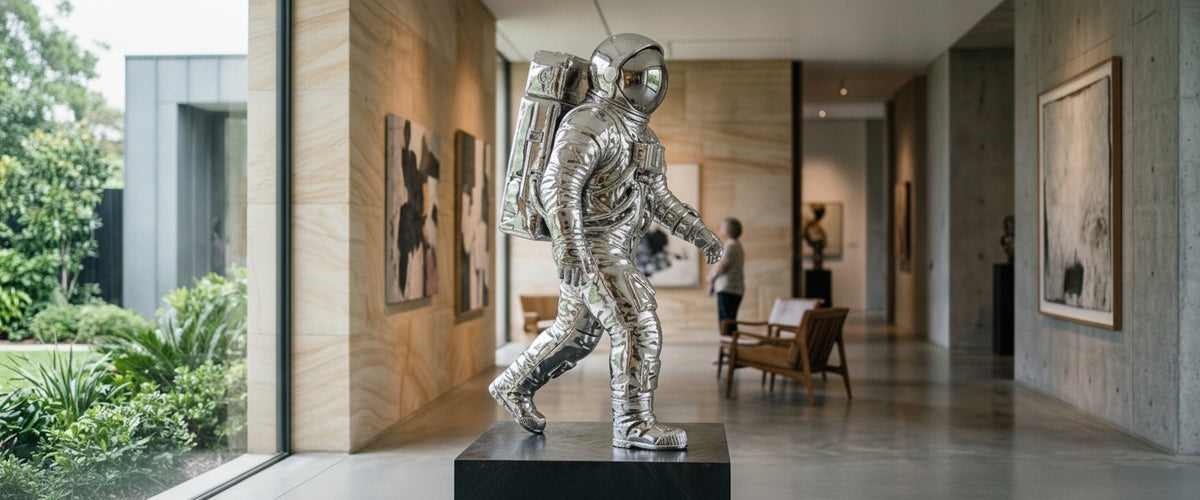

A spacesuit figure is the rare pop-culture subject that reads as both playful and serious, and that double life is exactly why astronaut sculpture art trips people up. Put a reflective spaceman in the wrong spot and it looks like a prop that wandered in from a trade show. Put it in the right spot, at the right height, against the right backdrop, and it anchors a whole room. The difference is almost never the piece. It is the placement.
Looking for the full range in this category? Browse our Astronaut Sculptures & Space Art collection for every available finish, size, and configuration.
We have shipped these figures to loft apartments, tech lobbies, and pool terraces, and the pattern holds every time: buyers obsess over the finish and underthink the sightline. This guide fixes that so your astronaut sculpture art earns its spot.

Key Takeaways for Placing Astronaut Sculpture Art
- Scale to the sightline, not the room. The distance a viewer stands at matters more than square footage.
- Pedestal height sets the mood. Floor-level reads friendly; raised reads heroic.
- Reflective finishes need controlled light, or they turn into a mirror of clutter.
- Outdoors demands engineered metal, not display-grade materials.
- Negative space is the whole trick. A spaceman needs room to float.

What Astronaut Sculpture Art Looks Like in Real Rooms
The subject is flexible in a way most figurative work is not. A polished silver figure caught mid-stride reads as motion and optimism; a seated figure with knees up reads as calm, almost contemplative. That range is why astronaut sculpture art shows up in such different settings, from a minimalist living room to the reception desk of a biotech firm.
Indoors, a mid-size piece such as the Lunar Silver Astronaut Glow Moon Sculpture - 86cm works as a sightline anchor at the end of a hallway or beside a stair landing, where you catch it from several angles as you move. Smaller desk and shelf figures like the Lunar Silver Astronaut Beats Figure - 36cm do a different job entirely; they punctuate a bookshelf or a home studio rather than command a room. Match the piece to the role you actually need filled.
Outdoors, the calculus changes. A garden or terrace flattens scale because the sky and planting give the eye no reference. A figure that felt tall in a showroom can look modest against a mature hedge. Size up when the setting is open, and let the astronaut sculpture art hold its own against the sky.

Scale, Sightlines and Pedestal Height
Three numbers decide how a spaceman reads: the height of the figure, the height it sits at, and the distance the viewer stands from it. Get those in proportion and almost any astronaut sculpture art looks deliberate.
Start with viewing distance. A sculpture seen from 6 to 10 feet (about 2 to 3 meters) across a seating area can be intimate and detailed. A piece seen from 30 feet (roughly 9 meters) across a lobby needs mass and a clean silhouette, because fine detail vanishes at that range. This is why a 110cm floor figure such as the Celestial Gold Astronaut Glow Moonwalk Sculpture - 110cm earns its keep in a double-height space where a shelf-scale figure would simply disappear.
Pedestal height is the lever most buyers forget. Set an astronaut at floor level and it feels approachable, almost like it is standing with you. Raise it to eye level on a plinth and it becomes a focal object. Push it higher and the pose starts to read as heroic or ceremonial, the same trick used for monumental figures for centuries. For a hovering or moonwalk pose, a low plinth exaggerates the sense of float; for a grounded standing figure, a taller base restores presence.
One studio rule we hold to: leave at least the figure's own height again as clear space above it. A spaceman crammed under a low ceiling looks trapped. The whole point of astronaut sculpture art is weightlessness.

Indoors vs Outdoors: When Each Wins
Indoors wins when you want the finish to do the talking. A polished or glow finish stays pristine, catches interior light, and rewards close viewing. It also lets lighter display-grade construction survive happily for years, because there is no weather to fight. That makes indoor astronaut sculpture art the easier build in most cases.
Outdoors wins on drama and scale. Open sky gives a figure room to breathe, and a metal astronaut against a lawn or gravel court has a stillness you cannot fake indoors. The trade-off is engineering. An outdoor piece needs a weather-resistant metal, a sealed or marine-grade finish, and a proper anchored foundation. Stainless steel and bronze are the honest choices here; the American Institute for Conservation notes that outdoor metal sculpture needs planned maintenance to hold its surface over time, so budget for it rather than assuming a one-time install (AIC guidance on caring for objects).
If you love a display-grade indoor finish but want it outside, that is a commission conversation, not an off-the-shelf swap. We can re-engineer a pose in stainless steel or bronze so your astronaut sculpture art survives a hard winter or a coastal salt breeze.

Light, Backdrop and Contrast
A reflective astronaut is only as good as what it reflects. A mirror-polished helmet in a cluttered room shows you the clutter. In a clean space with directional light, that same helmet becomes a bright point that draws the eye across the room, and the astronaut sculpture art starts working the way it should.
Backdrop contrast does the heavy lifting. A silver or chrome figure needs a darker or matte wall behind it to separate the silhouette; place it against white and it can wash out. A gold-toned figure like the Celestial Gold Astronaut Balloon Standing Figure - 48cm pops against charcoal, deep green, or exposed brick, and looks flat against beige. Where the palette leans cool and you want the figure to recede into a modern scheme rather than dominate it, the Galactic Blue Astronaut Balloon Sculpture - 55cm is closer to the right design language. Decide the wall before you decide the figure.
For lighting, a single warm spotlight raking across the suit reads far better than flat overhead light, which kills the form. Outdoors, uplighting a metal figure at dusk is one of the most reliable effects we know; the surface picks up sky color at the top and warm ground light below, and the astronaut sculpture art holds attention all evening.
Placement Mistakes We See in Commissions
For wider placement ideas, Fallen Astronaut Sculpture: How to Place a Space Figure so It Actually Lands is useful companion reading before finalizing the setting and sightlines.
The same handful of errors come up again and again with astronaut sculpture art, and all of them are avoidable.
- Under-scaling for the space. A figure chosen in a showroom looks smaller once it is in a real room with furniture and ceiling height around it. When in doubt, go up a size.
- No breathing room. Wedging a spaceman into a corner or under a shelf kills the sense of float. Give it clear space on at least three sides.
- Wrong wall color. Reflective finishes vanish against pale walls. Contrast first, sculpture second.
- Ignoring the foreground. A great figure ruined by a coffee table crossing its knees. Check what sits between the viewer and the piece.
- Treating outdoor like indoor. Display finishes are not built for weather. If it lives outside, it needs to be built for outside from the start.
For wall-mounted work the rules shift again. An astronaut wall sculpture wants a run of empty wall around it and a mount rated for the real weight, not a picture hook. We spec the fixing to the substrate, because a heavy metal relief in drywall is a repair waiting to happen.
The Cultural Pull of the Spaceman
Part of why astronaut sculpture art sells is the story it carries. There is the eerie Fallen Astronaut, a small aluminum figure left on the Moon in 1971 as a memorial. There is the famous carved figure on the facade of the New Cathedral of Salamanca in Spain, added during a 1990s restoration, which fuels the endless "astronaut sculpture in church" searches. And there is the so-called aztec astronaut sculpture, a Maya sarcophagus lid whose reclining figure gets misread as a spaceman by enthusiasts. Even a headless astronaut sculpture has become a recognizable motif, standing in for anonymity and the faceless explorer.
You do not need to reference any of that literally. But knowing the subject carries weight helps you place it with the seriousness it can hold, rather than as a gimmick.
Commissioning a Bespoke Astronaut Sculpture
Off-the-shelf covers a lot of ground, and our large astronaut sculptures range is the place to start if scale is your priority. A commission makes sense when you need a specific height for a specific sightline, an outdoor-rated build, a pose that matches a brand or architectural line, or a finish that has to coordinate with existing metalwork.
Budget depends on material, scale, complexity, engineering, installation and finishing, so the honest answer is to request a tailored quote rather than trust a headline number. Tell us the viewing distance, the ceiling or sky above it, the wall or backdrop behind it, and whether it lives indoors or out. Those four answers shape the whole build. As a bespoke sculpture supplier, Giant Sculptures would rather engineer the right astronaut sculpture art once than watch a beautiful piece look wrong in the wrong spot.