





































































































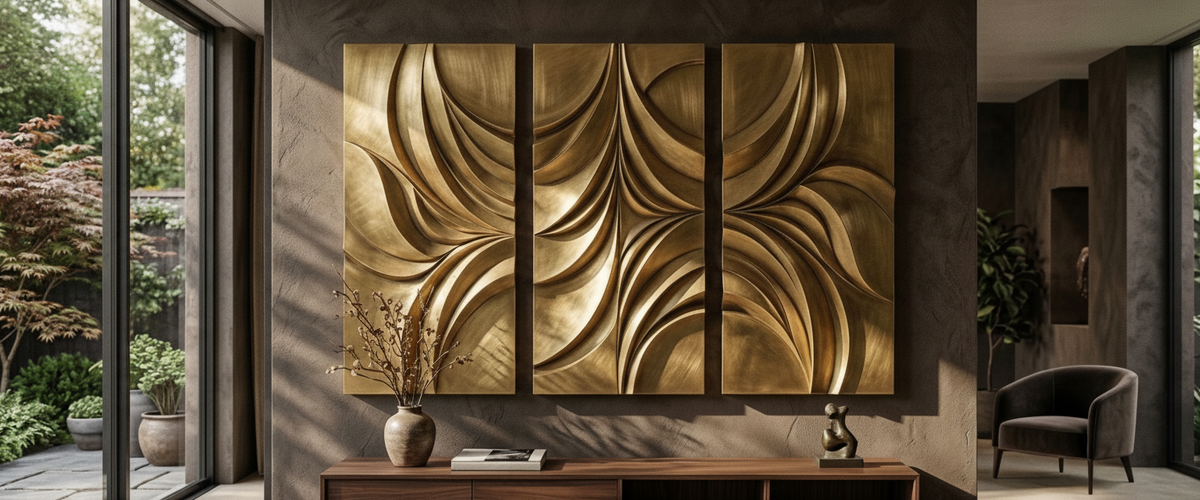

Most 3D wall art disappoints for one reason, and it has nothing to do with taste: the relief is too shallow for the distance it is actually viewed from. A panel that looks sculptural in a product photo, shot from two feet away under a hard studio light, can flatten into decorative wallpaper the moment it goes on a wall you walk past at eight feet. Treat depth as a math problem tied to viewing distance, bulb color temperature, and the angle light strikes the surface.

Key Takeaways Before You Buy
Viewing distance sets minimum depth. Roughly, every 3 feet (about 1 m) of viewing distance asks for another half inch of relief.
Bedside beats sofa wall for shallow panels, because you sit closer and the light is lower and more raking.
Gold and brass finishes need cooler or more directional light than most bedrooms provide at 2700K.
Gaps between panels in a triptych read as depth and should be planned, not guessed.
Deep relief is heavy relief. Anything past about 2 inches (50 mm) of carved depth usually needs a stud or a proper anchor, not a drywall plug.
The Three-Foot Rule: Viewing Distance Decides the Relief
Relief only reads as sculpture when the light skims across it.
Walk into a room and note where you naturally stop. That is your primary viewing position, and it does more to determine the right 3D wall art than color, subject, or frame ever will. At 3 feet (1 m), a shallow carved surface of about three quarters of an inch (20 mm) still throws visible shadow lines and your eye registers the undercuts. Step back to 10 or 12 feet (3 to 3.7 m) and those same shadows compress to nothing. The surface reads as texture, then as pattern, then as a flat rectangle.
Our working rule in the studio: add roughly half an inch of relief for every 3 feet of viewing distance, then add more if the wall gets flat frontal light. A hallway panel seen from 4 feet can be delicate. A double-height stairwell piece seen from 20 feet needs relief measured in inches, not millimeters, and often needs to be built rather than carved.

Why 20mm Panels Die Above a Sofa and Come Alive Beside a Bed
The sofa wall is the most common mistake we see. People hang a fine-carved 20 mm panel above a couch, then only ever see it from the opposite side of the room, usually lit by a ceiling fixture directly above it. Light falls parallel to the surface relief, shadows collapse, and a genuinely well-made piece looks like embossed board.
The same panel above a headboard behaves completely differently. You approach it, you stand next to it while turning down the bed, and you see it from 2 to 4 feet for a large part of its life. Bedside lamps sit low and throw light sideways across the surface, which is exactly what shallow carving needs. Where the wall is close and the lamps are low, a fine paper-craft relief such as TerraLuma Ivory White Bloom Paper Craft 3D Wall Art makes more sense than a heavy carved slab, because the short viewing range and raking lamp angle do the work the depth cannot.
Gold and Brass Finishes Under 2700K: The Warm Light Trap
A gold panel in a bedroom needs either extra depth or one directional light source.
Here is the trap with a gold 3D wall art panel in a bedroom. Bedrooms are usually lit at 2700K or warmer, often on dimmers that drag the color down further. Warm light on a warm metallic finish reduces the contrast between the lit face and the shadowed undercut, because everything trends toward the same amber value. The piece glows, but it stops reading as three-dimensional. Buying an art 3D wall panel in gold for a bedroom is a lighting decision before it is ever a taste decision.
Two fixes. Either increase the depth so shadows survive the flattening, or bring in one directional source at a slightly cooler temperature to cut across the surface. In a room you cannot relight, a convex, reflective form such as Lumicast Gold Cascade Crystal Lens 3D Wall Art holds up better than fine shallow carving, since the lens shapes catch a specular highlight rather than relying on shadow alone. Gilded and brass-toned surfaces were prized for centuries precisely because of how they behave under low, flickering light, as the decorative arts holdings at the V&A make plain. For a dim room, choose a finish that reflects rather than one that only casts.

Raking Light Versus Ceiling Downlight
Raking light is light that skims a surface at a shallow angle. Conservators use it to reveal tool marks and surface distortion, and it is the single most effective way to make 3D wall art look like the piece you bought. A small adjustable spot mounted 12 to 18 inches (300 to 450 mm) out from the wall, aimed steeply downward, will double the apparent depth of any relief panel.
A recessed ceiling downlight sitting directly above the panel does the opposite: it lights the top edges and leaves the body of the work in even, shadowless gray. If you cannot move the fixture, change the bulb beam angle, or accept that you need a deeper piece. Guidance from the Illuminating Engineering Society on beam spread and aiming angles is worth a read before you commit to a lighting plan around a sculptural wall.
Triptych Spacing: The Gaps Count as Depth
When 3D wall art is split across two or three panels, the negative space between them functions as part of the relief. Tight gaps of an inch or two (25 to 50 mm) read as one continuous surface with a seam. Wider gaps of 4 to 6 inches (100 to 150 mm) let wall shadow enter the composition and give the eye a depth cue the carving alone may not supply.
Our rule of thumb: make the gap roughly three times the panel depth, then step back and adjust. A grid-based composition such as Barwick Mocha Grid Abstract 3D Carving Wall Art is forgiving here, because the internal rhythm already sets a module you can echo in the spacing instead of inventing one. Mark the layout in painter's tape on the wall and live with it for a day before drilling.
Deep Relief, Heavy Panel: What 60mm Costs You on Drywall
Depth adds mass, and mass changes the fixing conversation. A 60 mm (roughly 2 1/3 inch) carved or built-up panel in timber, resin composite, or metal can be several times the weight of its 20 mm equivalent, and the load sits further off the wall, which increases the strain on the fixing. Standard drywall (plasterboard) plugs are not designed for that. Hit studs where you can, use rated toggle or expansion anchors where you cannot, and match the anchor to your actual board thickness and wall build-up, which the Gypsum Association documents in detail, rather than trusting the number printed on the pack.
Fixing Checklist
Confirm wall construction: stud, masonry, or hollow block.
Locate and mark studs before finalizing the layout, not after.
Use a French cleat for anything heavy; it spreads load and lets you level after hanging.
Check the panel's own hanging hardware is rated for its weight, not just present.
For bedrooms, keep the bottom edge clear of pillow height so the piece is never leaned on.
Ask us for the mounting specification before delivery, especially for commissioned panels.

Two Bedroom Commissions, and the Depth We Doubled
We made a brushed brass relief for a principal bedroom in Austin, specified at around an inch (25 mm) of depth because the client wanted something calm behind the bed. It worked because the viewing distance was short and two low lamps raked across the surface every evening. The second commission, for a Napa property, was going on a long wall opposite the bed with a viewing distance closer to 14 feet (4.3 m) and only ceiling light. We doubled the depth to just over 2 inches (50 mm), deepened the undercuts, and added a wall washer set at an angle. Same designer, same finish family, completely different build. The lesson we now apply to every bespoke brief: get the viewing distance and the lighting plan before the design is approved.
Choosing Your Piece
Start from the room, not the catalog. Measure the primary viewing distance, note the bulb temperature, identify whether the light comes from above or from the side, and confirm what the wall is made of. Then browse 3D wall art with those four numbers in hand. If nothing in the range hits the depth or the scale you need, that is exactly the point where a commission makes sense. Giant Sculptures builds bespoke relief panels and large-scale metal wall pieces to specified depth, weight, and finish, engineered for the fixing you actually have. Cost depends on material, scale, relief complexity, engineering, and installation, so send us the wall dimensions and a photo of the lighting and we will quote it properly.
For wider placement ideas, Wall Art Paintings or 3D Relief: Which One Should Hold the Wall? is useful companion reading before finalizing the setting and sightlines.