





































































































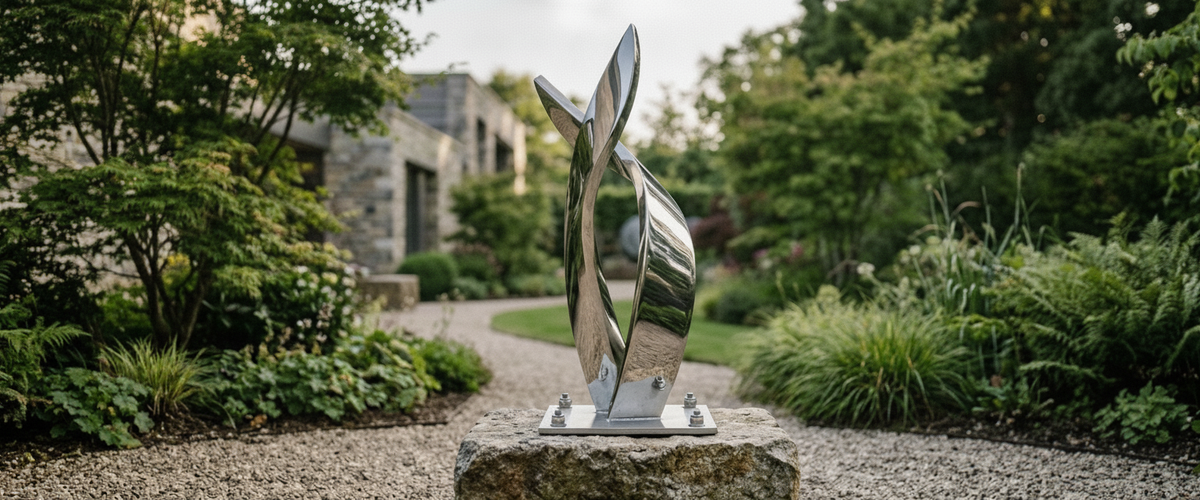

A piece weighing 200 pounds (90 kg) can shuffle across a terrace in a winter gale while something four times heavier sits untouched for a decade. Mass is only half the story. If you want to anchor outdoor sculpture so it stays exactly where the designer placed it, the first question is not how heavy the work is but how much wind it catches, and how that force travels down into the ground.
Most of the problems we get called about are not sculpture problems at all. The metalwork is fine. The fixing underneath it was chosen by whoever happened to be on site that morning, which is why how to anchor outdoor sculpture deserves a drawing rather than a guess.

Quick Answer: How to Anchor Outdoor Sculpture
Assess sail area first. Flat, tall, planar forms load a base far harder than compact figurative work of the same weight.
Match the method to the ground. Poured pad, screw anchors, pinned plinth or chemical dowels each solve a different problem.
Isolate dissimilar metals. Stainless bolts, galvanized plates and aluminum shims left in contact will corrode at the joint.
Never let water pond under a base plate. Drainage and a mortar bed with weep paths matter more than bolt count.
Get the fixing drawn, not improvised. On commissions we specify the base detail before the piece leaves the studio.
Cast-in bolts placed against a template before the pour: still the most reliable way to anchor outdoor sculpture on open ground.
Sail Area Beats Mass Every Time
Wind does not care about your invoice weight. It cares about the surface it can push and the height at which it pushes. A polished stainless ribbon standing eight feet tall presents a broad, smooth face to every gust; a squat bronze animal of similar weight barely registers. The taller the piece, the longer the lever arm, and the greater the overturning moment at the base.
This is why we ask for exposure conditions before quoting an installation. Anchor outdoor sculpture on an unscreened coastal bluff and the base spec looks nothing like the same piece in a sheltered city courtyard, or on a hillside that funnels afternoon wind straight down a valley. Large-scale work from our stainless steel sculpture collection is often the most demanding here, because the same mirror-polished planes that look weightless are exactly what the wind gets a grip on.
Snow and ice add a second load case. A horizontal element that collects a foot of wet snow gains real weight in an unhelpful place, and holds it there for weeks. A mountain site with genuine snow loading needs a heavier base spec than a warm coastal garden for that reason alone.

Concrete Pads, Ground Anchors and Pinned Plinths
There are three common ways to anchor outdoor sculpture into or onto the ground. Each has a job, and using the wrong one is how people learn this lesson expensively.
Poured Concrete Pads
The default for permanent, large-scale work on open ground. A reinforced pad below frost depth spreads load and resists overturning through sheer mass and soil bearing. Cast-in anchor bolts placed against a template beat drilled-in fixings, because the concrete cures around the bolt rather than being weakened by later drilling. The American Concrete Institute's anchorage provisions cover edge distances and embedment for exactly this reason; anchors set too close to a pad edge fail by breaking a cone of concrete out, not by snapping the bolt. Read the ACI guidance on anchorage to concrete if you want the technical background.
Helical and Screw Ground Anchors
Useful for softer ground, wet sites and installations that may be relocated. They work in tension, so they suit lighter, tall pieces where uplift on one side is the real risk. They are also kinder to established planting than excavating for a pad, which matters when a sculpture is dropped into a mature garden rather than a new build.
Pinned Plinths
When a work sits on stone, a plinth carries the load and the pins simply stop lateral movement. The pin is not doing the heavy lifting; the plinth mass is. Get the pin diameter and depth wrong and you get a slow rock that grinds the stone bed into dust over two or three seasons.
Dowel and Epoxy Into Stone: Where One Frost Undoes a Lazy Fix
Resin dowels let you anchor outdoor sculpture into granite, limestone or a solid stone plinth. Done properly they are excellent; rushed, they are a liability. The failure is almost always housekeeping. Drill dust left in the hole wrecks the bond. Wet stone in cold weather stops the resin curing to strength. Worse, an over-filled hole with no relief path traps water at the bottom of the dowel, and a single hard frost is enough to split the stone from the inside.
Our rule on site: blow and brush the hole out twice, check the resin's minimum substrate temperature rather than the air temperature, and never fix close to a stone's edge without a specialist opinion. Marble and softer limestones are less forgiving than granite, so on carved stone commissions we usually prefer a pinned plinth arrangement to a deep chemical dowel straight into the artwork.
Paving, Decking and Roof Terraces
Trying to anchor outdoor sculpture on top of an existing surface is a structural question before it is a sculpture question. Paving slabs are a wearing surface, not a foundation; bolt into one and you get a cracked slab and a piece that pivots on its own fixing. The correct approach is to break out the slab, build a pad below, and reinstate the paving around the base.
Roof terraces and podium decks bring waterproofing into play. Any penetration through a membrane is a future leak unless it is detailed by the membrane manufacturer. On one roof terrace commission, the answer was a weighted steel base spreading load across the pedestal paving system with no penetration at all, plus a wind study that governed the ballast. Decking has its own trap: a joist can carry vertical load and still offer nothing against the horizontal pull of a tall piece. Fix through to a proper structure, or don't fix there.
Galvanic Corrosion Starts Where Nobody Looks
Two dissimilar metals plus moisture makes a battery, and the less noble metal corrodes. A stainless bolt through a galvanized plate, or a bronze base sitting on mild steel, quietly eats the weaker partner at the interface while the visible surfaces look perfect. By the time a client notices, the bolt head is spotless and the plate around it has lost real section. The American Galvanizers Association publishes clear guidance on contact between dissimilar metals; isolation washers, nylon sleeves and correct fastener selection solve it for a few dollars at install and save a crane visit later.
Coastal sites need marine-grade fixings as standard. Anchor outdoor sculpture within reach of salt spray and any compromise you made on fastener grade will show, fast. This is also where Corten steel pieces need a considered detail, since running rust from the weathering surface can stain paving unless the base and drainage are planned for it.
The Drainage Detail Under the Base Plate
Shims, non-shrink grout and deliberate weep paths: the least photogenic part of how to anchor outdoor sculpture, and the part that decides its lifespan.
Water sitting in a shallow film between a base plate and its pad is the most common long-term killer of an otherwise sound installation. It sits there through freeze-thaw cycles, works into the bolt holes, and lifts coatings from underneath. The fix is unglamorous: shim the plate, bed it on a non-shrink grout with deliberate weep paths, fall the pad surface slightly away from the piece, and keep the whole base above the surrounding mulch or gravel line. Any base sitting in a puddle after rain has been installed wrong, whatever the fixings look like.

What We Specify Before a Commissioned Piece Leaves the Studio
For bespoke work we anchor outdoor sculpture by design rather than by decision on site, so the base is drawn alongside the artwork. Before a commission ships from Giant Sculptures, the drawing package typically confirms:
Center of gravity, overall height, and projected sail area for wind calculation
Base plate size, thickness, bolt pattern and hole tolerances
Fastener grade and isolation method for every dissimilar metal contact
Foundation type and the site information an engineer needs to size it
Grout, shim and drainage detail under the plate
Lifting points, rigging notes and safe access route for installation day
Reinstatement of paving or planting around the finished base
Budget for the groundworks sits alongside the piece itself and varies with material, scale, site access, ground conditions and engineering input, so ask for a tailored quote rather than assuming a standard figure. If you are still choosing the work, our garden sculpture collection is a sensible place to start narrowing scale and form, and we will tell you honestly which pieces need serious foundations and which will sit happily on a well-built plinth. Send us site photos, a rough wind exposure description and your surface build-up, and we will spec the base properly the first time. Nobody should have to anchor outdoor sculpture twice.
For wider placement ideas, A Lone Crane Metal Sculpture Looks Stranded: Group Them Properly is useful companion reading before finalising the setting and sightlines.