





































































































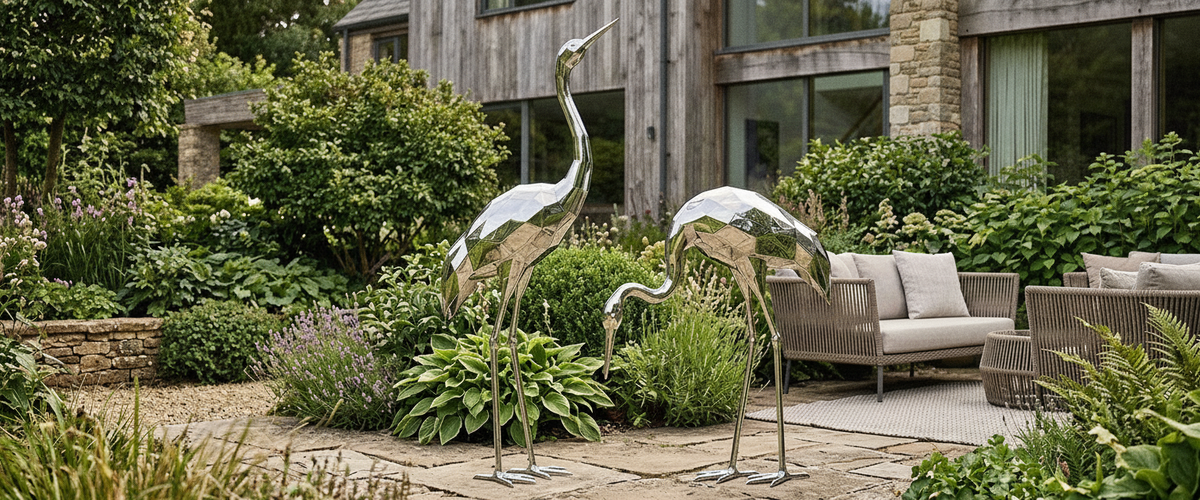

Set a single crane metal sculpture in the middle of a lawn and it reads like a garden ornament that missed its bus. The bird has nowhere to look, nothing to answer, and the eye files it as decoration and moves on. Put a second bird beside it at a genuinely different height, angle the heads so they are not staring at each other like bookends, and the same two pieces become a composition. Cranes are social birds and the sculpture inherits that logic. Buyers who understand this get a piece that anchors a garden; buyers who do not will move the thing three times and still feel something is off.

At a Glance: What Makes a Crane Group Work
Buy in twos or threes, never one. A solitary crane metal sculpture reads as an ornament, and two identical birds at identical heights cancel each other out.
Aim for at least a 12 inch (30 cm) height difference between the tallest and shortest bird in the group.
Place for the window you actually use, not the theoretical lawn view from the far hedge.
Check leg gauge before you check price. Thin legs and a shallow spike are the most common failure point.
Match the finish to your weather: Corten for dry inland gardens, marine-grade stainless near salt, matte black powder coat for planted backdrops.
Bespoke beats catalog when the site is awkward, sloped ground, shallow soil over slab, or a very specific sightline.
Why the Height Gap Does More Than an Extra Bird
Most people try to fix a flat arrangement by adding another crane. Usually the problem is not quantity. A pair at 55 inches (140 cm) and 70 inches (179 cm) already carries more visual movement than four birds cut to the same line, because the eye travels diagonally instead of scanning left to right. Twelve inches (30 cm) is roughly the threshold where the gap reads as deliberate rather than accidental. Below that it looks like a manufacturing tolerance.
In practice, the taller crane metal sculpture is the piece worth buying first, since everything else is staged against it. The Silver Mirror-Polished Abstract Duo Cranes Metal Sculpture - 179cm set that upper line, leaving room for a shorter feeding or preening bird a few feet in front. Pose matters as much as height. One head up, one head down, and the group tells a small story. Both heads up and you have a guard of honor.

A 30 cm height gap and a staggered front-to-back setout do more work than a third bird.
Depth is the third lever and the one most often ignored. Do not line the birds up on the same plane. Stagger them 3 to 6 feet (about 1 to 2 m) apart front to back so that when you walk past, the spacing changes and the group reorganizes itself. Sculpture that rewards movement earns its place.
Pond Margins, Gravel Gardens and Courtyards Compared
A metal crane garden sculpture behaves very differently depending on what sits behind it. Pond margins are the obvious home and the most forgiving; reflection doubles the bird, reeds break up the legs, and the association reads instantly. The catch is ground stability. Saturated margin soil will not hold a spike, so we usually specify a buried concrete pad or a submerged plate for any crane metal sculpture set at the water's edge.
Gravel gardens are the strongest backdrop for abstract or faceted birds, because a plain, pale, level surface lets the silhouette do all the work. Where the setting calls for reflection rather than detail, an abstract form such as Silver Mirror-Polished Abstract Crane Figures Metal Sculpture - 163cm picks up sky and planting color and shifts through the day, which a matte finish on the same gravel will not do. Courtyard planting is the trickiest of the three. Dense foliage swallows slender legs, so either lift the group on a low plinth or choose birds with heavier body mass so the shape survives against a busy background.
Pale gravel gives a matte black bird the clean outline that dense planting takes away.
For water features, a traditional pairing carries a different mood entirely. Where the garden is formal and the sculpture needs to sit inside the architecture rather than argue with it, a cast piece like the Large Traditional Crane Pair Bronze Fountain - 190cm is closer to the right design language than polished steel; bronze also weathers to a patina that reads as age rather than wear.

Set the Group for the Sightline You Use Every Day
Here is a lesson from a Napa commission we shipped a set of three cranes to. The client had planned the group around the view from the terrace, which they used a handful of times a year. We asked how often they stood at the kitchen sink. Every morning. We moved the group about 20 feet, reset the tallest bird slightly off-center so it broke the window frame's vertical, and the whole thing came alive. Same sculptures, different sightline.
Do this before you dig. Stand at the window, the desk, the head of the dining table. Have someone hold a broom handle at the height of the tallest crane metal sculpture and walk it around until the shape sits where you want it. Ten minutes of that saves an expensive relocation.
Silhouette Against Sky: Where Species Choices Part Company
All cranes are not the same outline. A sandhill crane metal sculpture has a compact head, a straight heavy bill and a distinctive bustle of tertial feathers over the rump, which gives a rear-lit silhouette real character. Gray and common crane forms are leaner through the neck and read more calligraphic. Crowned crane sculptures carry that fan of stiff golden plumes, which is beautiful but fragile in metal and needs thicker stock than it looks. The Cornell Lab's field description of the sandhill crane is a useful reference if you are briefing a sculptor on proportion.
If the piece will be seen against open sky, favor a species profile with a strong, readable outline. Against dense hedging or a dark wall, the reverse is true; you need mass and reflectivity, which is where polished stainless beats a fine wire form. A crane bird sculpture in metal lives or dies by that background contrast.
Leg Gauge and Ground Fixing, or How Cranes Fail in Season Three
The failure is almost never the body. It is the ankle. A crane concentrates a lot of use into two thin verticals, and wind loading on a broad body multiplies it. Under-specified legs flex, the weld at the foot work-hardens, and by the third winter you have a bird leaning at a polite angle.
What to ask a supplier before you buy a crane metal sculpture:
What is the wall thickness or bar diameter at the ankle, and is there an internal core rod?
Is the fixing a spike, a bolt-down base plate, or a hidden pin into a concrete pad?
Has the leg-to-foot joint been reinforced with a gusset or hidden sleeve?
What wind exposure was the piece engineered for?
Can the fixing be recessed so the plate does not show in gravel or planting?
For anything over about 5 feet (1.5 m) in an exposed position, we specify a concrete pad with cast-in threaded sockets. It costs more on install day and it is the reason a group still stands square after a decade of storms.
Corten, Mirrored Stainless and Matte Black Through a Wet Winter
Finish choice is a climate decision. Corten develops its protective oxide layer beautifully in gardens with real wet and dry cycles, but it stains pale stone and it does not enjoy permanently damp ground contact, so keep the feet on a pad rather than in a puddle. Mirrored stainless is the low-maintenance choice for coastal sites, provided you specify the right grade; 316 outperforms 304 markedly in salt air, as the International Molybdenum Association sets out for architectural exteriors. Black metal crane sculptures rely on their coating, so ask for marine-grade preparation and touch-up paint with the delivery.
British and Pacific Northwest buyers should assume months of low sun and constant damp. In that light, a matte black crane metal sculpture holds its shape while polished steel can go slightly flat, which is an argument for placing a reflective large metal crane sculpture where it catches water or a light-toned wall. Our wider metal sculptures and stainless steel sculptures ranges are the easiest way to compare how each finish behaves at scale.

Commissioning a Bespoke Crane Group
Catalog pieces cover most gardens. Commission when the site fights you: a sloped bank, shallow soil over a slab, a sightline that needs a specific height, or a client who wants three birds in staged sizes rather than two off the shelf. Giant Sculptures builds a bespoke crane metal sculpture group to a set brief, matching leg gauge to exposure and setting each bird's pose so the group reads correctly from your chosen viewpoint. Budget depends on material, scale, engineering, finishing and installation access, so send site photos and the sightline you care about and we will quote it properly.
For wider placement ideas, Large Abstract Garden Sculptures: A Buyer's Guide to Scale, Metal, and Placement is useful companion reading before finalising the setting and sightlines.