





































































































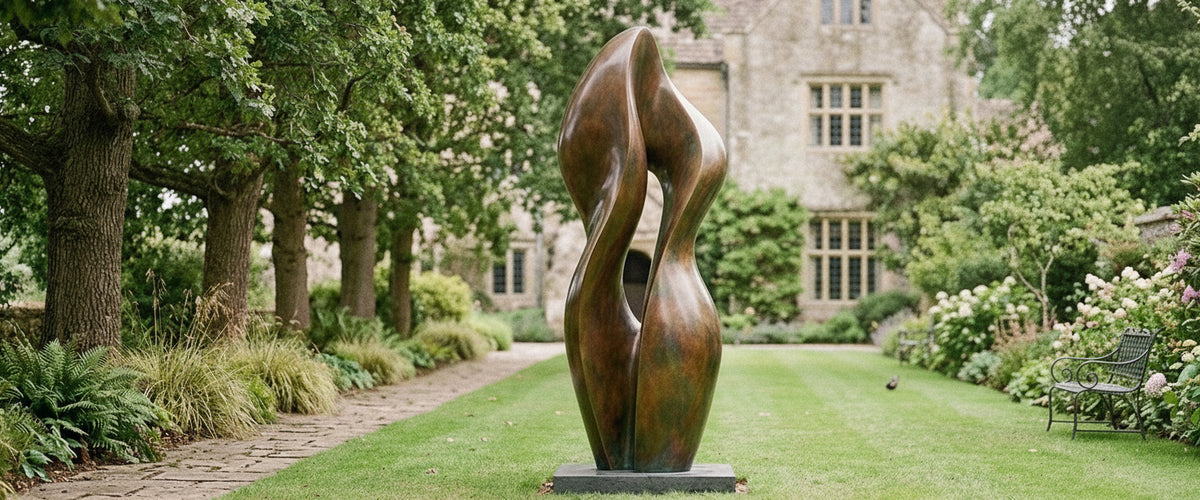

The wrong spot can flatten a great sculpture in seconds. We once watched a serious abstract modern art sculpture arrive at a Napa estate, get parked against a busy stone wall, and disappear into the texture behind it. Same piece, moved fifteen feet onto open lawn with sky behind it, suddenly commanded the whole garden. Nothing about the bronze changed. The placement did.
That gap between potential and payoff is the thing most buyers underestimate. An abstract modern art sculpture that reads as pure form in a gallery can turn muddy in a cluttered living room or vanish outdoors against the wrong foliage. Below is how we think about placing an abstract modern art sculpture in the studio, drawn from commissions we have shipped and installed.

Key Takeaways
- Scale is relational. A piece looks right because of the space around it, not its raw height.
- Sightlines beat centering. Where people first see the work matters more than where the geometry says to put it.
- Backdrop decides contrast. Sky, hedge, plaster or glass will either lift the silhouette or bury it.
- Indoor and outdoor ask different questions. Material, weathering and viewing distance all shift.
- Most placement mistakes are fixable before you pour concrete or set a pedestal.

What Abstract Modern Art Sculpture Actually Looks Like in Different Rooms
An abstract modern art sculpture lives or dies on how the eye travels around it. In a double-height entrance hall, a tall vertical bronze rewards the long upward view; the space gives the form room to breathe. Drop that same piece into a low-ceilinged den and it starts to feel cramped and apologetic.
Modern abstract sculptures reward negative space. Indoors, that means clearing a genuine pocket of air around the piece rather than slotting it between a console and a lamp. A single confident abstract modern art sculpture on an open landing does more work than three smaller objects competing on a shelf. For a broad hallway or a wide window ledge, a mid-height form like the Large Modern Abstract Bronze Sculpture - 94cm lets you walk past and watch the silhouette change with each step. That movement, the way a form reveals a new profile as you cross a room, is the point of abstract work.
Outdoors, the logic flips slightly. A garden gives you distance and sky, so you can go bigger and let the piece anchor a lawn or a gravel court. A modern abstract metal sculpture in polished bronze or stainless steel throws light differently across a day, which is why a piece that looks quiet at noon can turn luminous at golden hour.

Scale, Sightlines and Pedestal Height
Scale is the choice buyers get wrong most often, in both directions. People either buy too small for a large exterior, so the abstract modern art sculpture reads as a garden ornament rather than a statement, or they buy something monumental for a room that cannot hold it.
A rule we lean on: measure the primary viewing distance first, then size the piece to that, not to the height of a nearby wall. If your family and guests will usually see the work from thirty feet across a lawn, a 4-foot (1.2m) form gets lost. Where the space is genuinely open, a piece on the order of the Monumental Modern Abstract Biomorphic Bronze Sculpture - 340cm is closer to the scale that holds its ground against a large lawn or gravel court.
Pedestal height is the quiet lever. Raising a piece even 12 to 18 inches (30 to 45cm) can move the visual center of the work to eye level, which changes everything about how it reads. Too high and an abstract modern art sculpture tips into monument territory and loses intimacy. Too low and viewers look down on it, which flattens the silhouette. Set the strongest profile at, or just above, the eye line of a standing adult and most compositions come alive.
Quick Sightline Checklist
- Identify the two or three spots where people will most often first see the piece.
- Stand there and check the silhouette against its backdrop.
- Confirm the strongest profile faces the main approach, not the wall.
- Check the piece from a seated position too, if it is near a dining or lounge area.
- Leave clear walking room so viewers can circle an abstract form.

Indoor Versus Outdoor Placement: When Each Wins
For wider placement ideas, Contemporary Abstract Metal Sculpture: A Buyer's Guide to Form, Scale, and Placement is useful companion reading before finalizing the setting and sightlines.
Indoors wins when you want the work to be a daily companion, seen at close range and touched occasionally. Interiors also protect delicate finishes. A modern abstract ceramic sculpture, for example, belongs inside or under cover; glazed ceramic and fired clay do not enjoy freeze-thaw cycles and hard frost. If your heart is set on ceramic for an exposed terrace, we would steer you toward a cast metal interpretation of the same abstract modern art sculpture instead.
Outdoors wins when you want scale, weather and light to become part of the work. Bronze is our default for an exterior abstract modern art sculpture because it develops a living patina and shrugs off decades of weather when it is cast and finished properly. The sculpture conservation guidance from the Getty Conservation Institute is a useful primer on how outdoor metals behave over time and why surface care matters.
A middle path we set up often: a covered loggia or a sheltered porch. You get outdoor scale and daylight with some shelter from driving rain, which widens your material options and softens the maintenance load.

Light, Backdrop and Contrast
Contrast is what makes a silhouette legible. A dark bronze against a dark yew hedge reads as a blur. The same bronze against pale gravel, a rendered wall, or open sky snaps into focus. Before you commit a position, photograph the exact backdrop at morning, midday and dusk. The camera is honest about contrast in a way the eye, forgiving and hopeful, is not.
For an outdoor abstract modern art sculpture, think about where the sun tracks. A polished or partly polished surface will catch low-angle light and glow at either end of the day; a matte patina reads more sculptural and calm. Where the form is gestural and elongated, such as the Life-Size Modern Abstract Diving Figure Bronze Sculpture - 180cm, raking light travels along its length and throws a long, active shadow across a lawn, which is worth positioning for deliberately.
Indoors, resist the urge to floodlight. A single directional source, set to skim across the surface rather than hit it flat, does far more for an abstract form than bright, even light. Skimming light reveals texture, edges and the depth of a patina; flat frontal light erases all three.
Common Placement Mistakes We See
The same handful of errors come up again and again, usually late in a project when they are expensive to fix.
- Backing a piece into a busy wall. Stone, brick and heavy planting swallow abstract silhouettes. Give the form a clean field behind it.
- Centering on the architecture, not the view. An abstract modern art sculpture centered on a French door looks tidy on a plan and dull in the flesh. Position it where the eye lands, which is often slightly off axis.
- Sizing to a wall instead of to the viewing distance. This is the number one cause of the disappointed unboxing.
- Ignoring the base and footing. A monumental bronze needs a proper foundation. We advise on load, fixing and footing depth as part of any large commission, because a piece that leans or settles ruins the line.
- Forgetting the fourth side. Abstract work is usually meant to be walked around. If the back is against a fence, you have bought half a sculpture.
A modern abstract animal sculpture is a slightly forgiving exception, since a semi-representational subject like a bull or a hare gives the eye an anchor and can carry a tighter setting. Something like the Small Modern Abstract Bull Bronze Sculpture - 30cm sits happily on a plinth in an entryway or on a broad garden step, where a purely non-figurative form of the same size might feel underscaled.
Commissioning for a Specific Spot
When a room or garden has awkward proportions, a bespoke abstract modern art sculpture is usually the better answer than forcing a stock form into a space it does not fit. As a bespoke sculpture supplier, we design each abstract modern art sculpture around the actual sightlines, ceiling height, footing and backdrop of your site. That might mean adjusting the height so the strongest profile hits eye level from the main approach, or specifying a patina that reads against your particular wall or planting.
Start with photographs of the intended spot at different times of day, the key viewing distances, and a rough sense of scale. From there we can advise on material, finish and engineering, and give you a tailored quote. Budget on a large abstract modern art sculpture depends on material, scale, complexity, engineering, installation and finishing, so a figure only means something once the piece is defined. If you want to browse first, the abstract sculptures collection and our wider contemporary and modern sculptures are the best places to see the range of forms and scales we work in.