

























































































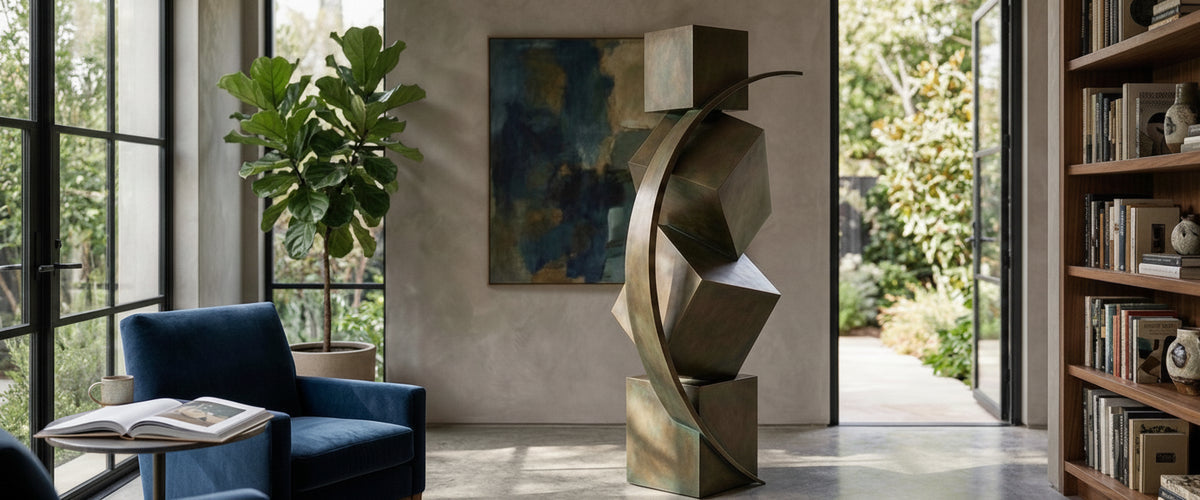

Buy the wrong scale or drop it in the wrong corner, and even a fine abstract geometric sculpture reads as an afterthought. An abstract geometric sculpture is doing intelligent work with planes, angles and negative space, but if the eye never settles on it, none of that lands. Placement is the difference between a piece that organizes a whole room and one people walk past without noticing.
We ship large-scale and bespoke work to homes, gardens and commercial sites, and the questions that come up before delivery are almost always about placement, not taste. Below is how we think through an abstract geometric sculpture, from a foyer in a Texas ranch house to a sculpture court outside a Napa winery.

Key Takeaways
Scale first. Match the piece to the sightline distance and ceiling height, not to the empty patch of floor you happen to have.
Pedestal height sets the read. A few inches up or down changes whether the geometry hits at eye level or slumps below it.
Outdoors rewards silhouette. An angular abstract geometric sculpture photographs and holds up best against open sky and simple planting.
Contrast decides impact. A polished stainless piece against a busy backdrop disappears; against a calm wall or hedge, it snaps into focus.
Bespoke solves the fit. When stock proportions fight the space, a commissioned abstract geometric sculpture lets you set exact height, footprint and finish.

What an Abstract Geometric Sculpture Actually Looks Like in a Room
A geometric sculpture is a form built from clear structural shapes: cubes, arcs, planes, intersecting bars, stacked or offset volumes. Abstract simply means it is not trying to be a literal object. Instead of reading as a horse or a figure, an abstract geometric sculpture reads as rhythm, weight and tension. That is the appeal for modern interiors; the piece talks to the architecture rather than competing with it.
Indoors, the same form behaves differently depending on the room. In a double-height entry hall, a tall angular bronze becomes the thing your eye lands on the moment the door opens. In a low-ceilinged den, that same piece would feel cramped, and a wider, more horizontal form works better. A polished arc catches reflected window light and shifts through the day; a matte Corten mass stays quiet and heavy. Neither is wrong. They just suit different rooms.
Wall-mounted geometric metal pieces are a separate question and a common search. If you are looking at metal wall sculptures with geometric designs, treat them as relief work: they need a clear rectangle of wall, controlled lighting from one side to throw shadow across the facets, and enough distance for the pattern to resolve. Hung too close to furniture, the geometry flattens.

Scale, Sightlines and Pedestal Height
Most placement errors are scale errors. The reliable method is to work back from where people will actually stand. An abstract geometric sculpture viewed from across a 30-foot living room needs real mass to hold that distance; something under about 3 feet (roughly 90cm) will read as a tabletop object no matter how good it is. For an entry or a stair landing where viewers pass within a few feet, a 4 to 6 foot (120 to 180cm) form sits comfortably.
For interiors, a Large Modern Abstract Bronze Sculpture - 120cm is tall enough to command a console-height plinth or a floor position in a mid-sized room without overwhelming a standard ceiling. Where the room can carry more presence, a piece such as the Large Contemporary Abstract Female Figure Bronze Sculpture - 180cm moves you into full floor-standing territory that needs breathing room on every side.
Pedestal height is the lever people forget. Our rule: the visual center of the piece should land near eye level for the typical viewing position, usually around 55 to 62 inches (140 to 158cm) off the floor for standing viewers. Get that wrong and a strong abstract geometric sculpture looks like it slipped off its base. For seated viewing areas, drop the whole thing lower. A plinth also does structural work outdoors, lifting the piece clear of splashback and mulch and giving the geometry a clean edge to sit on.

Indoor Versus Outdoor: When Each Wins
Indoors, an abstract geometric sculpture becomes a fixed focal point in a controlled setting. You manage the light, the backdrop and the traffic flow. That control suits reflective finishes and finer detailing, because nothing weathers and viewers get close.
Outdoors is where an abstract geometric sculpture often earns its keep. Angular, hard-edged work reads beautifully against sky, lawn and loose planting, and the changing daylight keeps the piece alive from dawn shadow to flat noon. Where the setting can absorb genuine monumental scale, a piece like the Monumental Modern Abstract Arch Bronze Sculpture - 370cm is built for exactly that job: framed against open space, an arch invites you to walk through or around it, and the negative space does as much work as the metal. We placed a large arch on a sloped lawn for a client near Aspen where the piece frames a mountain view; from the terrace it reads as a window, from the garden path it reads as a solid mass. Same object, two readings, entirely down to sightline.
Material choice tracks the indoor-outdoor decision. Bronze and stainless steel handle exterior life for decades with straightforward care. Corten steel is designed to develop a stable rust patina and is often specified for exactly this reason; the American Institute for Conservation has good background on how protective patinas form and why they matter for long-term outdoor metalwork. Marble and softer stone outdoors need more thought on climate, freeze-thaw and acid rain, so we talk that through per site.
Light, Backdrop and Contrast
A sculpture is only as strong as what sits behind it. The most common miss we see is a good piece lost against a busy wall or overplanted border. Give a polished form a calm, mid-tone backdrop and it snaps forward; put it in front of a dark hedge or a plain plastered wall and the silhouette does the talking.
Light is the other half. The angular geometry of an abstract geometric sculpture lives on shadow, so directional light, from a window, a spotlight, or a low sun, models the planes and makes the form legible. Flat, even lighting kills it; the facets collapse into a single gray shape. Indoors, a single raking spot from one side usually beats a symmetrical wash. Outdoors, note where the sun sits during the hours you actually use the garden, and orient the piece so the good side faces the terrace at those times.
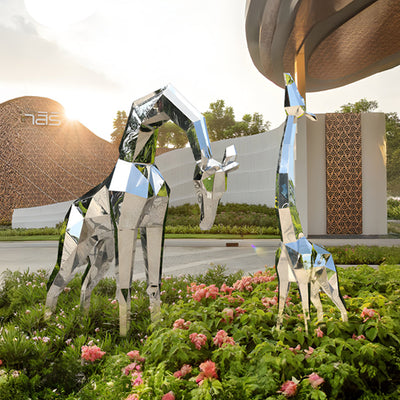
Reflective stainless steel is a special case. It mirrors its surroundings, so a mirror-polished piece placed against clutter simply reflects clutter. Against sky, water or a clean lawn it becomes almost weightless. Plan the reflection, not just the object.
Common Placement Mistakes and How to Avoid Them
For wider placement ideas, Abstract Geometric Wall Art: How to Place It so It Actually Reads is useful companion reading before finalizing the setting and sightlines for an abstract geometric sculpture.
Buying to fill floor space, not sightline. The empty corner is not the brief. Where people stand and look is the brief. Measure the viewing distance first.
Pushing the piece against a wall. Three-dimensional abstract work needs to be walked around. Pull it off the wall so the back and sides read.
Under-scaling outdoors. Open space swallows objects. A form that dominates your living room can look like a garden ornament on a big lawn. Size up.
Ignoring the base. A mismatched plinth undoes an expensive sculpture. Match the base material and proportion to the piece and the setting.
Fighting the backdrop. Do not place a detailed form against a detailed background. One of them has to stay quiet.
Forgetting maintenance access. Wax a bronze, rinse a stainless piece, check the fixings. Leave room to actually reach it.
When to Commission Instead of Buying Stock
Stock works when a piece fits the sightline and the space out of the box. Commission when it does not. If your entry hall needs a 7-foot form and everything available stops at 6, or your material has to be Corten to match the architecture, a bespoke route lets us set the exact height, footprint, patina and base. We have engineered pieces for wind load on exposed sites and adjusted a design's proportions so it read correctly from a specific mezzanine. A commissioned abstract geometric sculpture removes the compromise entirely.
Browsing helps you calibrate before you commit. Our geometric sculptures and broader abstract sculptures collections show the range of scale and finish, and the bronze abstract sculptures grouping is a good place to see how weight and patina change the mood of an abstract geometric sculpture. Budget depends on material, scale, engineering, finishing and installation, so the honest answer is to send us the space and the sightlines and ask for a tailored quote.
Giant Sculptures works in bronze, stainless steel, Corten, stone and engineered metalwork at a scale most galleries do not touch. Get the placement thinking right first, then your abstract geometric sculpture has room to do what it was made to do.