





































































































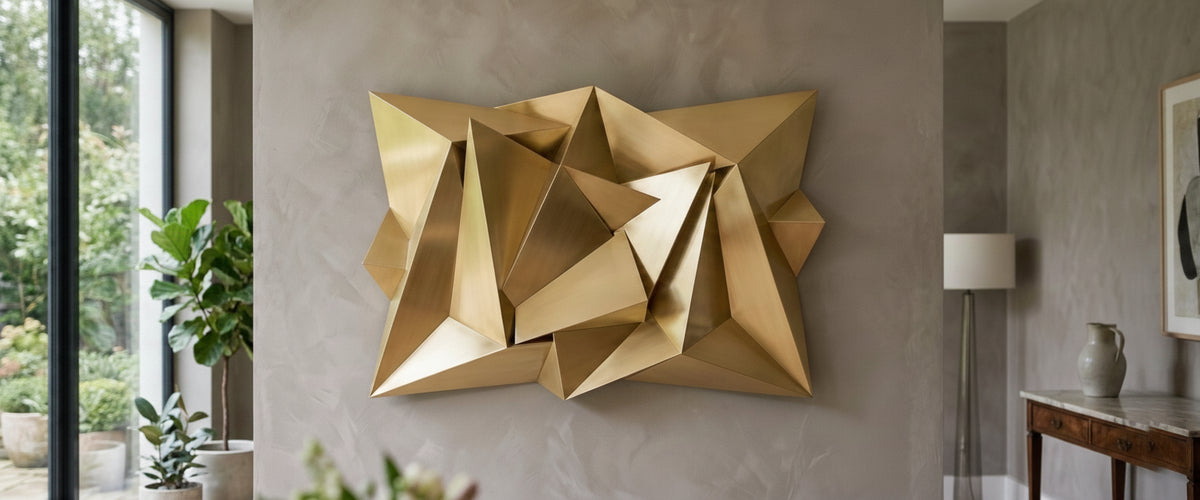

A geometric wall piece hung a foot too high, on a busy wall, in flat overhead light, will look like an afterthought no matter how good the metalwork is. That is the hard truth about abstract geometric wall art: the object matters, but placement decides whether it commands a room or disappears into it. We have shipped enough wall commissions to know the difference is rarely the piece itself. It is the wall, the light, and the height off the floor.
Looking for the full range in this category? Browse our Wood Art collection for every available finish, size, and configuration.
This is a placement guide first and a shopping guide second. If you are choosing abstract geometric wall art for a double-height entry in Dallas, a Napa poolside wall, or a gallery-style hallway in a Tribeca loft, the same principles apply. Get them right and a modest panel punches above its size. Get them wrong and a large sculpture reads as clutter.

Key Takeaways
- Scale to the wall, not the furniture. The empty space around a piece does as much work as the piece.
- Center on the sightline, not the ceiling. Eye level for the room matters more than a fixed measurement.
- Light is a material. Raking light across a faceted or mirrored surface is what creates the geometry people actually see.
- Backdrop contrast wins or loses the whole thing. A mirrored piece on a pale busy wall vanishes.
- Outdoor changes the rules. Weather, corrosion and structural fixing move from nice-to-have to non-negotiable.

What Abstract Geometric Wall Art Looks Like in Real Rooms
The term covers a wide field. At one end you have flat relief panels and layered wood wall art geometric compositions that sit close to the wall and cast shallow shadows. At the other you have three-dimensional metal pieces that project several inches out and behave more like sculpture than picture. Between them sit mirrored geometric wall art panels that shift with the room and the daylight, and pared-back minimalist geometric wall art that relies on one strong shape rather than a busy pattern.
Material sets the mood before the shape does. Warm woods soften a room and read well in a den, a bedroom, or a Colorado lodge where you want texture. Polished stainless steel and gold-toned finishes lean contemporary and architectural; they belong in rooms with clean lines and hard surfaces. Where a wall gets good natural sun and you want the finish to throw light back into the space, gold-toned faceted abstract geometric wall art such as the Eclipse Gold Abstract Steel Sculpture is closer to the right design language than a flat matte panel.
Outdoors, geometry does something different again. On a garden wall or a rendered exterior in the Hamptons, faceted metal abstract geometric wall art catches shifting daylight through the day, so the same object looks sharp at noon and moody at dusk. That movement is the whole appeal, and it is why we steer outdoor buyers toward stainless steel and Corten rather than anything that fears water.

Scale, Sightlines and Height: The Choices That Change How a Piece Reads
Most people buy too small. A wall reads as generous, the piece arrives, and suddenly it looks like a postage stamp on a bedsheet. As a working rule, abstract geometric wall art should occupy roughly two-thirds to three-quarters of the visual width of the wall zone it anchors, whether that zone is above a console, a fireplace, or a stair run. Leave breathing room, but do not leave a desert around it.
Height is where good intentions go wrong. The old gallery convention puts the center of a work around 57 to 60 inches (145 to 152 cm) from the floor, but that assumes a standing viewer in a neutral room. Above a sofa or a low credenza, you drop it so the bottom edge sits roughly 8 to 10 inches (20 to 25 cm) above the furniture, and you let the seated sightline lead. In a double-height entry, forget fixed numbers entirely; the piece needs to answer the balcony view and the ground-floor approach at once, which usually means going bigger and hanging higher than instinct suggests.
Projection matters as much as width and height. A flat panel forgives a tight corridor. A three-dimensional relief that stands three or four inches off the wall needs room to be walked past without a shoulder catching it, and it needs light coming from the side to reveal its depth. We often ask commission clients for a phone photo of the wall at three times of day before we finalize proportions on their abstract geometric wall art, because the shadow behavior tells us more than the dimensions do.

Indoor Versus Outdoor: When Each Wins
Indoors, you are choosing for intimacy and consistent light. Wood and mixed-media pieces belong here, as do finer finishes that would suffer outside. Indoor walls let you go quieter, because the viewer is close and the piece has time to be read. This is the natural home for minimalist geometric wall art, where a single clean form carries the whole wall.
Outdoors, abstract geometric wall art has to hold a bigger space and survive it. Sun, rain, salt air near the coast, and freeze-thaw cycles in mountain climates all attack lesser materials. Stainless steel resists corrosion well and keeps its finish; Corten steel is engineered to form a stable protective rust layer that then slows further corrosion, which is why architects specify it for exterior work (the American Institute of Steel Construction publishes guidance on weathering steel behavior). For a large exterior statement that has to read clean from across a lawn, a freestanding faceted form such as the Panther II Geometric Steel Outdoor Sculpture makes more sense than a wall relief that the setting will dwarf.
If you want geometry on an exterior wall specifically, mount your abstract geometric wall art on a substrate that can take the fixings and the weight, not on soft render alone. We spec stainless fixings for anything outdoors, because plated steel bolts will bleed rust down a beautiful wall within a season.
Light, Backdrop and Contrast: What Actually Creates Impact
Light is not a finishing touch on geometric work; it is half the sculpture. Flat overhead light flattens facets and kills the shadows that define the shapes. Side light, or a grazing wall wash, rakes across the surface and makes the geometry pop. For a mirrored or polished piece, you also have to think about what it reflects, because a mirror throws the opposite wall back at you. Point it at something worth seeing.
Backdrop contrast is the second lever, and the one most people ignore. A pale gold or silver piece on a white wall relies almost entirely on shadow and reflection to be seen, which works beautifully with good light and fails in a flat-lit hallway. On a charcoal, deep green, or exposed-brick wall, that same abstract geometric wall art separates cleanly and looks intentional. Where the backdrop is dark and you want the outline to do the talking, a slim sculptural form such as the Axis Silver Abstract Steel Sculpture reads sharply against that field rather than dissolving into it.
Color temperature is worth a mention too. Warm wood wants warm light; cool metal can take a cooler beam. Mismatch them and a lovely walnut composition looks gray and lifeless under a blue-white downlight.
Common Placement Mistakes We See in Commissions
For wider placement ideas, Large Abstract 3d Metal Wall Art: How to Place It so It Actually Reads is useful companion reading before finalising the setting and sightlines for your abstract geometric wall art.
These come up again and again on projects we ship, and every one is avoidable.
- Hanging to the ceiling instead of the eye. High ceilings tempt people upward. The viewer's sightline does not move just because the ceiling did.
- Undersizing for a large wall. A single small panel on a wide wall looks stranded. Go bigger, or commission at the right scale from the start.
- Ignoring the light before buying. People choose a mirrored or faceted piece for a wall that never gets a raking beam, then wonder why it looks dull.
- Wrong fixings for the weight. Heavier metal reliefs need proper anchors into stud or masonry, not drywall plugs. Ask us for the mounting weight before you drill.
- No contrast plan. A metallic piece on a busy patterned wall competes with itself. Give it a calm, contrasting field to sit against.
- Forgetting the approach. In a hallway or stair, people see the piece at an angle first. Test it from where the viewer actually walks, not from straight on.
Commissioning Geometric Wall Art at the Right Scale
Off-the-shelf abstract geometric wall art works for many rooms. But when a wall is unusual (a stair run, a double-height void, a long exterior render), a bespoke piece sized to the wall almost always reads better than a catalog size forced to fit. At Giant Sculptures we commission wall work in bronze, stainless steel and engineered metalwork, sized and finished for the specific wall and its light. Our geometric art collection is a good place to see the visual range before you brief a custom size.
On budget: cost tracks material, scale, projection, finishing and the complexity of the mounting system, plus installation if the piece is large or high. We do not quote from a catalog number for bespoke abstract geometric wall art; we quote from the wall. Send measurements, a few daylight photos, and the backdrop color, and we will tell you what will hold that space. That single step prevents most of the mistakes above.
How to Make Your Own Geometric Wall Art
If you want to make a piece yourself before commissioning something permanent, the method is straightforward: plan the composition on paper first, cut clean shapes from ply or reclaimed hardwood for a wood wall art geometric look, sand every edge, then stain or paint in a tight palette and layer the pieces for depth. Keep the shapes few and the contrast high. The prototype is genuinely useful; it tells you the scale and shadow behavior of your abstract geometric wall art on the actual wall before you invest in a metal or bronze commission built to last decades.