





































































































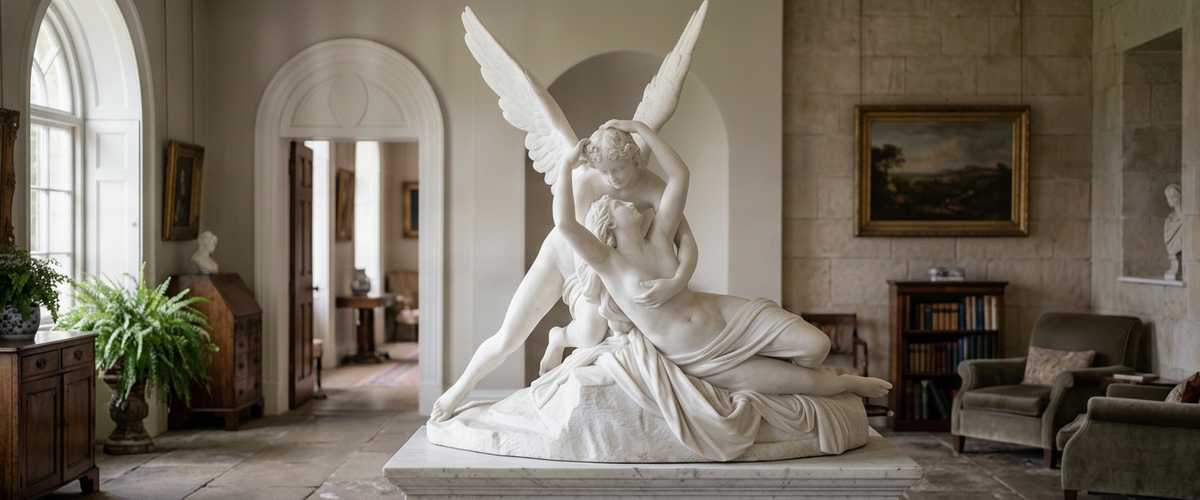

Most two-figure marble groups are installed backwards. Not upside down, not damaged, just turned so the visitor arrives at a shoulder blade and a wing tip instead of the moment the carver actually built. A marble sculpture portraying the relationship of Psyche and Cupid is where this shows up most often, because the piece has a genuine front, a strong secondary view, and at least two angles that read as an unresolved lump of stone. Choose the wrong one at install and no amount of uplighting will rescue it.

Key Takeaways
Every narrative group has one intended front. Find it in the studio, not on the day the crate opens.
The negative space between the two bodies carries the story, so never crowd it against a wall or hedge.
Rotating the plinth roughly 30 degrees usually fixes more than adding a second spotlight.
Approach distance decides whether an embrace resolves or collapses; plan the last 15 to 20 feet (4.5 to 6 m) of the walk.
Indoors, measure ceiling clearance against the highest wing tip, not the head height.
Raking light along the drapery tells you instantly whether the piece was carved or cast.
Every Narrative Group Has One Intended Front
Single figures forgive you. A standing nude or a portrait bust works from a wide arc, and if the orientation drifts 20 degrees nobody complains. Two figures in contact behave differently. The carver of a marble sculpture portraying an embrace resolves the composition from one primary sightline, and everything else is a supporting view: the turn of a head, the fall of a wing, the exact point where one hand meets another shoulder.
Find that view before the piece ships. Ask for photographs taken square-on at eye level rather than the three-quarter marketing angles, and look for the sightline where both faces are legible at the same time. On a piece at the scale of the Cupid And Psyche Angel Marble Outdoor Sculpture - 160cm (about 5 ft 3 in), the intended front is the one where you can see the space opening between the two chests. Stand ten degrees off and it closes up.
The intended front: both faces legible at once, with daylight in the gap between the chests.

The Gap Between Two Bodies Is the Subject
In a marble sculpture portraying two figures reaching for one another, the stone is not the point. The air is. Classical sculptors understood that a gap read against a bright background does more emotional work than any amount of surface polish, which is why the finest versions of this subject have daylight punching straight through the composition. Canova's celebrated treatment of the theme, now in the Louvre, is built entirely around that opening between the arms.
So stop pushing these pieces against walls. A client in Napa originally sited a marble group in a planted alcove with a dense yew backdrop roughly 18 inches (45 cm) behind it. The silhouette vanished. We moved it eight feet (2.4 m) forward onto open gravel with sky behind, and the same stone suddenly had depth. If you only have a wall, light the wall, not the sculpture, and keep the piece far enough forward to throw a shadow rather than smear into one.
Wings From One Side, a Kiss From the Other
Here is the useful thing about this particular subject. Approached from one flank, a marble sculpture portraying the relationship of Psyche and Cupid reads almost architecturally: two raised wings, a diagonal, a strong outline against sky. From the opposite flank it reads as intimacy, faces close, arms wrapped. Those are two different pieces of garden theater, and you get to choose which one greets arrivals and which one rewards the person who walks around.
Our rule of thumb: give the wing silhouette to the long view and the embrace to the short one. A driveway sightline at 60 feet (18 m) cannot resolve facial expression anyway, so let the outline do the work there. Save the tender angle for a terrace seat or a path that curls past at conversational distance. Where a garden has to serve both readings at once, a mid-height group like the Eros and Psyche Angel Marble Outdoor Sculpture at 150cm is a sensible compromise, since the wing line stays legible long after the faces have stopped registering.

Turn the Plinth 30 Degrees Before You Add Another Light
When a marble sculpture portraying two entwined bodies looks flat, the instinct is to add lighting. Nine times out of ten the problem is geometry. Rotating the plinth by about 30 degrees relative to the main approach pulls one figure forward and pushes the other back, which restores depth for free. It also breaks the dead symmetry that makes a frontal install feel like a museum label rather than a moment.
Do this with the sculpture physically on site, on packing timbers, before anything gets dowelled or mortared. Walk your real routes: the front door, the pool gate, the kitchen window at 7am. Mark the winner in chalk. Plinth height matters just as much; setting the base too high tips the faces away from the viewer and kills the eye contact between the figures.
Doorway Distance and Ceiling Height Indoors
A marble sculpture portraying an embrace resolves at a specific range. Too close and you see anatomy, not narrative. Too far and two bodies merge into one mass. For a piece around five feet (1.5 m) tall on a low plinth, the sweet spot is usually 12 to 20 feet (3.6 to 6 m), which is why entrance halls and atriums suit this subject so well and tight vestibules do not.
Ceiling height is the other hard constraint, and it catches people out. Measure to the highest wing tip and add plinth height, then leave visible air above; a wing that stops three inches short of a ceiling looks like it hit something. We shipped a marble group into a Dallas atrium where the client had measured head height only and forgotten the raised wing entirely. It fit, barely, but the piece needed relocating to a double-height bay before it looked like it was rising rather than ducking. Where the headroom simply will not take a winged pair, a single upright figure such as Cupid Kindling the Torch keeps the same classical register with a far simpler clearance calculation, and a piece from the marble busts and torsos range solves the problem outright.
Raking Light Tells You Carved or Cast
Low-angle light across the drapery exposes tool rhythm, varied fold depth and crisp undercutting.
Walk a low light source along the drapery at a shallow angle. Hand-carved marble shows tool rhythm: slight irregularities in the undercut, fold depths that vary, crisp edges where the chisel left the stone. Cast or reconstituted pieces show uniform folds, soft mold seams and a suspiciously even surface. The Getty's conservation team has published useful background on how marble surfaces weather and behave over long periods, and it is worth understanding before you commit to an outdoor site with freeze-thaw cycles.
This test is also your best defense at delivery. Check the undercuts between the two figures where dust and packing debris collect, because that is where the carving quality is either obvious or absent.

Placement Checklist
For wider placement ideas, Why a Turning Torso Marble Sculpture Needs a Bigger Block Than You Think is useful companion reading before finalising the setting and sightlines.
Identify the intended front from square-on photography before shipping.
Confirm nothing sits within about six feet (1.8 m) directly behind the gap between figures.
Trial-rotate the plinth 30 degrees on site and walk all real approach routes.
Check ceiling or canopy clearance against the highest wing tip plus plinth.
Set plinth height so the figures' faces sit at or slightly above viewer eye level.
Test the surface with raking light at delivery and photograph the undercuts.
Specify foundation and fixing for the full weight; large marble groups need engineered pads, not paving slabs.
Commissioning at Scale
If a catalog size does not suit your sightlines, this subject scales well. We regularly quote larger carvings where the client needs the wing line to hold across a long lawn, or a reduced version for a courtyard. Budget depends on block size, stone selection, carving complexity, base engineering, finishing and installation, so the honest answer is to send us your site photographs and approach distances and we will prepare a tailored quote. The full marble sculptures and statues range and the wider garden statues collection are both useful for gauging proportion first. Get the orientation right and a marble sculpture portraying Cupid and Psyche will hold a garden for generations.