






















































































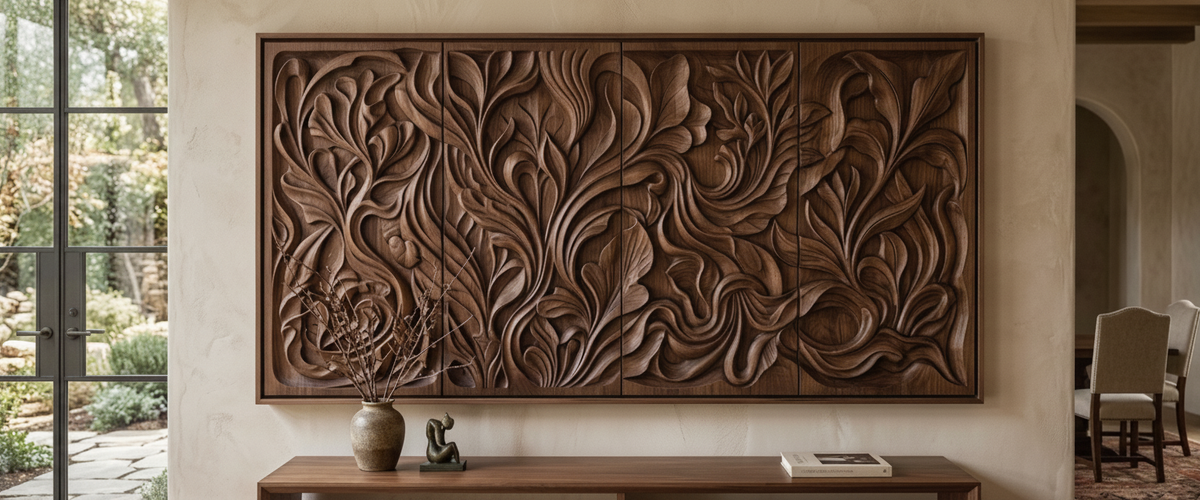

A large piece of wooden wall art decor can carry an entire room or quietly work against it, and that outcome is usually decided weeks before any tool touches timber. Buyers tend to focus on the picture in their head. Sculptors focus on how that picture behaves at 30 feet, under changing light, on a wall that may or may not take the weight. Good wooden wall art decor lives at the meeting point of those two views, and the commissions that go smoothly are the ones where both sides talk about the hard parts early.
This is a look inside how our studio approaches a wooden wall art decor commission, what pushes the price up or down, and the questions worth asking before you sign anything.

Key Takeaways Before You Commission
- Read distance drives the design. A piece meant for a 10 ft foyer is carved and finished differently from one seen across a 30 ft great room.
- Species and grain are structural choices, not just looks. They affect movement, weight, and how the piece ages.
- Weight and fixing matter as much as the art. Large wooden wall art decor panels need a mounting plan tied to your actual wall construction.
- Budget follows material, scale, complexity, engineering, and finish. Ask for a tailored quote rather than a headline number.
- A maquette or sample panel is worth paying for. It removes most of the risk before fabrication starts.

What Sculptors Actually Think About Before Taking a Commission
The first conversation is rarely about beauty. It is about the wall. Is it plaster over brick, stud partition, exposed concrete, or timber frame? A three-panel carved piece of wooden wall art decor can weigh well over 80 pounds (36 kg) once you account for the substrate and mounting hardware, and that number decides whether we are drilling into masonry or engineering a hidden cleat system spread across studs.
Environment comes next. Wood moves. It takes on and gives up moisture with the seasons, which means a piece bound for a humid Miami sunroom needs different joinery and sealing than the same design in a dry, heated Aspen home. The Smithsonian's Museum Conservation Institute has long documented how relative humidity swings cause wood to expand and contract; we design panels and joints to allow that movement rather than fight it, because a rigidly locked panel is a panel that eventually cracks.
Then we talk about what the piece is really for. Decorative wood wall art in a hospitality lobby needs to survive cleaning crews, HVAC drafts, and a decade of foot traffic below it. The same brief in a private study can lean into finer detail because nobody is power-washing the wall. Knowing the room's real life shapes every later decision about the wooden wall art decor.

Craft Decisions That Change the Final Result (and the Price)
Species is the first lever. Oak and ash bring open, assertive grain that reads well from a distance and forgives bold carving. Walnut gives depth and a darker field that suits layered relief. Softer woods carve faster and cost less in labor but dent more easily, which matters at hand height in a busy space.
Carving depth is the second lever, and it is the one buyers underestimate. A shallow relief and a deep, undercut relief can look almost identical in a photo and completely different in the room. Deep carving throws real shadow, changes through the day, and needs more stock, more time, and more skill. That is where a good chunk of the budget goes on ambitious wood art wall decor.
Finish is the third. A matte oil finish keeps the timber honest and tactile; a high-build lacquer protects harder but flattens some of the grain's life. Some pieces bring in other elements entirely. Where a wooden wall art decor commission needs light to be part of the material rather than an afterthought, something like Ventus Azure Depths Wood Carving 3D LED Wall Art shows what integrated lighting asks of the build, since you are now routing wiring and heat management through an object that also has to look effortless.
None of these choices has a fixed price tag. Cost on a bespoke piece of wooden wall art decor tracks material, scale, carving complexity, any engineering like lighting or concealed mounts, and the finishing standard. The honest answer to "what will it cost" is a scoped quote against your actual design, not a number pulled from thin air.

Why Some Pieces Read Right at 10 ft and Wrong at 30
This is the mistake we correct most often. A client falls for a design at arm's length in a studio photo, then installs it across a double-height room and wonders why it looks fussy and small. Detail that delights up close can turn to visual noise at distance. The eye stops resolving fine texture past a certain range and starts reading mass, silhouette, and contrast instead.
So we design the wooden wall art decor to the viewing distance. A piece for a 30 ft sightline wants bolder forms, stronger shadow lines, and a composition that holds as a shape before you read any detail. A multi-panel layout can help here, breaking a wide wall into a rhythm that carries across the space. For a broad wall where a single relief would feel lost, a multi-panel arrangement such as Harmonic Forms 4-Panel Brown Wood Carving 3D Wall Art uses repetition and negative space so the composition still reads as one gesture from across a large room.
Contrast does a lot of quiet work too. Against a pale plaster wall, a dark walnut relief holds its edges from far away. Put the same piece on a dark feature wall and the silhouette softens, so we might deepen the carving or shift the finish to bring it back. The wall behind the wooden wall art decor is part of the brief, not a detail to sort out later.
Studio Process: Maquette, Sample, Fabrication, Install
A wooden wall art decor commission that skips the early stages tends to produce expensive surprises. Our sequence is deliberate.
- Concept and sightline study. We agree the design, the wall, the viewing distance, and the environment. Rough dimensions and weight estimates come out of this stage.
- Maquette or scale drawing. For sculptural relief we produce a scaled study so you can judge proportion and depth before committing stock. It is far cheaper to change your mind here.
- Sample panel. A finished sample in your chosen species and finish shows exactly how grain, color, and sheen behave in real light. Screens lie about wood; a sample does not.
- Fabrication. Carving, assembly, and finishing happen in stages with checkpoints, so nothing is a black box until delivery day.
- Install and handover. We supply a mounting specification matched to your wall, and for large pieces we coordinate installation so the fixing is correct and the alignment is right first time.
We once shipped a wide carved panel to a Napa Valley residence where the client had assumed a standard picture hook would do. The piece needed a concealed French cleat anchored across three studs and a load spread the drywall alone would never have held. Because we specified it during the sample stage, the contractor added blocking behind the wall before the plaster went on. That is the difference an early mounting conversation makes for wooden wall art decor.
Honest Red Flags Buyers Should Ask About Before They Commit
A few questions separate a considered maker of wooden wall art decor from a risky one. Raise them early.
- "How will this handle humidity and heat where it's going?" If the answer ignores wood movement entirely, be cautious. Solid timber panels need joinery that allows seasonal change.
- "What's the mounting system, and does it suit my wall?" A maker who has not asked about your wall construction has not finished thinking about the piece.
- "Can I see a finished sample in this species and finish?" Reluctance here is a flag. Reputable studios expect it.
- "Is this solid wood, a veneer, or a composite core?" All can be legitimate, but you deserve to know what you are buying and how it will age.
- "What does aftercare look like?" Ask about refinishing, dusting, and what to avoid. A specialist will have a straight answer.
Timber also asks a little of you over the years. Keep pieces out of direct, all-day sun where possible, since prolonged UV will shift the color of most woods; the conservation guidance from the American Institute for Conservation on light exposure applies as much to a carved panel as to a painting. Dust with a soft dry cloth, avoid silicone-heavy sprays, and refresh an oil finish when the surface starts to look thirsty. Handled this way, decorative wood wall art outlasts most of the furniture around it.
Choosing Between Wood and Other Materials
Wood is not always the right answer, and a good studio will tell you so. For a coastal terrace exposed to salt spray, or a commercial exterior, we usually steer clients toward metal instead; the metal wall art range gathers pieces built for outdoor life. Indoors, though, timber brings a warmth and tactility that metal cannot fake, which is why it stays the default for wooden decorative wall art in living spaces and refined interiors. If you are still comparing options, the full wood wall art collection is a good place to see how species and scale change the mood of a piece before you commission your own. Well-chosen wooden wall art decor rewards this kind of planning.
Giant Sculptures works as a bespoke supplier of large-scale wall and freestanding pieces, so a wooden wall art decor commission can be sized and finished to your exact wall rather than trimmed to fit a standard product. That is the whole point of going bespoke: the art answers to the room, not the other way around.
For wider placement ideas, 3d Art Wall Panels: What a Sculptor Weighs Before Taking the Commission is useful companion reading before finalising the setting and sightlines of your wooden wall art decor.