






















































































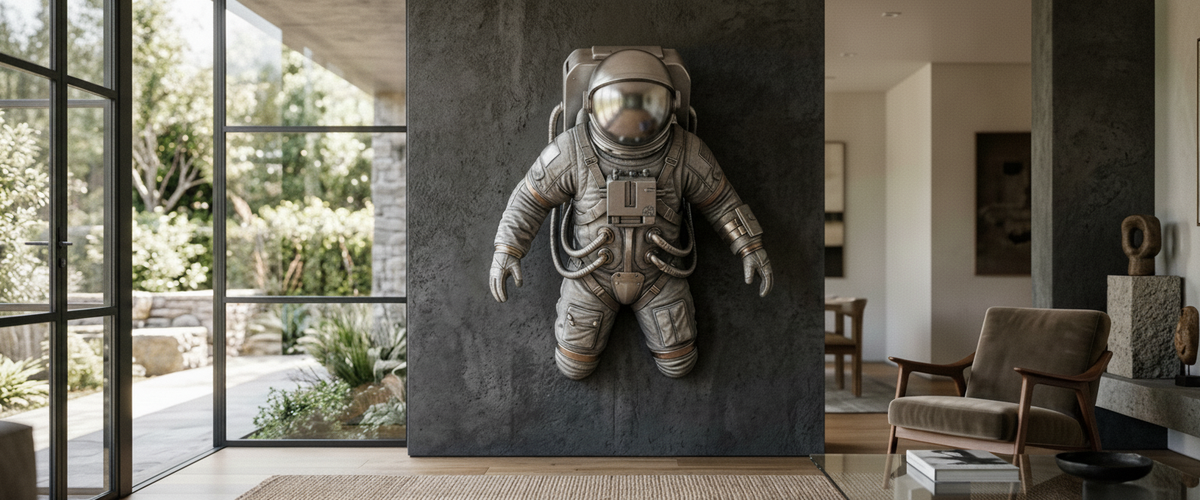

Hang an astronaut on a wall and you are asking one figure to carry a whole story: exploration, distance, the strange calm of a suited body floating where it should not be. That is why an astronaut wall sculpture is harder to get right than it looks. The suit reads as a smooth white blob from across a lobby unless the maker builds real depth into the helmet, the ribbed joints, and the pack. Get the depth wrong and you have an expensive silhouette. Get it right and the astronaut wall sculpture pulls people across the room.
Looking for the full range in this category? Browse our Astronaut Sculptures & Space Art collection for every available finish, size, and configuration.
We field these astronaut wall sculpture commissions often, usually from tech offices, private collectors with an aerospace streak, and a few venues that want a talking point above a stair. Here is how our studio actually approaches the work, and what you should press us on before you sign anything.

At a Glance: What Drives an Astronaut Wall Sculpture
Read distance matters most. An astronaut wall sculpture designed for 10 feet (3 m) fails at 30 feet (9 m), and the reverse is also true.
Material sets tone and weight. Bronze reads heritage and lasts generations; stainless steel reads clean and modern; lighter composites suit high indoor walls where load is a concern.
Depth is the whole game. The illusion of a body pushing out of the wall comes from how far the helmet and pack project, not from surface detail.
Mounting is engineering, not an afterthought. Concealed cleats, load ratings, and wall type get decided at design stage.
Budget depends on material, scale, relief depth, finishing, and install. Ask for a tailored quote rather than assuming a figure.

What Sculptors Actually Think About Before Taking the Commission
The first question is never the pose. It is the wall. How high, how wide, what is it made of, and how far back will people stand? A suited figure behaves differently at eye level in a corridor than it does floating two stories up in an atrium. Once we know the sightlines, we know how aggressive the relief on an astronaut wall sculpture needs to be and whether the figure should tilt toward the primary viewing angle.
The second question is the story you want the suit to tell. A crisp, mission-ready astronaut with a clean visor says optimism and forward motion. A weathered suit with scuffed panels reads as endurance. Some buyers ask about the more unsettling variants: a headless astronaut sculpture, where the missing helmet forces the eye to fill the gap, or the myth-adjacent aztec astronaut sculpture idea drawn from the carved lid of the Palenque sarcophagus, which most scholars read as a Maya ruler descending into the underworld rather than a spaceman. We are happy to build either interpretation; we just need to know which reading you are after, because it changes proportion, texture, and finish.

Craft Decisions That Change the Final Result (and the Price)
Three choices move both the look and the cost of an astronaut wall sculpture more than anything else.
Material. Cast bronze gives you a surface that ages honestly and survives outdoors for generations, which is why it remains the reference material for serious sculpture; a stable patina forms a protective layer over the metal beneath. Bronze is heavy, so on a wall it demands proper structural backing. Stainless steel, mirror-polished or brushed, throws light around and suits a modern corporate wall; it is our usual pick when a client wants the suit to feel engineered rather than sculpted. For very high interior installations where dead load is a real constraint, a lighter engineered composite can be the sensible call, and we will say so plainly if that is the case. Where a wall calls for illumination worked into the surface rather than raked in from the side, a piece like the Genesis Sunburst 3D Resin Crystal Porcelain LED Wall Art shows how integrated LEDs and a lighter resin body behave differently from cast metal.
Relief depth. A shallow bas-relief figure costs less and sits close to the wall, good for corridors. A high-relief or near-freestanding astronaut wall sculpture that appears to push out of the plaster costs more because it needs internal armature, more material, and a heavier mount. The projection is what sells the illusion of a body in a suit, so this is rarely the place to economize. If you want to feel how a shallow, geometric relief reads across a wall before committing to a deep figure, the Artisana White Grid 3D Paper Wall Art is a useful gauge of how low projection sits at close viewing distance.
Finishing. A raw brushed steel visor and a tinted, near-black glass visor are worlds apart in feel and in labor. Painted panels, gilded seams, and selective polishing all add hours to an astronaut wall sculpture. None of this is filler; each pass changes how the light behaves on the helmet.
If you are weighing metal against a lighter treatment, our metal wall art gives a sense of how brushed and polished surfaces carry a room, while the broader wall art and wall decor collection shows how relief depth changes presence at different scales.

Why Some Pieces Read Right at 10 ft and Wrong at 30
This is the mistake we correct most often. A buyer falls for a detailed maquette on a desk, then installs the finished astronaut wall sculpture high on a large wall and wonders why it looks flat. Fine detail disappears with distance. What survives is the big shape: the dome of the helmet, the mass of the life-support pack, the line of the tether if there is one.
For a piece seen from 30 feet or more, we exaggerate the primary forms and let the fussy detail go, because nobody will read it anyway. For a piece seen up close in an entrance or a study, we do the reverse and pour the effort into panel seams, glove articulation, and the reflection inside the visor. A well-made astronaut wall sculpture is designed for one dominant viewing distance. Trying to serve both usually serves neither.
Weight follows the same logic. A small, close-viewed relief might sit happily on a stud wall with two concealed cleats. A large atrium astronaut wall sculpture can run into the hundreds of pounds (over 100 kg) once you account for armature and mount, which means the wall structure gets involved and sometimes an engineer signs off. We would rather raise that early than surprise you at delivery.

Studio Process: Maquette, Sample, Fabrication, Install
Every bespoke astronaut sculpture we make runs through the same stages, and the order protects your budget.
Maquette. A small three-dimensional study, physical or digital, so we agree on pose, proportion, and projection before anyone cuts metal. This is where most creative changes should happen, because they are cheap here and costly later.
Material sample. A finished sample panel showing the exact patina, polish, or paint on the exact material. Screens lie about metal. A sample in daylight does not.
Fabrication. Casting or metal forming, armature, welding, and the finishing passes that turn parts into a finished astronaut wall sculpture. We photograph key stages so remote clients, and plenty of ours are in California and New York, can approve without flying to the studio.
Install. Concealed mounting hardware specified to the wall type and the load, crated for transit, and delivered worldwide. For large pieces we brief your installer or send our own.
Honest Red Flags Buyers Should Ask About Before They Commit
A good maker will welcome these questions about your astronaut wall sculpture. Be wary if they dodge them.
What is the total mounted weight, and will my wall take it? If the answer is vague, the mount has not been thought through.
What is the projection from the wall face? This number predicts whether the piece will read as a body or a smudge.
Is the finish specified on a real sample? Approving a patina from a photo is asking for disappointment.
Who owns the install and the hardware? Concealed cleats, spacing, and fixings should be part of the deliverable, not left to a handyman.
For outdoor placement, what protects the finish? Stainless and bronze handle weather well; painted composites need honest talk about UV and coatings.
One lesson from the workshop floor: a client once approved a helmet visor from a rendering and was surprised on delivery that the mirror finish reflected the ceiling grid rather than the sky-blue tint they had pictured. We reworked that astronaut wall sculpture, but a five-minute sample review would have caught it. That is why we now refuse to skip the sample stage, however much a client wants to rush.
Placing the Finished Piece
A suited figure like this wants breathing room. Crowd an astronaut wall sculpture with shelves and framed prints and the illusion of floating collapses. Give it a broad, quiet wall and side light, and the helmet and pack throw shadows that make the figure feel airborne. In a double-height space, mount it high enough that people look up at it, which is, after all, the natural way to look at an astronaut. The same instinct explains the appeal of an astronaut sculpture in church settings, where scale and upward sightlines do a lot of the work.
Whether you are drawn to a clean mission suit, a headless astronaut sculpture that leans into mystery, or a myth piece nodding to the Palenque carving, Giant Sculptures builds your astronaut wall sculpture as a bespoke commission in the material and scale your wall actually needs. Send us the wall dimensions and a rough idea of the story you want the suit to tell, and we will take it from there.
For wider placement ideas, 3d Porcelain Wall Art: What Sculptors Weigh Before They Say Yes is useful companion reading before finalising the setting and sightlines.