





































































































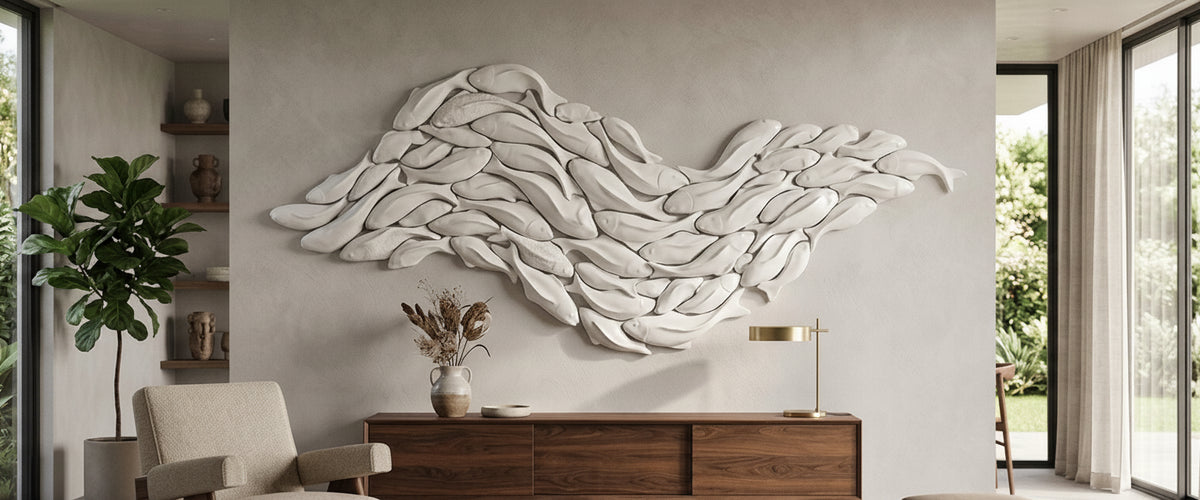

A porcelain relief that photographs beautifully in a small frame can look thin, busy, or oddly flat once it is mounted 12 feet up a double-height wall. That gap between the sample and the installed piece is where most disappointing 3d porcelain wall art comes from, and it is the first thing we talk about with a client before anyone commits to a commission. The material rewards patience and punishes shortcuts, so the smart questions about any 3d porcelain wall art project happen early, not after fabrication starts.
Looking for the full range in this category? Browse our Wall Art and Wall Decor collection for every available finish, size, and configuration.
Below is how our studio actually approaches 3d porcelain wall art, and what you should be asking any maker before you sign off.

Key Takeaways
- Scale drives everything. Detail that reads at 10 feet can vanish or turn muddy at 30. Viewing distance should be decided before the design, not after.
- Porcelain is a system, not just a surface. Body, glaze, firing, mounting, and (for lit pieces) the LED layer all affect the final look and the price.
- "Crystal porcelain" usually means a printed-and-coated panel, which is a different product from hand-built porcelain relief. Know which 3d porcelain wall art you are buying.
- A maquette and a fired sample de-risk the whole project. Skipping them is the most common regret.
- Budget depends on material, scale, complexity, engineering, and install. Ask for a tailored quote rather than trusting a flat rate.

What Sculptors Actually Think About Before Taking a Commission
The first conversation is rarely about the picture in your head. It is about the wall, the light, and how close people will stand. A porcelain flower wall art panel destined for a powder room reads completely differently from a 20-foot lobby installation, and the clay body we choose for a piece of 3d porcelain wall art shifts with it.
We look at three practical things before design work starts. Where the piece lives (interior humidity, direct sun, proximity to a pool or coast). How it will be seen (straight on, at an angle, from below). And how it mounts, because porcelain is dense and rigid, and the substrate behind it has to carry real weight without flexing. Get the wall wrong and even flawless ceramics crack over a season of thermal movement.
There is also an honest sorting step. Not every idea suits 3d porcelain wall art. A design that depends on deep undercuts and cantilevered forms may be better in cast bronze, and for a client set on that kind of dimensional drama at scale, a relief such as the Traditional Horse Head Bronze Relief - 80cm holds the projection and shadow that porcelain would struggle to carry.

Craft Decisions That Change the Result (and the Price)
Three or four choices quietly decide how the finished porcelain wall art looks and what it costs to make.
Clay body and translucency. True porcelain fires dense and can hold a faint translucency when thin, which is part of why white porcelain wall art looks so alive under raking light. Push the body too thick for strength and you lose that glow; go too thin for delicacy and you risk warping in the kiln. The sculptor is balancing those two the whole time.
Glaze and surface. A matte white reads as architecture and disappears into a plaster wall in the best way. A high-gloss or celadon glaze throws highlights and turns the same relief into a feature. For a porcelain fish wall art shoal, we might glaze each form slightly differently so the group catches light at staggered angles rather than flashing all at once.
Firing and shrinkage. Porcelain shrinks significantly between wet clay and finished piece, often more than a novice expects. That shrinkage is predictable but unforgiving across a large multi-panel wall, because tiny inconsistencies compound. This is why experienced studios building 3d porcelain wall art always work in test tiles.
Assembly logic. Very few large porcelain walls are a single slab. They are modular, and the seams have to be designed as part of the composition rather than hidden as an afterthought. On a good piece you stop noticing the joins within seconds.

Crystal Porcelain Wall Art Is a Different Animal
Search results blur two very different products under the same phrase, so it is worth being clear. Crystal porcelain wall art usually refers to a high-resolution image printed onto a ceramic-coated panel and finished with a crystal or resin glaze, sometimes with a raised 3D texture and LED backlighting. Where a project needs a glowing, color-saturated focal wall rather than a matte sculptural surface, the Lumea Deep Green 3D LED Crystal Porcelain Wall Art is closer to the right design language: a lit, textured panel built for immediate impact in a hallway or bar. It is a fast path to 3d porcelain wall art with instant drama.
Hand-built porcelain relief is the sculptural cousin: modeled or slip-cast forms, fired, glazed, and mounted as physical objects with real depth. Both are legitimate. They simply solve different briefs. If you want a glowing, color-rich focal wall behind a console, the crystal porcelain route is fast and effective. If you want a tactile, sculptural surface that a designer specifies for its craft and permanence, that is a commission conversation. You can compare finished examples in our Porcelain Art collection before deciding which language your project speaks.
Why Some Pieces Read Right at 10 Feet and Wrong at 30
This is the single biggest scaling error we see with 3d porcelain wall art. Relief depth and detail density have to be tuned to viewing distance. At 10 feet, fine ridges and subtle glaze shifts do real work. At 30 feet, they collapse into visual noise or simply disappear, and the wall looks flat and cheaper than it cost.
The fix is counterintuitive. Bigger pieces need bolder, simpler forms and deeper shadow lines, not more detail. A porcelain flower wall art panel meant for a stairwell viewed from below should exaggerate its undercuts so the shadows carry the drawing from a distance. We test this with a photo of the maquette pinned at true height and viewed from the actual spot where people will stand, which sounds low-tech and saves a fortune.
Light matters just as much as distance. Porcelain lives on shadow. A flat wash of downlight kills the relief; a raking light from one side brings it up in three dimensions. The Getty's conservation notes on ceramics are a useful reminder that how a glazed surface behaves under light is a real, studied property, not a marketing claim (Getty Conservation Institute). If you cannot control the lighting, the 3d porcelain wall art has to compensate with deeper modeling.
Studio Process: Maquette, Sample, Fabrication, Install
A serious 3d porcelain wall art commission moves through clear stages, and each one is a decision gate you can stop at.
- Maquette. A small three-dimensional study, sometimes digital, sometimes in clay, to fix composition, depth, and rhythm before any panel is fired.
- Fired sample. At least one full-size tile or module in the chosen body and glaze. This is where you confirm color under your actual lighting and check shrinkage behavior. Never approve a large run from a rendering alone.
- Fabrication. Modeling or casting, drying, bisque firing, glazing, and glaze firing, repeated across the panel set. This is the slow part; porcelain cannot be rushed through a kiln without risking cracks.
- Mounting system. Concealed cleats, standoffs, or a backing frame engineered for the total weight. For lit crystal panels, the electrical layer is planned here too.
- Install. Dry-fit first, then final mount, with the seams and light aimed on site. We have shipped multi-panel walls internationally, and the pieces that install cleanly are always the ones that were dry-fitted in the studio first.
One lesson from the studio: a client in Napa wanted a pale, sculptural fish wall for a wine-tasting room and initially asked for a single dramatic slab. Once we mocked the height on their wall, it was obvious a modular shoal would read far better from across the room and survive the trip in one piece. The modular version cost less to ship and looked more alive. Testing beat instinct.
Honest Red Flags to Raise Before You Commit
Ask these questions of any maker of 3d porcelain wall art, including us. The answers tell you who has actually built at scale.
- "Can I see a fired full-size sample in my glaze?" A studio that resists this is asking you to gamble.
- "How are you handling shrinkage across the panel set?" Vague answers here predict misaligned seams later.
- "What is the mounting system and how much does the finished wall weigh?" Porcelain is heavy. The wall behind it needs to be specified, not assumed.
- "Is this hand-built porcelain or a printed crystal porcelain panel?" Both are fine; pretending one is the other is not.
- "How do you crate and ship it?" Fired ceramic is brittle. International freight for porcelain is a craft of its own.
- "What happens if a module cracks in year three?" A studio that keeps molds or records can remake a matching piece. Ask before you need it.
If a quote arrives as a flat number with none of these details resolved, treat it as a placeholder. Real pricing for 3d porcelain wall art depends on material, scale, panel count, glaze complexity, engineering, and installation, which is exactly why we quote each commission individually rather than publishing a rate.
Where Porcelain Fits Alongside Other Wall Art
3d porcelain wall art is not always the right answer, and a good advisor will say so. For a large exterior wall or a coastal garden room, weatherproof metal often wins on durability. For an interior with dramatic angled light and a client who loves tactile, luminous surfaces, porcelain is hard to beat. If you are still comparing formats, our 3D Wall Art collection shows how depth behaves across materials, from ceramic to metal relief, so you can judge which one suits your wall before you commission anything. As a bespoke sculpture supplier, Giant Sculptures builds the piece around the wall and the way it will be seen, not the other way around.
For wider placement ideas, 3d Butterfly Wall Art: What Sculptors Weigh Before They Say Yes is useful companion reading before finalizing the setting and sightlines for your 3d porcelain wall art.