






































































































Personalized wood wall art that fails in its first year almost never fails for artistic reasons. The design was fine. The species was wrong, the lettering ran across the grain, or the panel went up on a reception wall three feet from an air handler that runs hot all winter. We have made and remade enough of these panels to know that the difference between a piece that holds its crisp edges for a decade and one that opens a hairline crack by March comes down to decisions made before anyone touches a cutter.

At a Glance: What Determines How Long Personalized Wood Wall Art Lasts
Species beats budget. White oak, ash and sapele hold a routed edge. Reclaimed pine and softwood pallet stock crumble along it.
Grain direction is structural, not cosmetic. Lettering cut across the grain is the single most common repair we take on.
Carved relief reads at distance, laser burn reads up close. Judge every mockup at six feet (1.8 m) and again at three feet (0.9 m).
Heated interiors move wood. Panel construction has to allow for seasonal expansion or it will split at the weakest point, which is usually your monogram.
Content ages at different speeds. A monogram outlives a logo. Coordinates outlive a tagline.
Cost depends on species, panel scale, carving depth, finish and installation, so ask for a tailored commission quote rather than working from a headline figure.
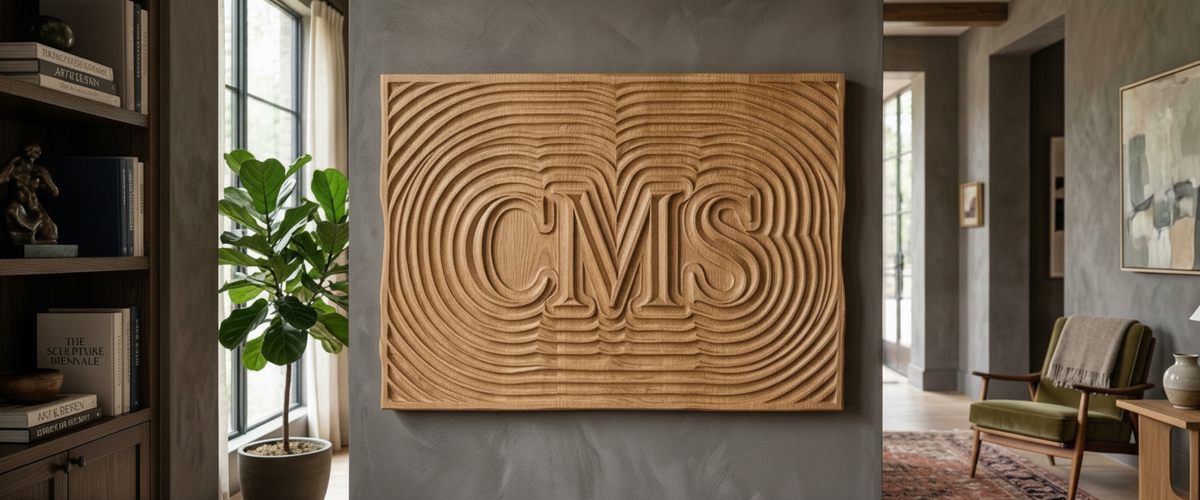
Deep carving in white oak: the construction we default to for personalized wood wall art that has to stay sharp for a decade.
Monograms, Coordinates and Company Marks, Ranked by How Well They Age
Three requests account for most of the personalized wood wall art we make: a monogram or family initial, a set of map coordinates tied to a place, and a company mark. They do not age equally.
A monogram is the safest. Letterforms drawn as geometry rather than as a trend survive rebrands, house sales and changes of taste. Coordinates come next, because the meaning is fixed to a location; a Napa estate we supplied wanted the latitude and longitude of the original planting block, and that number will still be true long after the current owners have gone. Company marks are the riskiest personalization on a permanent surface. Identities get redrawn far more often than a wall panel gets replaced, and carved oak cannot be updated. If you want a corporate identity on a wall panel, we usually push clients toward the abstract language of the brand instead: the mark's underlying geometry, its grid, its angle. Where a wall needs brand logic rather than a literal mark, a structured carved field such as the Barwick Charcoal Grid Abstract 3D Carving Wall Art keeps working through a rebrand in a way routed lettering cannot.

Oak Holds a Routed Line, Reclaimed Pine Crumbles at the Edge of It
Species selection is where most personalized wood wall art projects are quietly won or lost. Dense, tight-grained hardwoods take a clean cut and keep the shoulder of that cut sharp. White oak is our default for deep lettering. Ash carves well and takes stain evenly. Sapele gives a warmer tone, and its interlocked grain holds together well on tight radii provided the tooling stays sharp.
Reclaimed pine is the material clients ask for most in personalized wood wall art, and the one we talk them out of most often. It looks handsome in a mood board and it behaves badly under a cutter. Softwood earlywood and latewood have very different densities, so a router bit skates through the soft bands and bites in the hard ones. The result is a letter with a furry, inconsistent edge that no amount of sanding fully rescues. Add old nail holes and unknown moisture history and you have a panel that is charming as cladding and unreliable as a carving substrate. If the reclaimed look matters, we will often carve a stable hardwood core and frame it in the reclaimed stock so the character sits around the lettering rather than through it.
Carved Relief Against Laser Burn, Judged at Six Feet and Again at Three
Laser engraving is fast, precise and almost free of setup. It also produces a mark that lives on the surface, defined by tonal contrast rather than depth. Walk back six feet and a laser-burned monogram flattens into the grain, especially on darker species. Carved relief does the opposite: the shadow line does the work, so the letterform holds at distance and keeps changing as light moves across the room through the day.
Our test is simple. Look at the sample at six feet, which is roughly how a piece reads from across a reception area, then step in to three feet and check the edge quality and the burn halo. Layered relief work such as the Wenlock White & Burgundy Wood Relief 3D Wall Art separates those two readings cleanly: depth is what you register from the doorway, and finish quality is what you register from arm's length. Both distances have to pass. For large commercial walls we generally recommend carved or built-up relief for personalized wood wall art, and reserve laser work for fine secondary detail such as a date line or a small dedication.

Why Personalized Wood Wall Art Splits in an Office That Runs the Heating Hard
Wood is hygroscopic. It gives up moisture to dry air and takes it back in humid conditions, and it moves far more across the grain than along it. The USDA Forest Products Laboratory's Wood Handbook sets out how equilibrium moisture content shifts with relative humidity, and interior offices swing hard: forced-air heating through a Chicago or Denver winter can pull a room down to the teens in relative humidity, then air conditioning shifts it again in July.
A solid slab panel with no allowance for that movement will relieve the stress somewhere. It picks the weakest cross-section, which on a personalized panel is the deepest cut, which is your initial. We build commercial pieces as engineered panels or floating-frame constructions so the field can move without tearing. We also acclimate stock in the studio before cutting rather than machining wood that arrived on a truck that morning. If your building has aggressive HVAC and a west-facing glass wall, tell us at the enquiry stage; it changes the construction, not just the finish.
Reception Walls Versus Boardrooms: Letter Height and the Eye-Level Trap
Personalized wood wall art for office spaces has to answer a different brief in each room. Reception is a distance read. A visitor sees the wall from fifteen to twenty-five feet (4.5 to 7.5 m) away while walking, so the signage rule of thumb applies: allow roughly one inch (25 mm) of letter height for every ten feet (3 m) of viewing distance, then add margin because carved letters lose apparent weight compared to printed ones.
Letter height follows viewing distance, which is why personalized wood wall art for office reception areas is drawn larger than it looks on screen.
Boardrooms are the opposite problem. People sit, so personalized wood wall art has to survive being read from a seated position. The eye-level trap is hanging a panel at the standing center height of 57 to 60 inches (145 to 152 cm) when everyone in the room will be looking from a seated eye level nearer 45 inches (114 cm). Drop the center accordingly, and check the sightline against the far end of the table rather than the doorway. There is also the desk-back problem: a panel centered behind a chair gets a head in front of it in every video call. We usually shift personalization off-center or split it across a wider field for that reason. Where a panel has to live behind a chair, a wide tonal composition such as the Wenlock White & Teal Gradient Wood Relief 3D Wall Art survives being partially blocked far better than a single centered monogram.
Cross-Grain Lettering Is the Mistake We Spend Most of Our Time Undoing
Here is the repair that reaches our studio most often, almost always on personalized wood wall art made elsewhere. A client sources a panel, has a name routed vertically down a horizontally-grained board, and within two seasons the horizontal strokes of each letter have opened into visible cracks. The cuts sit perpendicular to the direction of maximum movement, so every seasonal cycle levers them apart.
The fix is layout discipline. Long lettering runs should follow the grain direction wherever possible, deep cuts should avoid landing on a growth ring boundary, and serifs with thin cross-strokes need either a species that can carry them or a redraw. Conservation guidance from the Victoria and Albert Museum on caring for wooden objects makes the same underlying point about stable humidity and avoiding direct heat, which is exactly the environment a badly laid-out panel cannot tolerate. Good layout buys you tolerance for an imperfect building.

What We Need From You Before a Bespoke Panel Goes Near a Cutter
Commissioning personalized wood wall art goes faster when the brief arrives complete. Before we cut anything, we ask for:
Vector artwork for any monogram, mark or coordinate set. Outlined text, not a live font, and not a JPEG lifted from a website.
Exact spelling and character set, signed off by whoever has the authority to approve it. Carved wood has no undo.
Wall dimensions and a photo taken straight on, plus the viewing distance and whether the audience is standing or seated.
Wall construction: stud, masonry, glass partition or plasterboard only. This determines the hanging system and often the maximum panel weight.
Environmental notes: heating type, air conditioning, humidification, direct sun hours and proximity to vents or exterior doors.
Light sources, because relief depth is calculated against the angle of the primary light. A wash from above reads very differently from a spot mounted to one side.
Finish preference: oiled, lacquered or pigmented, and whether the piece needs to match existing joinery.
Access and install constraints, including elevator dimensions, delivery windows and whether we are fitting or handing over to your contractor.
From there we work up a scaled drawing and a physical sample of the carving depth and finish on the chosen species. Seeing the real material under the real light of your space settles arguments that renders never do.
Where Wood Is the Right Answer, and Where It Is Not
Wood gives warmth, acoustic softness and a hand-made quality, which is why personalized wood wall art reads well in law firms, hospitality lobbies and residential studies. Browse the wood wall art collection to see the range of carving styles we work in, and the wider 3D wall art pieces if depth and shadow matter more than material warmth.
For covered exterior walls, unconditioned warehouses or humid pool rooms, we steer clients toward metal wall art instead, where stainless or coated aluminium will carry personalization without the moisture argument. Wood is a superb material with clear limits, and a good supplier tells you where those limits are before taking the commission rather than after. If you have a wall, a mark and a deadline, send us the photograph and the spelling, and we will tell you honestly what the material will and will not hold.
For wider placement ideas, Large Wood Wall Art That Survives Its First Winter is useful companion reading before finalising the setting and sightlines.